
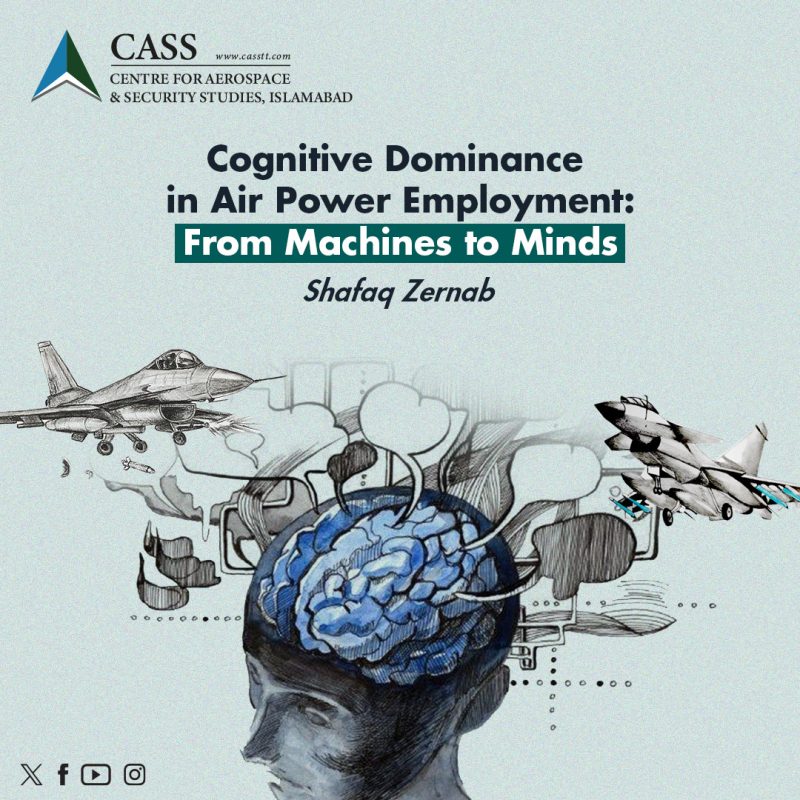
In contemporary air warfare, there is a silent battle that begins long before the first missile is fired: the battle of the mind. The Indo-Pakistan conflict of 2025 reaffirmed this truth. In that short but decisive engagement, Pakistan Air Force (PAF) demonstrated that in modern warfare, victory is no longer about airframes destroyed but in the mastery of cognition, which is the ability to think faster, act smarter and control perception under stress. To make victory second nature, institutionalisation of cognitive gains through AI, cross-domain integration and leadership development is paramount for modern air forces.
Modern air warfare has undergone a drastic change, irrevocably shifting from platform-centric dominance to the cognitive domain. In an era defined by information saturation, conflicting narratives and real-time decision making, superiority in the air now rests on excellence in the cognitive domain. It depends on how swiftly a force interprets the ‘fog of war,’ maintains its composure and alters the enemy’s perception of control.
The aerial exchange during the Indo-Pak conflict of 2025 amply highlighted that operational and cognitive supremacy can offset a numerically superior and technologically versatile Indian Air Force (IAF). In response to Indian incursions using long-range standoff weapons within their borders, PAF carried out calibrated strikes on high-value Indian strategic targets inflicting shock, confusion and operational loss on enemy.
The successful cyber-attacks on Indian assets, as part of integrated Multi-Domain Operations, not only neutralised the activation of the S-400 but also blinded both the enemy’s radars and its strategic vision. In a remarkable display of Beyond Visual Range (BVR) air engagement, PAF downed 7 Indian aircraft including 4 Rafales. Within half an hour of PAF’s counter strikes, Indian political leadership intervened, forcing IAF to land on unlit diversionary bases. Using kinetic means coupled with Electronic Counter Measures (ECM), PAF neutralised Indian drones thereby eliminating even the change of any tactical of the adversary.
In this short but decisive engagement, PAF showcased that cognitive superiority is the pre-requisite to achieve full escalation dominance along with platform-dominance. Cognitive ascendency is defined as the ability to out-maneuverer, out-think and surpass the enemy in communications by balancing emotional steadiness and narrative control.
By employing Colonel John Boyd’s Observe-Orient-Decide-Act (OODA) loop, PAF remained inside IAF’s operational cycle, denying Delhi effective employment of its costly technologies, confirming PAF’s cognitive ingenuity driven by speed of thought. Coordinated situational awareness through Pakistan’s Link-17 system compressed PAF’s decision cycle and acted quicker than its rival. Thus, PAF achieved full escalation dominance by imposing strategic gridlock on the enemy.
During this conflict, PAF’s decisive operational tempo highlighted the limitations of India’s operational outcome and political narrative at every rung. After sustaining significant losses to its air assets, India lost the opening gambit in the conflict. Indian disinformation campaign during the conflict and contradictory remarks regarding IAF’s losses further deteriorated its credibility, whereas Pakistan’s narrative based on factual and strategic calculations gave it a strategic leverage. The events of this war have demonstrated that psychological and perception management are as important as kinetic success.
In order to sustain this full-scale dominance, modern air powers need to integrate cognitive warfare principles through structural reforms with technological modernisation. In this regard, AI can be utilised in warfare, influencing strategic decisions, military systems, and even propaganda. Data-centric organisations, AI-enabled cross-domain integration and a comprehensive cognitive training framework for leadership would serve as the doctrinal evolution pathway.
Advance air forces have already dovetailed kinetic power with cyber, space, informational and psychological tools in its command-and-control system. This may also include AI-enabled ISR fusion, electronic deception, AI prediction analytics with autonomous decision aids to improve decision, speed, quality and information advantage. AI-backed deception tactics could be used for false radar signatures, analysing enemy transponders, creating ambiguity for the command centre and the pilot as well. Similarly, AI-driven electronic warfare can intercept an enemy’s radar system and provide intelligence in real time. The Russia-Ukraine war has become a testing ground for AI utilisation in analysing satellite imagery and informing military decisions.
Along with airpower, cross-domain integration should also synchronise with other apparatus of national security like intelligence agencies, cyber bodies, diplomatic channels, and information mechanisms to strengthen the national narrative and legitimacy in a conflict. However, solely integration cannot ensure cognitive superiority unless coupled with leadership training.
Training is one of the crucial components in this aspect. It converts intent into capacity. It is crucial to focus on commander’s decision psychology, ambiguity management, and stress-resilient judgment. AI-driven simulations, which depict incomplete, deceptive and complex environments, should be included in the training. AI would help train commanders to detect factual errors and change perceptions so cognitive discipline becomes second nature.
Lastly, leadership is the enabling software of cognitive warfare. In a rapidly evolving crisis landscape, good character, efficient clarity, and composure can outperform numbers. Restraint and cohesion demonstrated by PAF in 2025 are even commended by prominent Indian defence analysts like Pravin Sawhney. Leaders must receive continuous training at every tier in cognitive resilience, information and education discipline, decision ethics, and multi-domain situational awareness.
The recent conflict between India and Pakistan illustrates that cognitive dominance acts as a strategic deterrent, where even a relatively smaller but smarter adversary would give a potent look. In this changing world of technology, integration of AI-backed systems in doctrine, training and leadership is the need of the time. Tomorrow’s battle will require strategic minds as much as advanced machines.
Shafaq Zernab is a Research Assistant at the Centre for Aerospace & Security Studies, Islamabad. She can be reached at [email protected]



