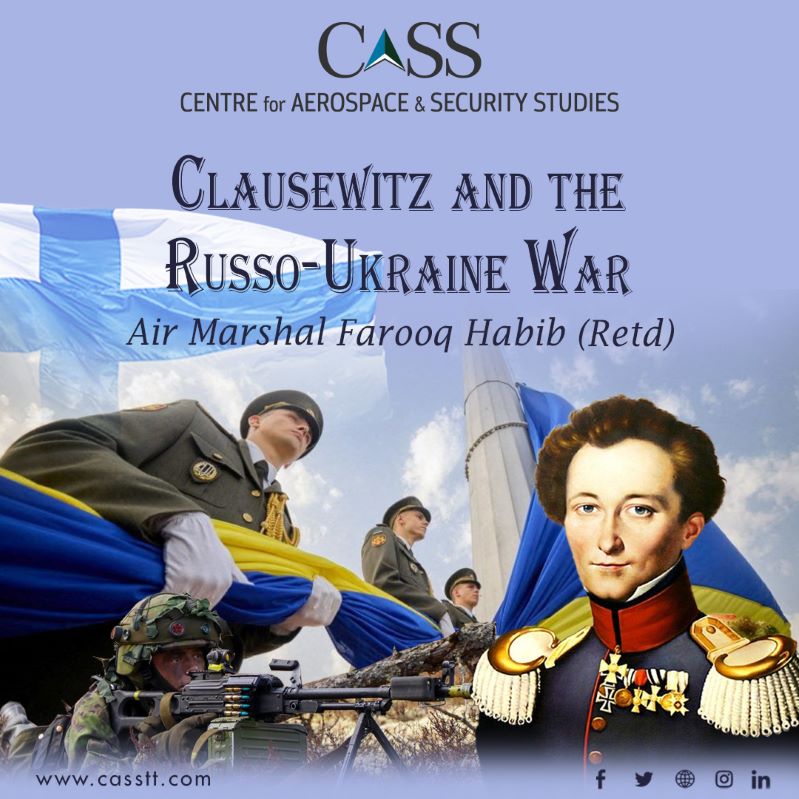
For students of strategy, the fascination with Clausewitz never ceases. His genius lies in providing a general theory of war which identifies it as a political activity with an interplay between the people, army, and the government. Being an extension of policy, war is conducted on the basis of rationality. It is often brutal and destructive yet it retains its strong linkage with rationality. Hence, the belligerents always do careful analysis of cost and benefit before going to war. An unaffordable cost in terms of men, material, honour, etc. curtails the liberty of action of leaders in decisions regarding waging wars and vice versa. Cold war thus, remained confined to the domains of posturing, influencing, and fighting through proxies, despite enormous hostility between USA and erstwhile USSR, because both sides realized the unacceptable costs of a physical conflict. Even when a war is actually being waged, Clausewitz’s logic stresses that the objectives should be pursued until a point is reached where the price of continuing are not worth the objective being sought.
Finland represents a relevant example of such rationality. It fought two wars with USSR between 1939-40 and 1941-44, in which despite huge numerical disadvantage, it inflicted heavy losses upon the outsized neighbour. However, being a small country, Finland’s own losses though comparatively lower, were simply unbearable. This prompted the Finnish nation to do a realistic appraisal of its potential for its future relations with the Soviet Union. Former Finnish President Kekkonen highlighted the foundation of this relationship in his autobiography in these words, ‘Experience has taught us that small country purely and simply cannot afford to mix emotions – be they feelings of sympathy or antipathy – into its foreign policy. A realistic foreign policy should be based on awareness of the essential factors in international politics, namely national interests and power of relationships between states’. What ensued was a carefully crafted policy which ensured that Finland win the trust of Soviet Union by maintaining good ties with it while also joining European associations like European Economic Community and European Free Trade Association around that time. Becoming a leading trade partner of both, the Western world and Soviet Union, Finland focused on its economic and social progress. Today, the GDP per capita of Finland is higher than that of Canada, France, and UK.
Present day Ukraine offers a contrasting model. Though much larger than Finland, it is still an undersized country as compared to Russia. Yet, against all odds, it has put up a spirited response to the Russian onslaught since February 2022, albeit with huge moral, material, and financial support from the Western nations. As per the press statement made by the US Secretary of State, Anthony Blinken, on 19 January 2023, the total US military assistance to Ukraine is expected to reach a staggering USD 27.5 billion. The military assistance includes large quantity of offensive and defensive capabilities. The humanitarian and financial aid packages are over and above these figures. Similarly, UK and Germany have also contributed with a combined figure of over USD4.8 billion of military assistance. Contributions have also poured in from other European countries and Canada.
Such massive support by the West has enabled Ukraine to prolong the war and inflict considerable losses to the Russians. As Russia gets embroiled in the conflict, the Western analysts are busy predicting the future trajectory of the war. Writing in Guardian, on 22 December 2022, Olga Chyzh, raised an important point by reminding that ‘Russia has a history of initially failed military campaigns that have succeeded in the second go’. As per her assessment, it is not an option for Ukraine to destroy Russia’s will or have long-time capacity to take its land. Meanwhile, Russia relentlessly continues its destruction campaign of Ukrainian infrastructure, which, according to ‘Statista’ has reached a combined figure of USD 123.9 billion. This includes cost of residential buildings, transportation, industry, education, agriculture, energy, trade etc.
There is yet another view of the massive US support being provided to Ukraine as expressed by US Republican Representative Marjorie Taylor Greene, when she asserted that Ukraine has turned into a proxy war conducted by the US against Russia. Stressing the same point, Independent, UK published an opinion piece titled: ‘It’s time to stop pretending what’s happening in Ukraine is anything other than a US proxy war.’
While there are analysts who do not agree with the idea of US waging a proxy war, the fact remains that a prolonged war serves US interests. Ukraine, on the other hand, continues to suffer unparalleled destruction which may not be easy to recover from, in spite of large Western funding.
It remains the responsibility of leadership of each country to look after its national interests. In complex situations like war, having a clear perspective on one’s interests becomes even more crucial. Finnish leaders were successful in the tight ropewalk of balancing their objectives – how Zelensky would fare, only time will tell.
Air Marshal Farooq Habib (Retd) is presently working as Senior Director at the Centre for Aerospace & Security Studies (CASS), Islamabad, Pakistan. The article was first published in The Nation. He can be contacted at: [email protected]