
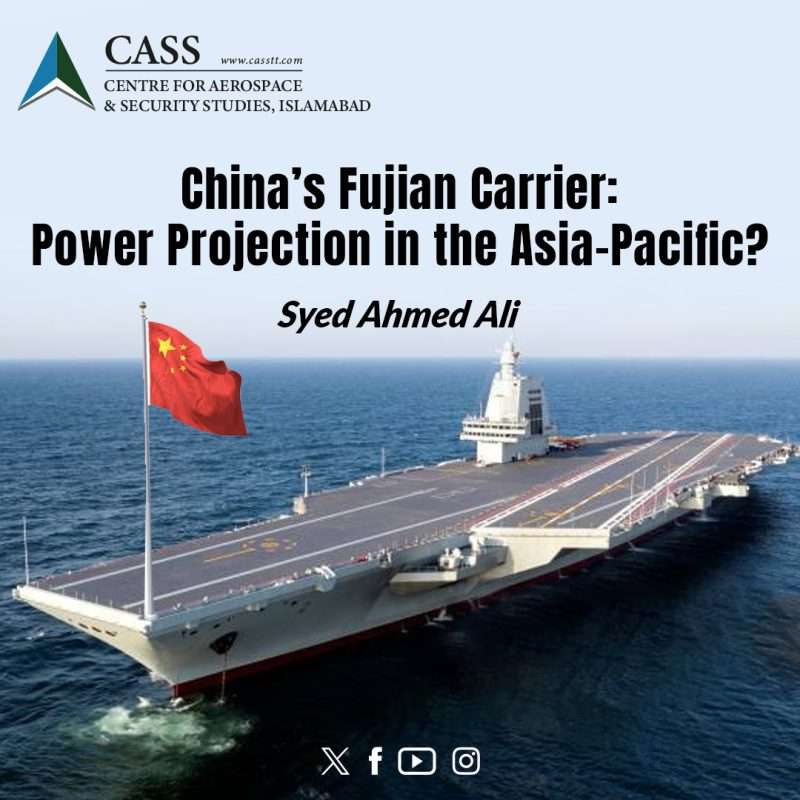
On June 17, 2022, China commissioned its third aircraft carrier, Fujian, named after the southeastern coastal province near Taiwan. The carrier began sea trials in May last year, marking another milestone for President Xi Jinping’s plan for Chinese naval modernisation and power projection capabilities, where the People’s Liberation Army Navy (PLAN) plans to deploy six aircraft carriers by 2035.
The Chinese maritime industry has come a long way in the construction of aircraft carriers, from the import of a Soviet aircraft carrier (‘Varyag’ latter ‘Liaoning’) to the construction of its first indigenously built carrier, Shandong, commissioned in 2019. The Fujian (Type 003) aircraft carrier symbolises China’s pursuit of strategic autonomy enhancing its capability to compete with major powers in the Asia-Pacific region.
The Fujian (Type 003) aircraft carrier has a single pyramid island design, resembling US carriers. With a length of 315 metres and an estimated displacement of 80,000 tonnes, it ranks as the third-largest aircraft carrier in the world.
Its smooth hull design reduces radar cross-section, while the surface is embedded with integrated panels functioning as Active Electronically Scanned Array (AESA) radars and sensors for enhanced situational awareness. For defence, Fujian is equipped with four Close-In Weapon Systems (CIWS) and a missile defence system capable of intercepting incoming projectiles, improving its survivability in combat scenarios.
Being a super carrier, Fujian has a large capacity to carry about 50 to 60 aircraft, including J-15 and KJ-600, though some sources claim that China may operate J-35 stealth aircraft. The aircraft carrier has a propulsion system that is powered by diesel, which also powers the three catapults for launching the aircraft, two airlifts for transporting planes from the hangar, and four recovery lines to assist in landing aircraft.
The Fujian distinguishes itself from previous Chinese aircraft carriers by replacing the Short Take-Off But Arrested Recovery (STOBAR) system with a Catapult Assisted Take-Off But Arrested Recovery (CATOBAR) system, powered by an Electromagnetic Aircraft Launch System (EMALS). This advancement provides China with a significant operational advantage, as CATOBAR enables the launch of heavier aircraft, such as the KJ-600 early warning aircraft and the stealth J-35 fighter jet. Plus, the electromagnetic launch system offers variable launch speeds, allowing the deployment of lightweight Unmanned Aerial Vehicles (UAVs) without the risk of airframe damage, a limitation commonly associated with steam-powered launch systems.
The Fujian aircraft carrier marks a significant leap in China’s power projection capabilities, positioning it to advance its strategic ambitions in the Asia-Pacific. The first being to provide air support for sustaining forces in areas such as Taiwan and the Senkaku Islands. The second to deny or delay US military access to East Asian waters, granting China greater operational flexibility in the region. The third to secure economic interests, particularly Sea Lines of Communication (SLOCs), as China considers maritime power integral to its economic growth. To help realise these objectives, China must contest the absolute military technology edge that the US Navy has, as historically the US has used its air projection capability for coercive diplomacy. This drive for dominance is why China has moved away from the outdated ski-jump launch system, upgrading the Fujian with a modern catapult launch system. This transformation isn’t just about keeping up with naval advancements – it is about enabling long-range maritime strike capabilities, a game-changer in the region’s power balance. With this upgrade, China is no longer just defending its waters; it is asserting itself as a formidable naval force capable of projecting power far beyond its shores, reshaping the strategic landscape of the Asia-Pacific.
Power projection is central to China’s naval strategy of ‘Near Seas Defense’ and ‘Far Seas Protection’, outlined in 2015. ‘Near Seas Defense’ focuses on PLAN’s ability to operate within the first island chain, which includes Taiwan and the Senkaku Islands—waters China considers part of its sovereignty. To enforce its claims, China relies on coastal air bases in Guangzhou, Nanjing, and Jinan for naval air operations.
However, the limited range of these air bases necessitates the use of aircraft carriers for ‘Far Seas Protection’, covering waters beyond the first island chain. China aims to secure its SLOCs and overseas interests by controlling strategic passages through its surface fleet and carriers. These carriers allow China to challenge hostile air forces, protect its naval assets, and conduct strategic strikes, ensuring greater operational freedom across the Northwest Pacific and Indian Ocean.
The Chinese Fujian aircraft carrier gives China the strategic freedom and ability to contest the dominance of hostile airspace, which can alter the security equation of the region. Whether this new emerging maritime power can upset the status quo of the Asian Pacific region, is a question that remains to be seen.
Syed Ahmed Ali is a Research Assistant at the Centre for Aerospace & Security Studies (CASS), in Islamabad, Pakistan. He can be reached at [email protected]



