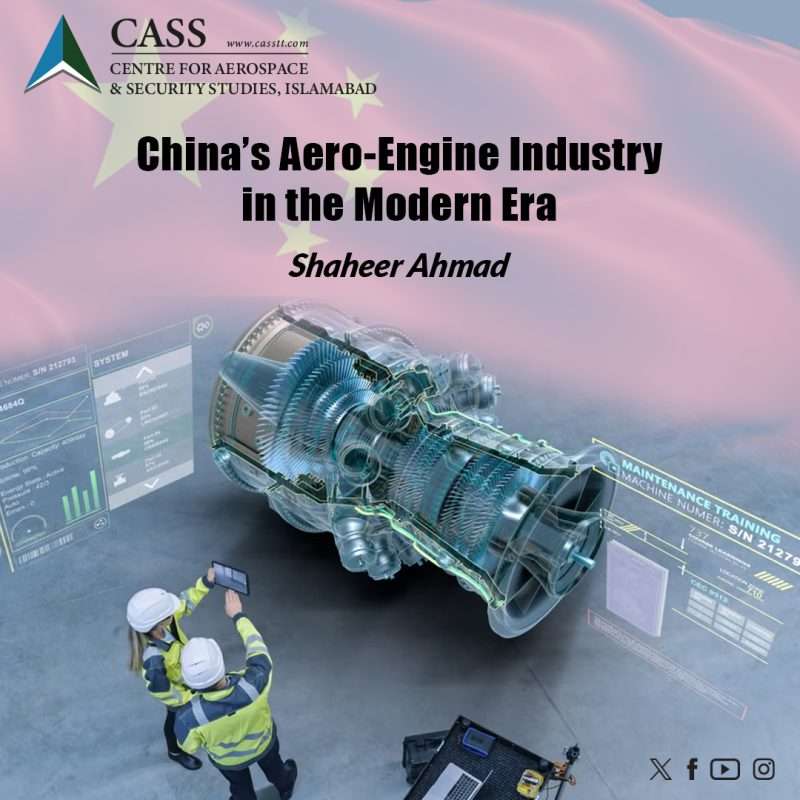
Ever since Xi Jinping announced a comprehensive defence overhaul of China’s military, developing an indigenous aero-engine baseline has retained the status of top priority in the country’s aerospace endeavours. Considering the dominance of cross-European consortiums in manufacturing cutting-edge engines, China is making incremental efforts to offset its foreign dependence on aero-engine research, development, and production.
Initially drawing on Russian assistance, China’s preliminary strategy was to benefit from the technological expertise of its Russian and Western counterparts. However, this imitation was of little or no use due to the lack of technical expertise and a profound industrial base. The pitfalls associated with this strategy were later acknowledged by Chinese analysts, highlighting the absence of an indigenous industrial base, which caused China to lag behind its peer competitors.
However, the technological gap between Western and Chinese engine technology is gradually closing. The intent to develop indigenous engines is powered by a multitude of factors. Long-standing Western sanctions, limited access to Russia’s aero-engine industry, and cutting-edge benefits of indigenously produced engines serve as a precursor to establishing a formidable aero-engine industry.
In past few years, China has made significant leaps in the aero-engine industry. In 2022, it had a notable achievement by installing the Shenyang WS-20 engine in the indigenous airlifter Xian Y-20. These engines proved their value in a critical mission, airlifting HQ-22 air defence systems to Serbia. The development was unexpected, given the PLAAF’s history of shortcomings in strategic airlift and logistics. Relatedly, China has fast-paced efforts to retrofit its J-10 and J-11 fighter jets with indigenous WS-10 and phasing out the Russian AL-31. Lately, China’s J-20A stealth prototype—which initially used Russian AL-31—captured the headlines by flying with a domestically manufactured WS-15—an engine expected to close the gap between Chinese fighters and their Western counterparts.
Additionally, in its 13th five-year plan, China put forward its ambitious USD 15 billion ‘Two-Engine Plan’ to develop domestic aero-engines as a national priority. The plan has also retained its status in the current 14th five-year plan. It comprises low-bypass, medium-bypass, and high-bypass ratio engines, which will likely serve as a bedrock to fully indigenise its domestic aero-engine development that will power its fighter jets, strategic bombers, and transport aircraft. Similarly, it will also complement China’s effort to create a ‘Strategic Air Force’ to achieve peer-to-peer status with the U.S. Air Force.
Despite its ambitious outlook, China’s aero-engine industry faces a minefield of challenges. A key hurdle involves the absence of machine tooling, including five-axis and seven-axis systems, which are critical to producing engine components and chassis parts. Chinese aerospace sector imports these systems from Japanese, German, Korean, and Italian firms which impedes its efforts towards comprehensive indigenisation. Similarly, China’s insufficient advancements in metallurgy hamper its ability to manufacture high-performance alloys and composite materials.
Another drawback of China’s aero-engine industry is its relatively short-lived span. China’s WS-15 engine has a service life of 3600 hours which is considerably less than the US aero-engines usually having a service cycle of 6800 hours. This drawback hinders PLAAF’s pilots from achieving proficiency similar to their Western counterparts.
To tackle these associated downsides, China is expected to ramp up investment in its domestic R&D base to compete in the global engine market. However, exploring next-generation technologies like AI-driven engine management and adaptive engine cycles is crucial to making significant leaps toward self-reliance and curtailing foreign dependence. In this regard, collaborating with countries like France and Russia is imperative. However, tightened export control measures by current and previous US administrations limit the prospects of technology-sharing mechanisms between China and these countries. Furthermore, metallurgical advancements, especially in 3D printing and casting, are crucial for maintaining quality control in engine manufacturing.
The aero-engine industry has remained a critical node to achieve aerospace ascendency. Considering rapid technological proliferation, it is evident that China has made monumental efforts to bring its engine industry at par with its Western counterparts. However, it still requires sustained innovation and resource investment to match the US in terms of capabilities. Meanwhile, as tensions in the Asia-Pacific escalate, China’s aero-engine industry is increasingly aligned with its broader military modernisation efforts. Its advancements in powering fighters, strategic bombers, and transport aircraft reflect a strategic push to narrow the capability gap with both regional and Western counterparts.
Shaheer Ahmad is a Research Assistant at the Centre for Aerospace & Security Studies, Islamabad. He can be reached at [email protected].