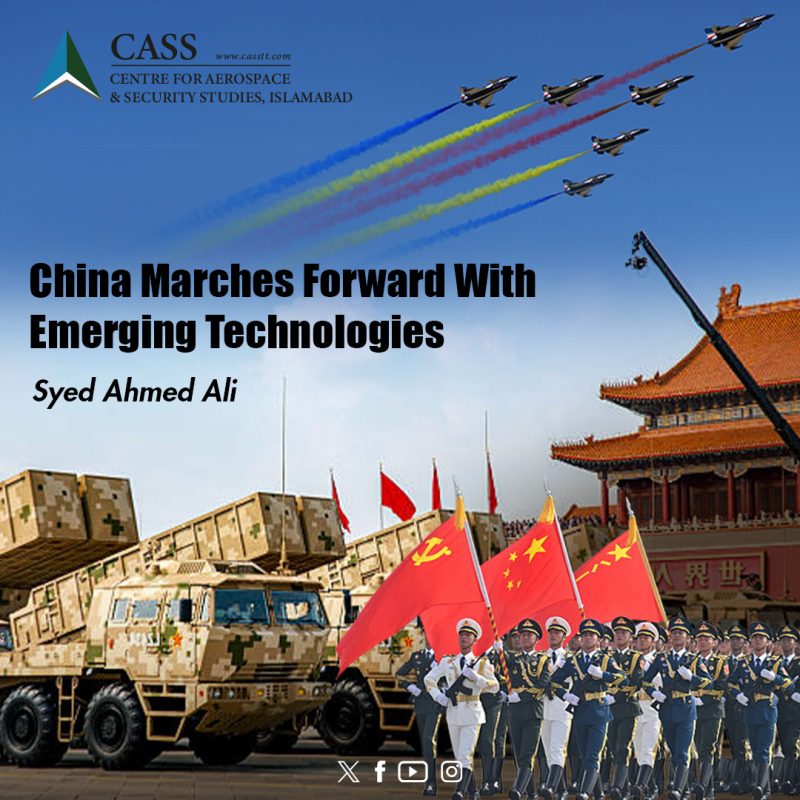
There is no doubt that the People’s Liberation Army (PLA) has come a long way from a modest force to a fully modernized force at par with the greatest militaries of the world. On 3rd September, China celebrated its 80th anniversary of the Japanese surrender in World War 2. The event was marked by a high-powered political delegation from various countries and the showcasing of China’s military might. The parade provided a rare glimpse into the PLA’s roadmap, which included unmanned intelligence systems, hypersonic missiles, cyber, and electronic weapons—clearly demonstrating that the adoption of emerging technologies is a core pillar of Chinese modernization strategy.
The trajectory of China’s military technological innovation is in line with its centenary goals, which has set a timeline for its progress. The objectives clearly outline that by 2027, China will accelerate its efforts to mechanize, Informationise, and eventually intelligentize its military. This follows a logical sequential trajectory, where each phase builds upon the next. The mechanization will transform the PLA force by providing greater mobility and firepower. The Informationisation will provide better situational awareness and connectivity in integrated operations. And lastly, Intelligentisation represents the ability to process the data through artificial intelligence and allow platforms to act independently. Through these changes, China aims to become a fully modernized force by 2035 and become a “world-class military” by the year 2050.
These bold, ambitious goals of the Chinese military were clearly reflected in the military parade where various remote unmanned platforms were displayed, clearly signalling the shift from mechanized to informatised warfare. Chinese remote technology is well-known in the defence community, with unmanned ground vehicles (UGVs) like VU-T10 and robot wolves are redefining the drone industry. These UGVs can perform a variety of functions such as reconnaissance missions, bomb defusing and coordinate with infantry through its Manned Unmanned Teaming (MUM-T) capabilities. This will enable China to drastically reduce its manpower requirements for military operations such as patrolling the border or surveillance of large geographic spaces.
China has expanded its drone technology in the maritime domain with unmanned surface vehicle (USVs) and introduced large unmanned underwater vehicles (UUVs) like AJX002 and HSU 100. These maritime drones are said to be capable of demining operations, independent target identification through passive sonar, capable of conducting naval blockades through torpedoes, and coordinating with conventional ships for group-based operations. With respect to the air domain, China has unveiled its unmanned helicopter and loyal Wingman Aircraft, the Hondu GJ-11, which made its debut in the 2024 Zhuhai. The trend of remote-based platforms enables Chinese forces to develop Recon strike-based drones that are capable of operating with reduced costs and may develop autonomous capabilities in the future.
As China pushes forward its drone expansion program, it also realizes the importance of counter-drone capabilities, which have been a defining feature of the Russo-Ukrainian war. The Chinese anti-drone systems are layered and operate both Kinetic and non-kinetic weapons as a single system. New technologies such as microwave weapons, advanced jamming technologies, and directed energy weapons LY-1, enhance the efficiency of anti-drone systems. These capabilities are essential in reducing the cost per kill, making engagement of drone swarms sustainable.
Apart from drone and counter-drone technology, China showcased its information and cyber technology as a part of its modernization effort. The Chinese have introduced new arms, Information Support Force (ISF), the Aerospace Force (ASF) and Cyberspace Force (CSF). This is particularly important as it indicates that the domains of Space and cyber have been militarised. Commentating on the creation of these new arms Wu Qian, spokesperson of the Chinese National Defence explained the function of these new arms. He stated that that ASF acted as the ears and eyes, the ISF represented the nervous system and CSF protects the network from malicious cyber-attacks.
The new Chinese doctrine seems to be centred on information superiority, which is clearly reflected in President Xi’s speech in which he stated the ISF is the central pillar for the coordination and construction of the network system. According to this new war-fighting concept, the ISF acts as the central hub of intelligence and communication in a multi-domain environment. The ASF acts as an advanced reconnaissance unit that provides satellite surveillance, global navigation, early observation, and tracking for anti-missile systems. The CSF is responsible for the protection of critical networks from malicious malware. While simultaneously undermining the enemy’s network through cyber espionage, disruption, and active psychological warfare. The modern PLA has successfully shifted from the mass mobilization of the People’s War to the precision of informationized warfare. If the trend of integrating Artificial Intelligence into military hardware, such as the Feihong FH-97 Loyal Wingman, continues, the future of the Chinese military appears poised towards intelligentised warfare.
China’s modernization efforts have made it into a new emerging player in the arms industry. The 3rd September march was an exhibition of Chinese military hardware, aimed at countries which face structural restrictions and sanctions from America. President Xi’s photo with world leaders, particularly Kim Jong Un and Vladimir Putin, seems to signal a new axis of resistance to Western hegemony. With new weapons system, parallel economic system and a possible new alternate political alliance, China’s rise as a near peer competitor seems almost inevitable.
Author’s Bio: Syed Ahmed Ali is a research assistant at the Centre for Aerospace and Security Studies (CASS), Islamabad, Pakistan. He writes on technopolitics and can be reached at [email protected]