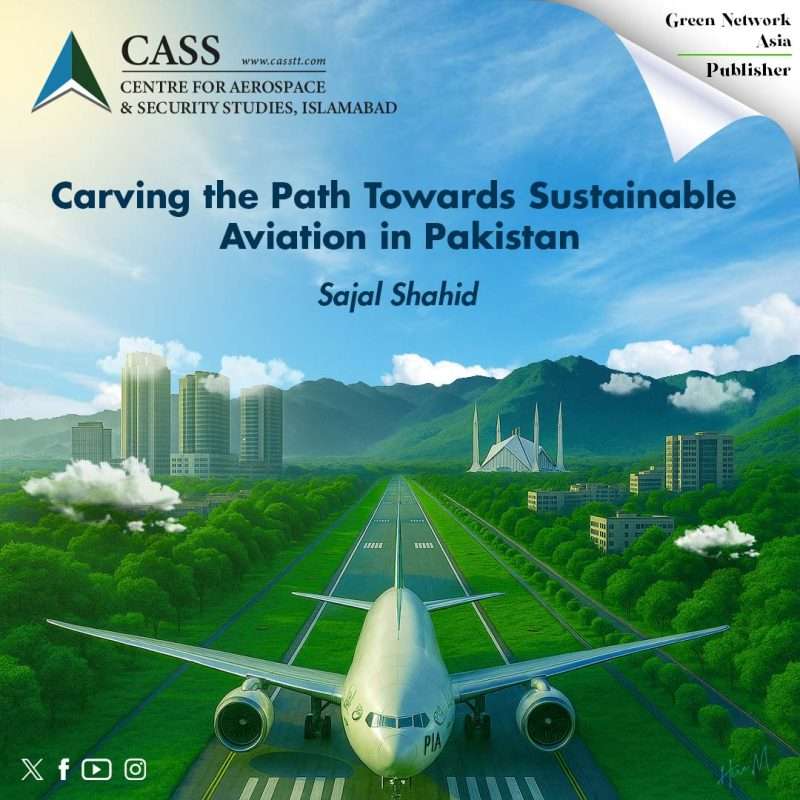
The aviation industry has been under increasing scrutiny for its major contribution to climate change. This rings true globally, including for Pakistan whose aviation sector continues to expand. As such, the country’s aviation industry stands at a critical juncture where the alignment of growth with sustainable practices is no longer a choice but a national imperative. Paving the way toward sustainable aviation in Pakistan is now more relevant than ever.
Growing Industry, Growing Impact
The aviation industry may account for only 2.5% of global emissions, but its impacts are disproportionately high. Aviation emissions occur at high altitudes, where gases, such as nitrogen oxides (NOₓ) and contrails (condensation trails), actively contribute towards radiative forcing. This is a phenomenon that effectively traps heat, resulting in a greater contribution towards warming than CO2 alone.
With the continued growth of global air travel, aviation emissions are projected to double or even triple by 2050 under a business-as-usual scenario. It is a prospect that bodes ill in the current climate trajectory, and a timely intervention is crucial.
In reality, climate change disproportionately impacts those who contribute to global emissions the least. Pakistan, for instance, contributes less than 1% and has consistently ranked in the top 10 most climate vulnerable countries in recent years.
Meanwhile, Pakistan’s aviation sector is a growing industry—along with its carbon footprint. Its annual carbon emission rate is approximately 1.94 million tonnes from domestic commercial flights alone. Compounded by international aerial traffic, creating a pathway toward sustainable aviation in Pakistan is beyond relevant to the country’s future and development.
Broad Policy Framework and Industry Support
The Pakistani government took a constructive step in this direction with the 2021 National Climate Change Policy (NCCP). The NCCP recognises the impact of the aviation industry on global warming by outlining three clear areas of interest. First is encouraging the national airline to consider fuel efficient fleet upgrades. Second is supporting the International Civil Aviation Organisation’s (ICAO) carbon emission reduction initiatives, which build capacity in developing states through various projects. Last but not least is for Pakistan to maintain an active presence in the development of international mitigation policies.
This move has been supported by airlines, such as the Pakistan International Airlines (PIA) refurbishing its aging fleet with more fuel efficient Airbus 320 aircrafts. Another example is the Airblue inducting A31neo aircrafts equipped with LEAP-1A engines, predicted to reduce fuel consumption by up to 20%.
Furthermore, these steps have been supplemented by other plans towards sustainable aviation. One of which is the ISO-14001 certification for Environmental Management Systems of major airports. Pakistan is also taking steps to develop its first Sustainable Aviation Fuel (SAF) facility in Sheikhupura, with joint funding by the Asian Development Bank (ADB) and International Finance Corporation (IFC). The SAF development, in particular, is a worthwhile endeavour for a state like Pakistan that is currently dependent on imports to meet 40% of its energy needs.
Critical Blindspots
While these are all encouraging steps towards sustainable aviation in Pakistan, critical gaps remain. Though the NCCP is quite a forward-looking policy for sustainable progress, key areas are missing.
Thus far, it does not address private commercial aviation and military aerospace, despite their presumably notable contributions to carbon emissions. For instance, there is a complete absence of publicly available information on military aviation emissions, along with the long-standing lack of demand for its transparency and accountability.
This data gap, among other aviation data, makes the process of identifying priority areas significantly more complex. It also hinders the development of a unified national fuel planning system to coordinate and fulfil projected requirements, further compromising fuel efficiency. Furthermore, concrete actions, such as establishing measurable and time bound targets, enforcement mechanisms, and impact assessment frameworks, are also noticeably absent.
Toward Sustainable Aviation in Pakistan
The ICAO has declared a global net zero emission goal for international aviation by 2050. To meet those targets and to keep pace with regional players such as China and India, which are actively progressing towards sustainable aviation practices, Pakistan must consciously evaluate its way forward.
Building enduring frameworks that promote environmental responsibility through emissions reporting, though time-consuming and complex, will have substantial long-term benefits. For a state like Pakistan, where broad policy frameworks such as the NCCP already exist, the overarching challenge lies in implementing clear, measurable, and actionable steps that aid in the pursuit of sustainability.
Moreover, exploring additional financing avenues is also important, such as by engaging with international development organizations and public-private partnerships. At the same time, Pakistan should support and empower its Research and Development (R&D) and local initiatives through financial, technical, and strategic investment. Advancing research and collaboration across stakeholders, including at existing aviation-focused institutions like the National Aerospace and Technology Park (NASTP), is also key. After all, it is steady, consistent, and collaborative progress that will lead to viable and lasting positive change.
Sajal Shahid is a Research Assistant at the Centre for Aerospace & Security Studies (CASS), Islamabad, Pakistan. The article was first published in The Green Network Asia.She can be reached at [email protected]