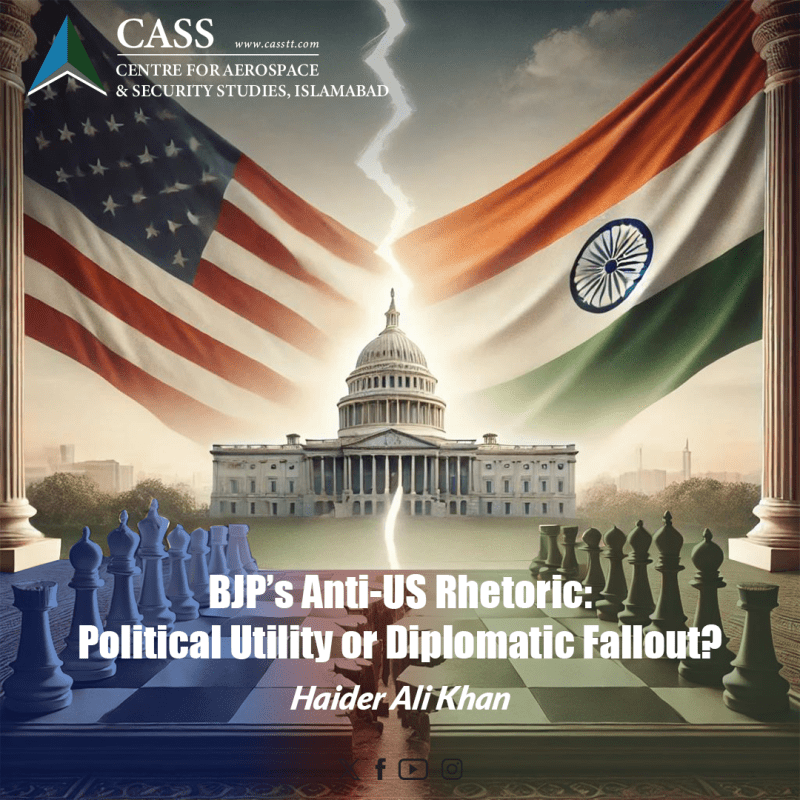
Allegations of foreign meddling have taken a centre place in Indian politics as India’s ruling Bhartiya Janata Party (BJP) accuses the U.S. Department of State and Deep State of orchestrating a destabilising campaign against the incumbent Prime Minister Narendra Modi and India’s international image. The accusations have also been linked to the investigations on the corrupt business practices of the Adani group by the Sarajevo-based Independent media conglomerate Organised Crime and Corruption Reporting Project (OCCRP) which linked the Indian Business giant with the Modi government claiming both have strong connections.
BJP claims that there is a nexus. In a press conference on 5 December 2024, BJP Spokesperson Sambit Patra stated that the State Department was destabilising India by financing the media group OCCRP to orchestrate a defamation campaign against India. Patra also accused the opposition leader, Rahul Gandhi, of conspiring with OCCRP and the US Department of State to ‘destabilise India’. The BJP spokesperson referred to the left-leaning French news agency ‘Mediapart’ quoting that half of the funding of OCCRP comes from USAID, which gives the US considerable influence over the reporting preferences of the media group. The cynicism comes despite the strong bilateral relations forged over the decades. The US embassy in New Delhi called the accusations ‘disappointing’.
In the backdrop of the political antagonism is the indictment of Gautam Adani, founder of the Adani group. The recent OCCRP investigations revealed the Adani Group’s involvement in a USD 250 million bribery scheme to secure solar energy contracts that could yield up to USD 2 billion in profits. The investigations also revealed that the Adani Group kept the American investors in the dark about the bribery scheme disclosed by the OCCRP investigations – leading to his indictment in the US of committing securities and wire fraud. Gautam Adani was indicted on 20 November 2024 by the United States Attorney’s Office for the Eastern District of New York.
The role of Indian domestic politics is inseparable from the controversy. Indian opposition parties have accused the BJP government of shielding Adani. Congress leader Rahul Gandhi has demanded the formation of a Joint Parliamentary Committee (JPC) to address Adani’s indictment, which the ruling party has consistently denied. The opposition accuses the government of protecting the unlawful activities of the Adani group. ‘It is a vindication of what we have been saying. The prime minister is protecting Adani and the prime minister is involved in corruption with Adani. This is being clearly indicated,’ said Rahul Gandhi. BJP’s accusations indicate a stronger opposition in the legislature by the INDIA alliance, led by Congress. After the recent elections, the BJP came to the parliament weaker than the previous term, as the party failed to gain a majority to form a government. Rahul Gandhi did not respond to BJP’s accusations.
So far, the BJP has not produced any substantial evidence for the involvement of the US deep state or the Department of State in undermining India’s sovereignty, nor has it proved the alleged nexus between the Congress, the OCCRP, and the US Department of State. Furthermore, Mediapart, criticised the BJP for wrongly instrumentalising the OCCRP investigation to serve its political agenda and attack press freedom. Mediapart further stated that the BJP has exploited their report to spread fake news.
In response to the BJP claims, the US embassy spokesperson in New Delhi accentuated the US commitment to press freedom. ‘A free and independent press is an essential component of any democracy, enabling informed and constructive debate and holding those in power accountable,’ the spokesperson said. The Indian Ministry of External Affairs (MEA) said that the US Department of Justice’s indictment of Adani and members of his conglomerate is a private matter. The BJP’s statement on the issue is not the official position of the Government of India.
The feud between the ruling party and the US Department of State could have ramifications for US-India ties. However, realpolitik suggests otherwise –BJP’s allegations of the US deep state’s involvement resonate with the rhetoric of President-elect Donald Trump, who claims to dismantle the supposed deep state. Modi and Trump have shared like-mindedness in their populist politics. Nevertheless, the ruling party’s position does not equate to the Indian government’s official position. BJP could leverage this narrative to stifle opposition and dissent, further consolidating its power. The OCCRP has also investigated the Indian government’s employment of Israeli spyware Pegasus to spy on dissenting journalists, raising serious questions about democratic freedoms. In the long run, the BJP might implicate this strategy to bolster nationalist support for the Modi government, which has witnessed serious counteraction by civil society and opposition parties in the legislature. This trajectory underscores the delicate balance between political manoeuvring and democratic practice in India’s evolving political milieu.
Haider Ali Khan is a Research Assistant at the Centre for Aerospace & Security Studies (CASS), Islamabad, Pakistan. He can be reached at [email protected].