‘Space is a warfighting domain just like the air, land, and sea.’ – General John W. Raymond (Retd), Former Chief of Space Operations, U.S. Space Force
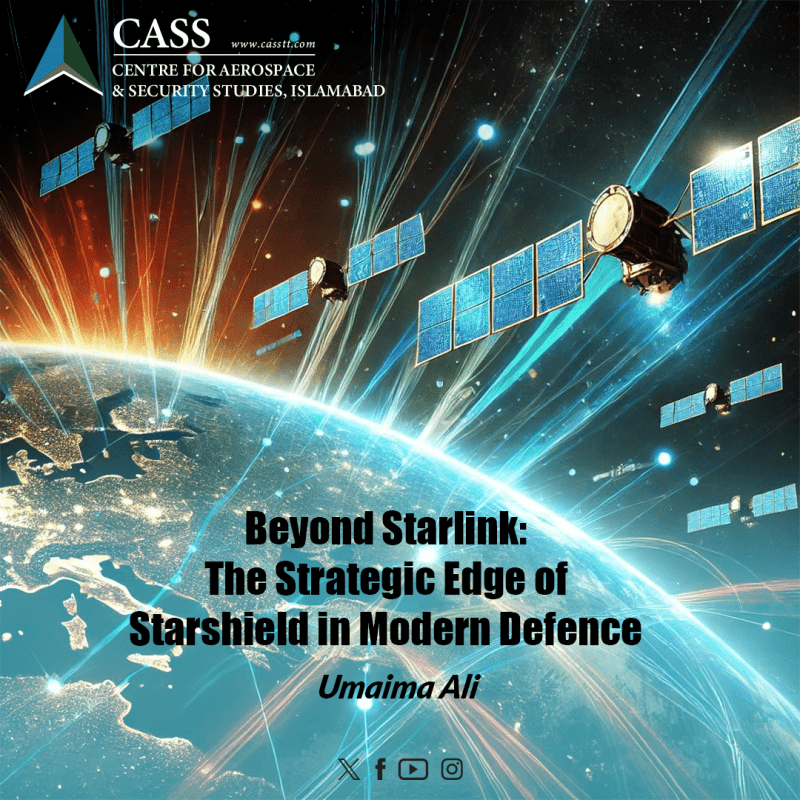
The drive to explore space has intertwined power, politics, and technology. SpaceX, led by Elon Musk, collaborates with the U.S. government through its ‘Starshield’ technology, which leverages the same infrastructure as its ‘Starlink’ initiative to support secure communication networks for military applications.
The ‘American way of war depends on instantaneous communication and coordination’ that satellites can provide. Using Low-Earth Orbit (LEO) satellites, Starshield offers a ‘redundant’ or ‘backup’ system in case of hostile interference with the main communication system. LEO technology originated from efforts to develop the now-abandoned ‘Star Wars’ defence system but has since evolved into a catalyst for real-time star wars in space. Starshield presents a shift in military technology but raises concerns about the privatisation of national security.
To augment the satellite capabilities of the Department of Defense (DoD), the U.S. military has launched Commercial Augmentation Space Reserve (CASR) programme to integrate commercial technology to enhance cyber security and support the military. SpaceX provides LEO satellite-based services to DoD under the Starshield programme. Starshield prioritises communications, hosted payloads, and earth observation. In contrast to Starlink, it leverages ‘additional high-assurance cryptographic capability to host classified payloads and process data securely.’
The National Reconnaissance Office (NRO) has adopted what is referred to as a ‘proliferated architecture’ to provide significant resilience against anti-satellite (ASAT) threats. Although the government has not officially disclosed the use of Starshield in NRO’s proliferated architecture launch missions, it is believed that NROL-126 carried Starshield satellites. According to SpaceX, 20 Starlink satellites were also part of the mission. Similarly, Starshield is also a part of a satellite launch mission ‘Straight Up’. Under this mission, seven satellites have been carried to LEO for USSF, including Slingshot 1. According to the Aerospace Organisation, Slingshot 1 will use Starshield, which defends spacecraft from attacks by detecting cyber intrusion. Starshield uses machine learning to identify and stop new types of attacks. However, Starshield’s resilience could be challenged by the ICARUS that exploits the routing mechanisms of LEO satellites to disrupt communication.
Starlink is set to revolutionise mission readiness and response capabilities. Researchers from China claim that Starlink will create a ‘mosaic’ around the Earth once all 42,000 of its satellites are in orbit. With different payloads, each satellite in the network will perform various tasks, including communication, reconnaissance, navigation, meteorology, and offensive and defensive operations. In 2023, the U.S. Navy evaluated Starlink terminals on two ships. The terminals helped the Fleet download cyber security patches and conduct administrative functions rapidly. While Starlink already had adequate infrastructure, security was embedded into it through the development of Starshield. Therefore, the U.S. Marine Corps used Starshield during a bilateral exercise with the Swedish Marine Corps and found that marines could conduct fire missions throughout the battlespace due to Starshield.
Although Starshield is a more advanced version of Starlink, no system is impervious to vulnerabilities. For example, Starlink terminals can be compromised by using a custom modchip that performs voltage fault injection to bypass signature verification. Nonetheless, SpaceX demonstrates a proactive approach to addressing these challenges. For example, during the Russia-Ukraine conflict, jamming attacks targeting Starlink terminals prompted SpaceX to update the system’s software to counter such threats.
The military applications of Starlink do not come without geopolitical implications. During the Russia-Ukraine War, Ukraine used Starlink for military purposes. According to Russia’s Foreign Ministry, such systems, ‘become a legitimate target for retaliatory measures, including military ones.’ Similarly, China has accused the US of ‘militarising space’ with the help of SpaceX, causing ‘huge challenges’ for information and space asset security of ‘other countries.’ In 2024, SpaceX and the Pentagon signed an agreement that expands Ukraine’s access to Starshield. Therefore, Starshield could aggravate global tensions, making private corporations targets of state aggression or vice versa.
Unlike state-owned and traditional satellite systems like China’s BeiDou, Russia’s GLONASS and American GPS, Starshield is a business unit of a private entity that integrates Starlink’s inter-satellite laser communication terminals that are difficult to intercept. The private ownership of Starshield creates hurdles for the government. For example, US troops stationed in Taiwan lacked access to Starshield, so the U.S. House Select Committee on the Chinese Communist Party demanded clarification from Musk. According to military analyst Fauntleroy, Starshield is a ‘Trojan horse’ that will enable SpaceX to ‘dictate policy’ to governments. This underscores the tension between private ownership and strategic demands of defence contracts.
Technological innovation from the private sector offers a stairway for achieving satellite sophistication. Starshield’s laser-based communication and cyber defence mechanisms set new benchmarks for military technology. The precedent this system sets could lead to further militarisation of space. However, private ownership of these technologies makes it challenging for nation-states to integrate civilian ingenuity into the defence sector. Starshield’s rise signals a shift where governments might rely more on profit-driven entities than state-owned systems.
Umaima Ali is a Research Assistant at the Centre for Aerospace & Security Studies (CASS), Islamabad. She can be reached at [email protected].