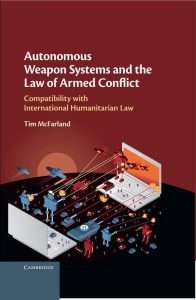
Tim Mcfarland, Autonomous Weapon Systems and the Law of Armed Conflict: Compatibility with International Humanitarian Law

  • Post author:

Autonomous Weapon Systems (AWS) are a rapidly evolving disruptive technology that not only impact the characteristics of warfare but also pose significant challenges for the Law of Armed Conflict (LOAC). The distinctive feature these weapons present is their ability to select and eliminate their targets without human intervention. While these weapon systems have been gaining much consideration amongst Armed Forces of a number of countries, they are also becoming an immediate cause of humanitarian, ethical and legal concern.
[WPPV-TOTAL-VIEWS] views

Continue ReadingTim Mcfarland, Autonomous Weapon Systems and the Law of Armed Conflict: Compatibility with International Humanitarian Law

Minsk-Moscow Nuclear Rendezvous

  • Post author:

Moscow and Minsk, a supranational union called the Union State, agreed to station tactical nuclear weapons (TNWs) in Belarus on 25 May 2023, a decision in consideration since December 2021. Russia delivered the first batch of weapons in June 2023, with the rest expected to be deployed by year-end. In August 2023, Poland also confirmed the movement of weapons.
[WPPV-TOTAL-VIEWS] views

Continue ReadingMinsk-Moscow Nuclear Rendezvous

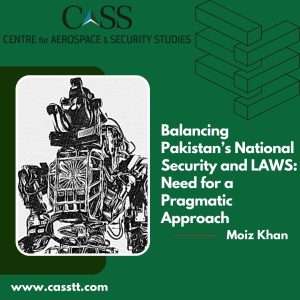
Balancing Pakistan’s National Security and LAWS: Need for a Pragmatic Approach

  • Post author:

Robust advancements within conventional weapons technology and amalgamation with Artificial Intelligence (AI) and Machine Learning (ML) have led to the development of Lethal Autonomous Weapon Systems (LAWS), also known as ‘Killer Robots.’ Distinct from other conventional weapons, they integrate the element of autonomy in their critical functions. LAWS autonomously perform critical tasks such as navigation, identification, tracking, and targeting using sensors and algorithms, without human control.
[WPPV-TOTAL-VIEWS] views

Continue ReadingBalancing Pakistan’s National Security and LAWS: Need for a Pragmatic Approach

Securing Cloud Computing: Balancing Growth and Risk

  • Post author:

Cloud computing refers to the accessibility of a wide range of ‘resources including applications, servers, data storage, development tools, and networking capabilities.’ These resources remain stored at off-site data centres managed by Cloud Service Providers (CSPs), allowing users to easily access them over the Internet without users needing them physically on their devices. ​
[WPPV-TOTAL-VIEWS] views

Continue ReadingSecuring Cloud Computing: Balancing Growth and Risk

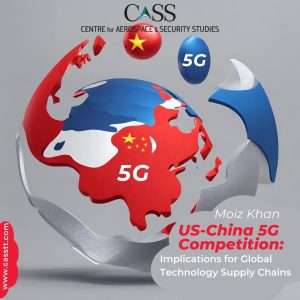
US-China 5G Competition: Implications for Global Technology Supply Chains

  • Post author:

The Fifth Generation (5G) cellular network is the latest telecommunication system with significant implications for various sectors. Compared to its previous generations of 4G, 3G and 2G, 5G offers higher radio frequencies and speed that enables swift data transmission.
[WPPV-TOTAL-VIEWS] views

Continue ReadingUS-China 5G Competition: Implications for Global Technology Supply Chains