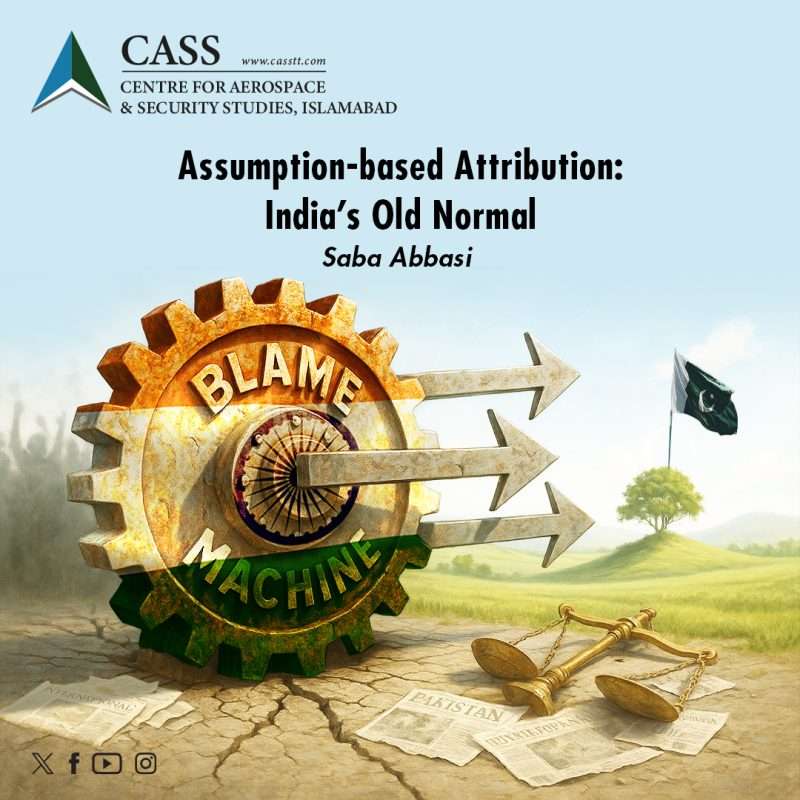
The Indian narrative post-Pahalgam was a variant of an old template—a terror attack followed by India’s unsubstantiated accusation against Pakistan. The convenience of this template lies in India’s ability to divert attention from its security lapses, political miscalculations, and failure to introspect.
Right after the Pahalgam incident, the Indian government began to vehemently disseminate the narrative of Pakistan’s involvement in the attack. Without a shred of evidence, India followed the long-standing pattern of blaming Pakistan. The hostile rhetoric pledging to punish the terrorists and their “backers” finally culminated in India attacking Pakistan on 7 May 2025.
Strikingly, in the wake of the Pahalgam episode, there has been remarkably little focus by India on the assailants’ exact identity and the nature of their links to Pakistan. Moreover, no independent international intelligence agency confirmed a direct link between Pakistan’s state machinery and these attacks. In fact, the incident actually warrants raising critical questions about the Indian state. Given that the assailants operated for an extended period without any apprehension and interruption in a heavily militarised area with abundant surveillance is questionable and controversial. However, the failure of the Indian security apparatus and habitual blame game are not limited to what happened in Baisaran meadows.
The Pahalgam incident is only an escalatory and exacerbated recurrence of a previous pattern. In 2019, India’s deficient security preparedness, vulnerabilities in its intelligence and response mechanisms, and negligence of early warnings led to the Pulwama incident. However, to pre-emptively justify its acts of aggression in the form of Balakot strikes, India attributed the attack to Pakistan.
Despite India’s aggressive posture following these incidents, Pakistan’s leadership emphasised peaceful resolution by stating its openness to neutral, third-party investigation. After the Pulwama attack, Pakistan asked the Indian government for actionable intelligence that could prove India’s claim of terrorists’ link to Pakistan. If there had been any credible proof, it would have been disclosed.
On the other hand, evidence of Indian cross-border and global terrorism is irrefutable. From Kulbhushan Jadhav, the poster child of Indian-sponsored terrorism, to the thwarted assassination plot of a US citizen or the targeted killing of a Canadian Sikh separatist, there remains ample proof of Indian state-backed terrorism.
The Indian tradition of writing off any armed assault that takes place in its jurisdiction as a terror attack from Pakistan is appallingly predictable. It goes to the extent of accusing Pakistan in instances where no group officially claims responsibility for undertaking the attack whatsoever, as was exhibited after the Uri episode. The denial of the Pahalgam attack by The Resistance Force is another example of the stubborn Indian approach of maintaining its position to blame Pakistan, even if the facts suggest otherwise. Absurdly, back in 2007, India accused Pakistan of the Samjhauta Express bombing, which later was revealed to be the doing of India’s militant group, RSS.
The only thing more problematic than India’s offensive victimhood is its diplomatic manoeuvring. Leveraging first-mover advantage after any crisis to build the narrative of being the target of terrorism has served India well. It takes international attention away from the Indian oppressive regime in Indian Illegally Occupied Jammu and Kashmir, and hence, the calls for any investigation are projected as mere dilatory attempts.
India’s growing appeal as a rising trade and strategic power also contributes to its effort to move allies beyond the need to interrogate questions of attribution. However, the momentum of diplomatic monopoly was disrupted after the four-day war between Pakistan and India. India’s provocative actions, as witnessed by the global community, defy the norms of a responsible nuclear state. Moreover, India’s ambitious goal to emerge as a regional hegemon and to become a permanent member of the UN Security Council is also not consistent with its reactive and imprudent approach to a neighbouring nuclear state.
In an effort to control the narrative, India risked global credibility and peace in the region. Moreover, consistently bypassing accountability has also conditioned Indian opinion-makers to believe that attribution and retaliation should happen with a pro forma automaticity. This plays right into the hands of India’s extremist and hardliner leadership, which attempts to not only avoid public litigation for its own security lapses, but also strives to secure electoral victories by influencing public opinion.
In a democratic setting, security mishaps and systemic failures prompt governmental investigation, institutional reassessment, and reform. However, India finds it easier to assign culpability to Pakistan and act out of political expediency. India’s effort to neutralise the attribution question blindsides it from assessing its failed administration, excessive militarisation, and fractured security structure.
Saba Abbasi is a Research Assistant at the Centre for Aerospace & Security Studies (CASS), Islamabad, Pakistan. She can be reached at [email protected].