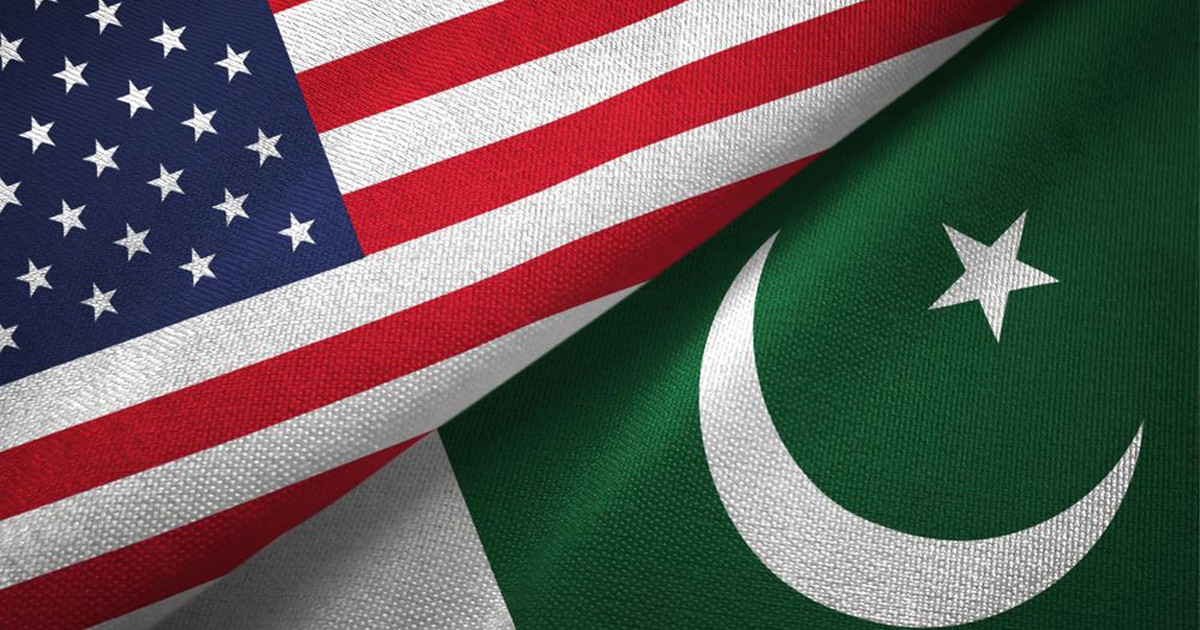
Since the withdrawal of the US/NATO forces from Afghanistan, US-Pakistan relations are standing on the edge of a cliff and at crossroads.
Nevertheless, despite the undesired agitation between the two nations, there is still room for cooperation over several subjects where their mutual interests converge. These subjects could be cooperation to counter transnational terrorism, arms control, trade, media, education, democracy and climate change. In fact, these areas could become a foundation for realignment of this relationship. Since the fall of Kabul, there is an undeniable threat of the rise of terrorism in Afghanistan feared in Washington and Islamabad.
This looming threat could be from IS-Khorasan (IS-K), Al-Qaeda, and Hezbollah. The prevailing perception in Pakistan is that domestic like-minded groups could take inspiration, funding and training from these groups. While on the other hand, the vacuum in Afghanistan could give transnational terrorist groups a fertile ground to breed. Under such circumstances, a rapid rise of terrorism could impact the US National Security Strategy as well as threaten Pakistan’s national security.
To counter these threats, the US can engage with Pakistan’s National Counter-Terrorism Authority (NACTA). Furthermore, the two states can coordinate efforts in devising a strategy, training, intelligence and technology sharing to counter transnational terrorism. In addition to terrorism, Pakistan and the US could put in efforts towards arms control in the region. It is part of the US’ National Security Strategy to re-engage with Russia to cater to the threat posed by nuclear weapons. Countries in the South Asian region have been building their offensive capability aggressively.
This build-up could cause miscalculations and unintended escalation. The level of miscalculation also increases due to emerging technologies, such as AI and cyber, being incorporated into offensive and defensive capabilities.
Moreover, hypersonic ambitions also add complexities to strategic stability in the region and could impact the deterrence calculus gravely.
Pakistan, despite the precarious security situation of the region, has been making efforts to develop economically. This offers vast potential for bilateral trade and economic cooperation. The US is Pakistan’s largest export destination and one of the country’s top five investors.
Data released by the State Bank of Pakistan showed that during the first quarter of the fiscal year (July-Sept FY22), Foreign Direct Investment (FDI) from the US was five times higher than China. This indicates that the US investment has not died down despite the ongoing Chinese projects in Pakistan.
Notwithstanding the antagonistic relations between the US and China, Pakistan has attempted to maintain a balanced approach towards the two and it remains open for business for both countries.
Furthermore, the two states can also enhance cooperation in news and journalism. Given the rise of misinformation, fake news and deep fakes, it would be ideal to strengthen communication in order to avoid the fabrication of narratives.
For this purpose, the two governments can improve cooperation through journalism exchange programs, partnerships and workshops. In addition to this, according to research conducted by Google and Kantar, Pakistan’s internet penetration stands at 54% in major cities.
This presents an opportunity for Silicon Valley’s giants such as Facebook (aka Meta), Twitter, Amazon and so on to enhance their business linkages here. This opportunity can further add value if local offices are set up in various Pakistani cities.
Lastly and most importantly, climate change is seen as a national security threat in the US. Similarly, climate change and its adverse impact on food security are important for Pakistan as it is an agrarian country.
Pakistan actively participated in COP26 and put forth a realistic goal to cut emissions by 50% and make the shift to renewable energy by 2030.
Its drive towards forestation is now widely recognized. Both countries can learn from each other’s best practices in the areas of mitigation and adaptation.
However, in order to work together in these areas, it would be essential that an accommodating and broad-minded approach be adopted. Both states view their relations through the lens of China, India or Afghanistan.
Pakistan assesses its relations with the US based on how intimate Washington is with New Delhi and similarly, the US analyzes its relations with Islamabad based on Pak-Sino coziness.
Afghanistan is the third triad between the two. If the US and Pakistan continue to view their relations through the lens of other states, complexities would continue to add up turning the relationship into a triangle to square to hexagon, rather than a straight line.
Therefore, in order to strengthen bilateral ties, external third-party noises need to be muted and a collaborative effort to achieve mutual goals needs to be put in place.
Maheen Shafeeq is a researcher at Centre for Aerospace & Security Studies (CASS), Islamabad. She holds a Master’s degree in International Relations from The University of Sheffield, UK. The article was first published in Pakistan Observer, She can be reached at [email protected].
Image Source: “Govt to make effort to restore Pak-US relations.” (2021, March 8). Global Village Space. https://www.globalvillagespace.com/govt-to-make-effort-to-restore-pak-us-relations/