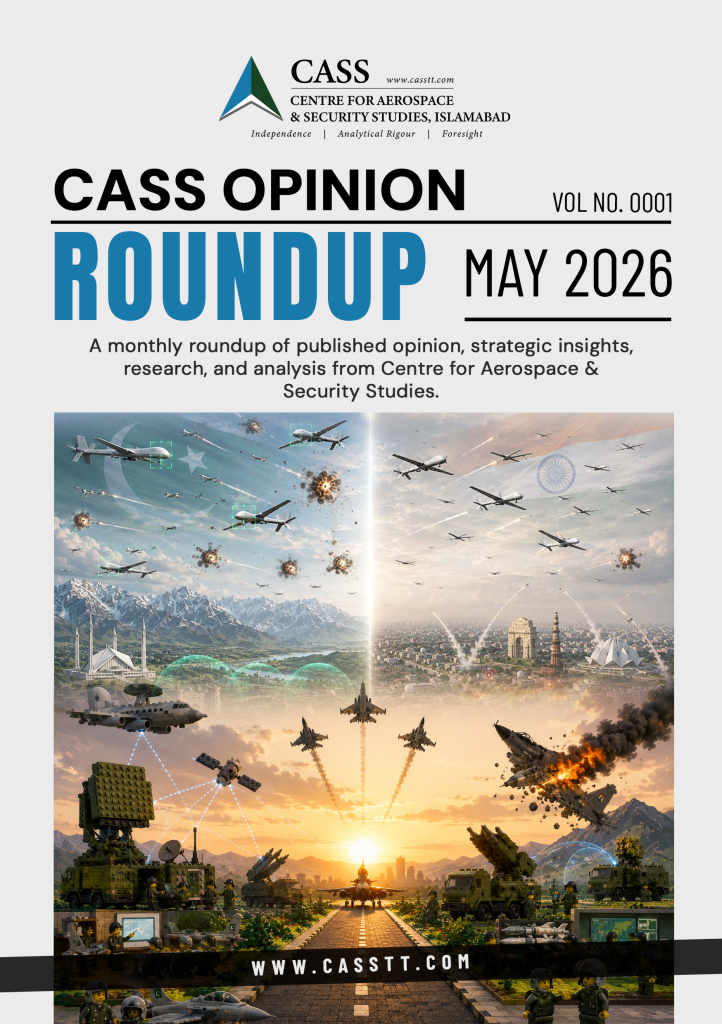
Growing use of drones in contemporary military operations has transformed them into one of the most formidable innovations on the battlefield. According to a study, over 95 states possess drone technology, among which more than ten countries have used drones for active combat operations. This has been evident in the Nagorno-Karabakh, Russia-Ukraine wars and Israel’s onslaught on Gaza, where drones have played a commanding role in conducting intelligence, surveillance, and reconnaissance (ISR) missions, hitting ground-based air defences (GBAD), destroying combat vehicles, targeting ground formations and even civilians at close proximity.
However, as drones become increasingly lethal, so does anti-drone technology, primarily seen as the future of aerial defence strategies and a protective shield to prevent them from hitting high-value targets.
Anti-drone technology, also known as Counter-Unmanned Aircraft System (C-UAS) or Counter Unmanned Aerial System (C-UAV), refers to the system capable of detecting and disabling hostile drones. The technology is distinguished into two categories, i.e., kinetic and non-kinetic. Usually, kinetic systems target incoming drones with projectiles, including bullets and missiles. Meanwhile, non-kinetic systems utilise jamming and spoofing methods to disrupt communications, making it hard for the drone to follow its predetermined path.
The US military owns multiple anti-drone systems, including Vehicle Agnostic Modular Palletised ISR Rocket Equipment (VAMPIRE); National Advanced Surface to Air Missile System (NASAMSTM); Ku Band Radio Frequency Sensors; and Coyote Missiles, to name a few. Similarly, China uses Type 625E Short-Range Air Defence System (SHORAD), armed with missiles and a Gatling-style cannon to take down incoming drones. Recently, South Korea took the lead by deploying its ‘Star Wars’ laser weapons, making it the first country to field and operate laser weapons for countering drones.
Beyond speculation, the frequent collisions between drones and legacy battle systems make C-UAS an increasingly attractive option for military and strategic planners. Earlier this year, Ukraine rammed into a Russian guided missile ship by using sea drones, powered by jet skis, causing gridlock to Russia’s Black Sea fleet operations. Similarly, in July 2024, a Houthi drone traveled over 2,600 kilometers from Yemen to Tel Aviv, marking the first successful breach of Israeli air defences by Houthi forces. This attack, which resulted in one death and multiple injuries, demonstrated the Houthis’ growing proficiency in drone technology. Despite previous drone and missile strikes against Israel since October 2023, this event stands out due to its success in reaching Israeli soil and causing casualties, underscoring the group’s escalating drone capabilities and the evolving threat posed by such technology. Owing to this incremental adeptness and battlefield lethality, the challenge for anti-drone systems becomes even greater to counter these small ‘unwanted guests’ in the sky.
However, as anti-drone technology advances, so too do drones, which continue to evolve in response to realities of the battlefield. Currently, most anti-drone systems rely on radio frequency or global navigation satellite system (GNSS) jammers, yet these systems are increasingly vulnerable to inexpensive counter-jamming methods. While radars can detect drones over long distances, they struggle with low-flying, small drones that are difficult to track due to their agility and maneuverability. Advancements in autonomous drone technology have also enhanced their role in gray zone operations, allowing them to bypass defensive triggers. These challenges underscore the growing complexity of developing effective anti-drone solutions in modern warfare.
Challenging, but not insurmountable! To counter growing drone threats, making counter-drone technology more adaptive is essential. Integrating advanced technologies such as Machine Learning, AI, and computer vision is critical for enhancing detection and response times, particularly against low-flying, fast-moving drones that evade conventional systems. Moreover, mobile, low-powered laser systems like China’s LW-30 and the U.S. M-SHORAD are proving to be efficient and cost-effective methods for neutralising incoming drones with precision.
Beyond new technologies, modernisation of traditional defence systems such as anti-aircraft guns and man-portable air defence systems (MANPADS or MPADS) can significantly enhance the counter-UAV kill chain. These systems, traditionally used against larger aircraft, are now being retrofitted to deal with the growing threat of drones on the battlefield. Importantly, swarm drone technologies — where multiple drones operate together — are on the rise, further complicating defence strategies. To mitigate these, systems must evolve to engage multiple targets simultaneously, underscoring the need for scalable, intelligent defence.
At a time when global strategic competition is intensifying, bloc politics is returning, and uncertainty between the United States and China is growing, drones are becoming a tactical enabler for states and non-state actors to project power across distant expanses. Rapid development of autonomous drones, capable of operating in complex, contested environments without human input, further heightens the urgency for adaptive countermeasures. The battlefield of the future will demand a combination of innovative technologies and upgraded traditional systems to effectively neutralise the evolving drone threat. The focus must be on creating integrated, layered defence systems that not only detect but also disrupt and destroy hostile drones before they become critical threats. In this evolving strategic landscape, having a robust and scalable defence against drones is essential to maintain balance and deter power projection through unmanned systems.
Shaheer Ahmad is a Research Assistant at the Centre for Aerospace & Security Studies (CASS), Islamabad, Pakistan. He can be reached at [email protected]