Since its inception, air power has been the vanguard of military diplomacy by virtue of its speed, reach, flexibility, and precision. This unique combination has made it the instrument of choice for states seeking both coercion and persuasion without boots on the ground. With immense potential in the one-man, one-machine, high-flying, long-range push-button approach, air power has achieved strategic effects throughout history. Whether it was the bombing campaigns of World War II, the surprise aerial strike on Pearl Harbor, or nuclear detonations over Hiroshima and Nagasaki, air power has delivered outcomes that have had global repercussions. Today, this legacy has entered a new phase: the Aerospace Age. With expanded capabilities, modern air power is not just faster and farther: it is deadlier, more autonomous, and increasingly integrated into the broader theatre of multi-domain operations (MDOs).
Factors transforming the use of air power include proliferation of unmanned systems, Artificial Intelligence (AI), and outer space. Near and fully autonomous systems are now the new face of airpower. However, effective use of aerospace power hinges on the strategic maturity of decision-makers who grasp both the intended political objectives and the risks of rapid escalation inherent in airpower employment. Marka-e-Haq presents a textbook example of this principle in action: air power employed not for escalation, but as a calibrated deterrence tool to compel belligerents towards the negotiating table.
Following what happened in Pahalgam, an uncontrolled Indian media was shaping public perception putting pressure on Prime Minister Modi to demonstrate the efficacy of India’s military apparatus, beefed up by numerous expensive inductions, such as the Rafale fighter jets. The aircraft which had become a national symbol of India’s offensive punch after its scandalous induction. Just as India’s hard-line government became trapped in its own fabricated narrative and launched ‘Operation Sindoor’, Pakistan demonstrated restraint, clarity of purpose, and a clear understanding of strategic signalling under Marka-e-Haq.
In its initial assault, the Indian Air Force (IAF) deployed its best assets and most experienced operators. The attack was initiated in the early hours of 7th May. To prevent an Abhinandan-style shooting and capture, the IAF had taken precautions to stay well inside its borders and only use long-range standoff weaponry. The PAF combat patrols were all visible to India’s command centres. As the IAF released their weapons, the tables turned. The PAF took charge, snatched the initiative, and control of the air battle from the IAF.
In what is now considered largest Beyond Visual Range (BVR) air engagement in history, the PAF shot down six Indian aircraft. The multi-domain counterstrike was so effective and timely that several disoriented IAF aircraft were forced to land on unlit diversionary bases.
The strategic gridlock was complete: the PAF established full escalation dominance. India’s military strategy unravelled. In a calculated display of restraint and responsibility, the PAF limited its response to downing only six Indian aircraft though more targets were well within reach. The message was clear: the PAF had secured air superiority, and any further Indian air, ground, or naval operation would be suicidal.
In shock, the IAF retreated to rear bases. The boots on ground stayed put, resorting to counter-fire. INS Vikrant, so ceremoniously put to sail with a blockade of Pakistani waters in mind, retreated back to calmer waters, well out of range of PAF fighters.
In contemporary warfare, the loss of air superiority is more than a tactical failure; it is tantamount to a loss of sovereignty.
India’s subsequent shift to drone warfare was a desperate political and military face-saving measure after the failure of its conventional air campaign. The drone incursions, especially the reckless attack on the Rawalpindi cricket stadium where Pakistan Super League (PSL) matches were planned, reflected a dangerous mix of political posturing and military irresponsibility. The PAF’s swift and disciplined response, including reciprocal drone operations that carefully avoided civilian targets, conveyed a powerful counter-narrative: escalation could be matched, but without recklessness.
India’s resort towards drone warfare was a contingency manoeuvre implemented as the only option to save face. The drone incursions were met with resolute defence. The reckless drone attack on the Rawalpindi cricket stadium reflected India’s desperate psyche by targeting Pakistan Super League (PSL) matches. These attacks were matched by PAF’s drone incursions, carefully avoiding civilian targets. If there was no PSL, the Indian Premier League (IPL) could also not be held. The SSM attacks, another frantic and dangerous precedent, were countered with ECM denials and a regulated national response.
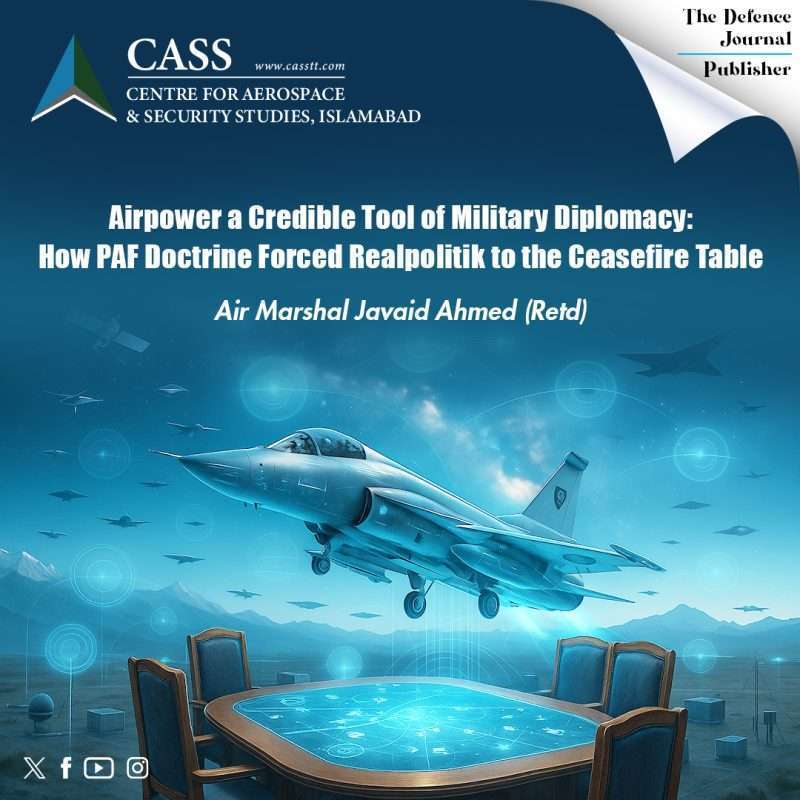
The subsequent PAF Offensive Counter Air (OCA) campaign was a masterclass in coercive military diplomacy. Striking 34 carefully selected military targets near the Indian border, the operations show Pakistan’s resolve to respond forcefully yet responsibly. The destruction of the S-400 was a signal that the defence dome around key targets in India’s geographical depth could be taken out by the PAF. The PAF’s doctrine, grounded in precision, proportionality, and escalation dominance, brought realpolitik back to the table forcing a cessation of hostilities and compelling India to seek a ceasefire.
Pakistan’s aerial doctrine has been formulated and refined following numerous conflicts with its belligerent neighbour and geostrategic compulsions of being located in a restive region. Decades of conflict in Afghanistan and numerous wars with India have ensured that the PAF equips, trains, and employs its assets to meet the dictates of national military strategy. The influence of global conflicts, emerging technologies, and a compulsion of indigenisation is reflected in PAF’s force structure and its integration into a well-knit system, fully capable of conducting, sustaining, and winning.
But the most significant factor that has made a difference is the role of PAF’s leadership. Marka-e-Haq demonstrated the classic execution of centralised control with decentralised execution: a key feature of advanced airpower doctrine. With the Air Chief personally overseeing all decisions and the Air Staff translating directives into precise operational action, the PAF gained a clear and decisive edge. This top-down clarity and bottom-up agility enabled the PAF to dominate the tempo, timing, and thresholds of escalation. The leadership’s use of both Air Operations and MDOs was critical in executing strikes and countermeasures as well as in controlling the psychological and diplomatic outcome. By actively managing the escalation ladder at every rung, the PAF leadership ensured that force was used with precision, not provocation delivering military results while keeping the political space open for de-escalation. It was this combination of doctrinal discipline and foresight that transformed airpower from a tool of retaliation into a credible instrument of military diplomacy forcing the adversary to reckon with the limits of escalation and return to the logic of realpolitik. Having lost the opening gambit in a shocking turn of events, a ceasefire and face-saving exit was the only option for the Indians.
The four-day war between two nuclear neighbours in South Asia brought forth the limitations of India’s political narrative and its Israeli-influenced strategic thinking. The episode also lays down the guiding principles for any future attempts to impose a so-called ‘new normal’ in the region: any future misadventure will not be met with hesitation rather with deliberate and decisive action based on a doctrine that has unambiguously demonstrated its strategic credibility.
Air Marshal Javaid Ahmed (Retd) is President of the Centre for Aerospace & Security Studies (CASS), Islamabad and a former Vice Chancellor of Air University. The article was first published in the Defence Journal Magazine. Email: [email protected]