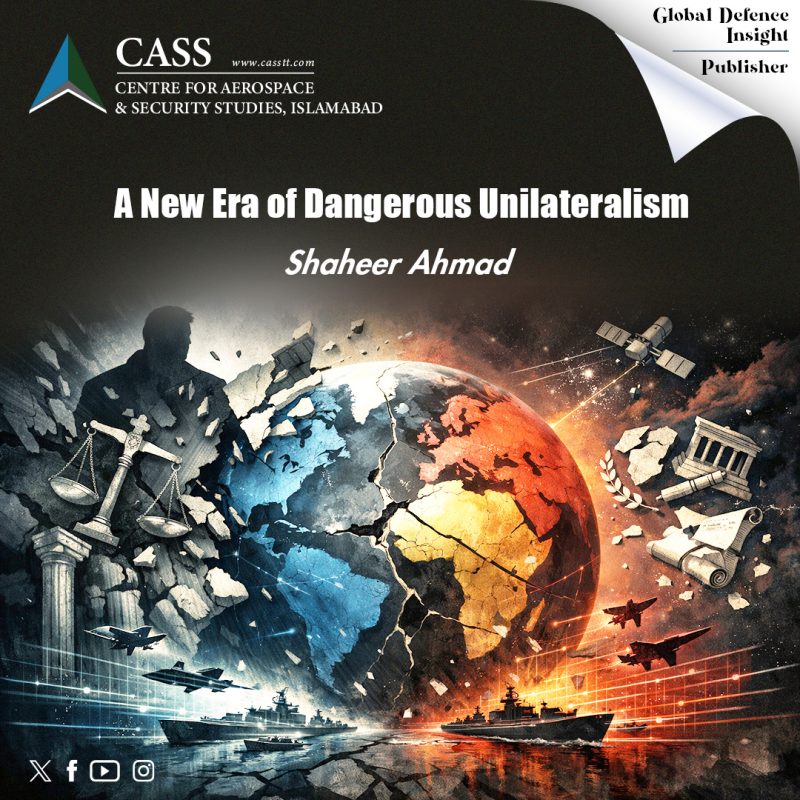
The United States’ use of brute force to oust Venezuelan President Nicolas Maduro marks a turning point for the US foreign policy in the Western hemisphere. The overnight swift execution of the integrated joint operation by the United States Air Force, Navy, Cyber Command and Special Operations Aviation Regiment (SOAR) has sent shockwaves in geopolitical hotspots elsewhere. In hindsight, the raid has reinforced the realist foreign policy ethos by setting a precedent for unilateral intervention by other great powers across the globe.
The US has long promoted the significance of rule-based international order and democratic governance. Its foreign policy discourse has stressed the importance of liberal institutionalism by empowering the international entities and governing bodies like the United Nations (UN), World Trade Organisation (WTO) and United Nations Security Council (UNSC). The global norms enforced by these entities were believed to facilitate cooperation, restrain unilateral behaviour and prevent conflict among the states.
However, the era of rule-based order has weakened significantly in the last few years. The US action in Venezuela has largely shaped the international geopolitical environment. Besides Venezuela, President Trump has reinitiated his desire to take over Greenland for its critical resources via purchase or the use of military force. Similarly, he has also reiterated his aim to conduct strikes against drug cartels in Mexico. Several analysts have touted these measures as the ‘Donroe Doctrine’ in practice, which is not constrained by international norms and institutions. It also accelerates the erasure of US credibility, alliance commitments and the tenets of liberal world order established after the dismemberment of the Soviet Union.
Scholars of international relations believe that, when a powerful state uses brute force without clear justification, it diminishes the significance of normative values of international order. Most notably, it encourages other dominant actors to commit such behaviour in their respective spheres of influence and strategic backyards. Authoritarian states and other great powers use such instances to legitimise their actions and behaviour against the weaker states.
The new norm also brings into focus issues such as Taiwan and the South China Sea. After the US aggression on Venezuela, several commentators have pointed toward the possibility of an enhanced role of China in the region with respect to all disputed areas. Consequently, it eradicates the moral cover for the US to criticise China for challenging the rule-based order while pursuing its historical territorial claims.
Similarly, for the Kremlin, the Venezuelan episode signals a new era of a rival great power being prompted to act with impunity. Having experience of conducting grey zone operations in Crimea, Russia may find itself emboldened to challenge Ukraine and Europe in numerous ways. Trump’s categorisation of the Venezuelan raid as an ‘extraordinary military operation’ resonates with Russia’s connotation of the Ukraine invasion as a special military operation.
Therefore, the overt contravention of international law may give other powers, like Russia and China, the opportunity to discard international legal norms and constraints for their actions in Eastern Europe and East Asia subsequently. Trump’s announcement of running Venezuela is similar to Putin’s aims of governing Ukraine. For China, it is a low-cost opportunity to criticise the US behaviour on the international front, in addition to forwarding its claims on Taiwan. This is evident through Foreign Minister Wang Yi’s remarks, where he warned that no country has the right to act as the global policeman. These factors demonstrate that US actions in Venezuela have been instrumental in setting a norm of unilateral actions by the great powers.
The strong do what they can, and the weak suffer what they must. This timeless maxim of Thucydides explains the crude reality of modern geopolitics. The Venezuela case reveals that power overrides the normative aspect of international relations. It also underlines how international law and conventions are uneven in practice, making it binding for the weaker states more than the strong ones. Moreover, when great powers’ interest collides with the international rules and regulations, the latter can be bypassed. In sum, the US actions have set a dangerous precedent of unilateral actions where international law and regulations cannot constrain powerful states when their core interests are at stake.
Shaheer Ahmad is a Research Assistant at the Centre for Aerospace & Security Studies, Islamabad. The Article was first published by Global Defence Insight. He can be reached at [email protected]