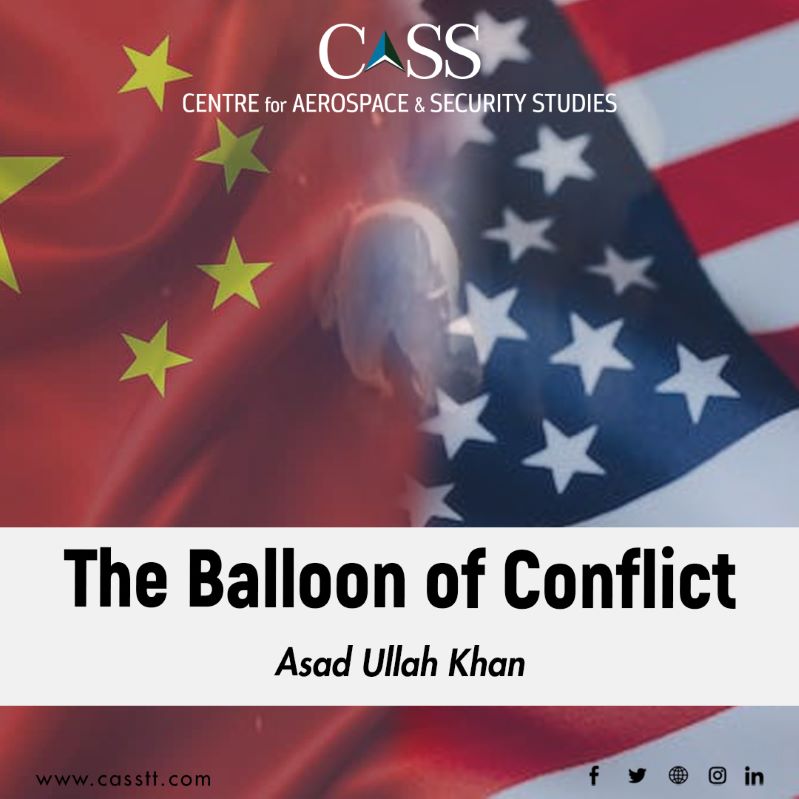
Quite recently, the United States Air Force shot down a suspected Chinese ‘spy’ balloon near the South Carolina coast. The balloon had been drifting across North America for a couple of days as Beijing asserted that it was being used to collect meteorological information. The Chinese diplomatic officials described the drifting of the balloon to be merely ‘force majeure—accidental’. US officials, on the other hand, said that the balloon could be made to change course and was being used for ‘surveillance’ of sensitive sites. While the US accused China of violating its territorial sovereignty, Chinese diplomats termed Washington’s response as an overreaction to an ‘unexpected, isolated’ incident.
The incident caused a political uproar in the US and resulted in a diplomatic fallout – Secretary of State Antony Blinken postponed his trip to China. Moreover, Washington briefed 40 nations about the balloon, sharing information on what it termed as a ‘spy balloon’. Along with the rise in diplomatic tensions, the matter attracted greater traction from people all around the world. Chinese officials noted US reaction over the ‘accident’ as ‘seriously impacting and damaging’ for relations between the two sides. The Pentagon, in a statement, informed that Beijing declined a call between U.S. Defense Secretary Lloyd Austin and Chinese Defense Minister Wei Fenghe, shortly after. It appears that Chinese and American officials have not been using official lines of communication to deal with the matter in an open and transparent manner.
In the same context, three more such incidents have been reported. On 10th February, a high altitude object was shot down by F-22 Raptor of the US in northeastern Alaska; considered to be a threat to civilian air traffic. Another cylindrical shaped object was shot down in Canada’s Yukon Territory. However, the FBI and Canadian authorities have yet to investigate. Similarly, another unidentified object was shot down by the US on 12th February in the Lake Huron area. All these subsequent events could further impact the ongoing episode of the ‘balloon of conflict’.
The use of surveillance balloons is not a novel activity between states. If one goes back to history, their primitive use can be traced back to as early as the 1800s. However, they became more common during the two World Wars. The Japanese military used balloons in WW II to bomb US territory. Washington, too, used photographic balloons during the Cold War for surveillance purposes against the Soviet Union. Interestingly, the entry of foreign balloons in US airspace has been a relatively more common incident in recent years as well. During the Trump administration, as per a senior defense official, Chinese surveillance balloons transited over US airspace ‘three’ times. However, the latest incident has caused severe diplomatic tensions, prompting Blinken to postpone his trip to Beijing.
Late last year, on 21 December 2022, a US reconnaissance aircraft was intercepted by China in South China Sea with almost 30 people on board. However, China dealt with the matter wisely as there was no escalation from that particular episode rather a warning was given by the Chinese side to respect sovereignty of the state. Therefore, it is important to note that intelligence gathering of Chinese by the US is also happening as Washington wants to keep an eye on Beijing, particularly to check its technological advancement.
The US has been encircling China in order to outcompete her in the economic, security, diplomatic domains by strengthening alliances and defence partnerships, and exerting more pressure in the form of the Indo-Pacific Strategy. The trade war has also exacerbated tensions between the two great powers to an extent that a ‘New Cold War’ is already foreseen. China’s assertive claims in the Indo-Pacific, growing geoeconomic and geostrategic clout at the global level, and increasing military might have alarmed Washington. The balloon incident has shown how the two states were unable to mitigate escalating tensions through diplomatic channels. The formation of alliances like QUAD and AUKUS is the manifestation of the US increasing alliance formulation in the region. However, the two competing powers must realise that their intense confrontation would come at a cost, which is likely to be more than what either side (or even the world) can afford. If this prevails, there would be much at stake with respect to international stability, trade interdependence, and mutual interest in promoting international cooperation on global issues.
Using fighters to shoot an unarmed platform and cancellation of a high-level visit (like Blinken’s) planned as a follow up of the Biden-Xi Summit, is perhaps an overreaction to an activity that China has claimed as meteorological data gathering. Such overreactions would only accelerate US-China rivalry that has implications for world peace. Rather than accelerating the rivalry further, both big powers should resume diplomatic channels to reduce tensions.
Asad Ullah Khan is a Senior Research Associate at the Centre for Aerospace & Security Studies (CASS), Islamabad, Pakistan. The article was first published in Eurasia Review. He can be reached at [email protected]