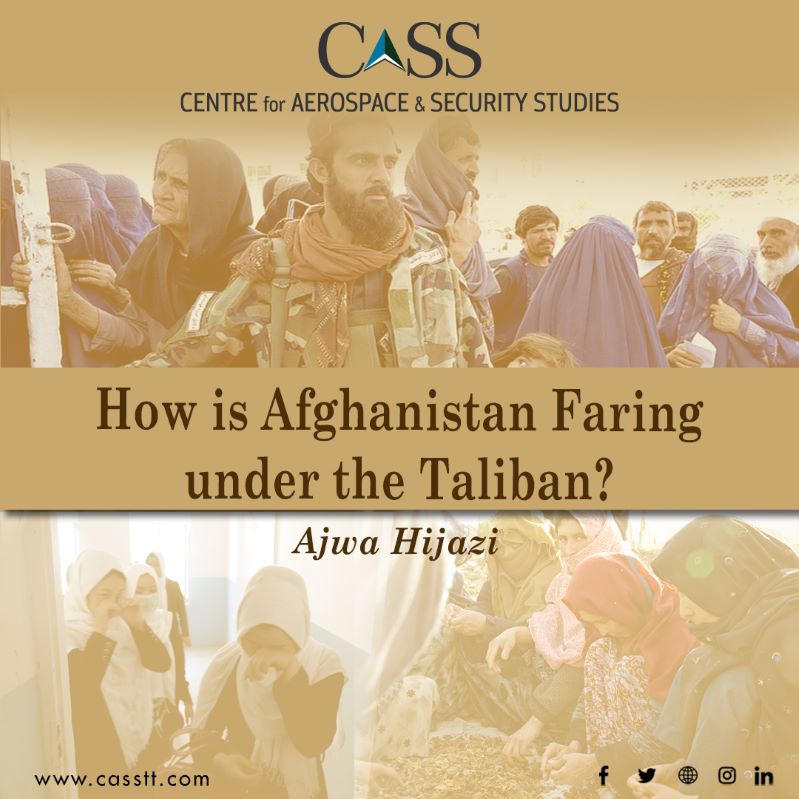
After being out of power for nearly two decades, Afghan Taliban have been in the country’s driving seat since August 2021 following complete US troops’ withdrawal from Afghanistan. Taliban, at first, assured the world that they would adopt inclusive governance, give right of education to girls, and freedom of media, along with the promise of not letting their soil be used against any other state. This provided the world with the view that the 2021 Afghan Taliban were different from the regressive Taliban of the 1990s and early 2000s. However, Taliban rule turned into the opposite of the moderate version they initially showed.
Today, an appraisal of Afghanistan’s current situation shows that the country’s state of affairs under the Taliban has deteriorated, whether in terms of humanitarian needs, socioeconomic stability, women’s rights, or physical security.
According to World Food Program (WFP), 20 million people would become acutely food insecure from November 2022 to March 2023. In the midst of this, the risk of disaster, in the form of flash floods, cold weather, and famine is likely to create a severe humanitarian crisis which was on the horizon even before the Taliban took office. However, halting the free flow of global aid under the Taliban has worsened the crisis manifold. Subsequently, whatever relief operations by various international agencies were underway have been impacted by the Taliban’s ban on local female aid workers. A concerted effort is required to address the structural drivers of the humanitarian crises as it does not seem that the Taliban will be able to alleviate those alone.
Meanwhile, The World Bank has given a somewhat optimistic economic round-up for the first nine months of 2022. The report has highlighted high revenue collection, a stable exchange rate, an acceleration in exports, and reduction in the rate of inflation. While this report has obviously been welcomed by the Taliban, the real question is sustainability. According to the economist William Byrd, this window of stability is due to the flow of scattered humanitarian aid. Along with stressing the need to go door-to-door using household surveys for obtaining more grassroots-based input, he has argued that, for Afghanistan, there is no substitute for sustained economic growth driven by the private sector. This reflects the necessity of a long-term economic vision, translating into efficient national development, which the Taliban lack right now.
The suppression of women’s rights and clamp down on freedom of media expression has been the hallmark of the current Afghan regime. Deviating from their earlier commitments to ensure inclusivity for women, the Taliban have restricted women from gaining education, working with NGOs, accessing public health etc. Their marginalisation has also had a negative impact on the national economy. Besides, intolerance towards dissent has been instrumental in forcing many journalists to opt for self-exile in Pakistan in order to protect their life and careers.
On the security front, the Taliban have been unable to rein in the IS-K, regardless of the counter-military raids against them. Growing space for Islamic State Khorasan (IS-K), Tehreek-e-Taliban Pakistan (TTP), and other non-state actors in Afghanistan, apart from endangering the lives of Afghanis, can impact the country’s relations with neighbouring China and Pakistan. The latter remains concerned that Afghan Taliban have not extended the required assistance to contain TTP activities. While on the other hand, China has demanded ‘resolute action’, especially against the East Turkmenistan Movement. It shows that the Taliban are struggling to mitigate the spill-over effect of their internal security lapses on neighbouring countries.
The above-mentioned turbulent dynamics are characterised by the presence of an ‘interim’ government that is non-inclusive in nature. The Taliban did not let other political and ethnic groups become part of the government. Amidst efforts to maintain a united posture, the process of decision-making in the government is becoming more centralised. The top tier of leadership is exclusionary to an extent that, even input from fellow moderate Taliban, Muslim countries, and religious scholars, is turned down. The international community is constantly raising questions about such non-inclusive governance which is a deflection from the Doha commitments. Their non-compliance is derived from the assertive manner in which they assumed government after the fall of Kabul. It emboldened them to not care about international recognition and go ahead with the trajectory of governance, characterised by absolute centralisation of power.
The people of Afghanistan have been under decades of instability owing to various turbulent dynamics, be it foreign invasions or the civil war. Their quest for stability is still intact under the current regime. In light of prevailing domestic issues, the Taliban need to adopt comprehensive inclusivity and flexibility in their mode of governance. Additionally, the world community cannot remain oblivious to its responsibility towards the common Afghans. Afghanistan deserves durable prosperity which depends on multilateral efforts of constant engagements to ensure that human rights and the socioeconomic needs of the people are being met by the de-facto rulers.
Ajwa Hijazi is a Research Assistant at the Centre for Aerospace & Security Studies (CASS), Islamabad, Pakistan. She can be reached at [email protected]