
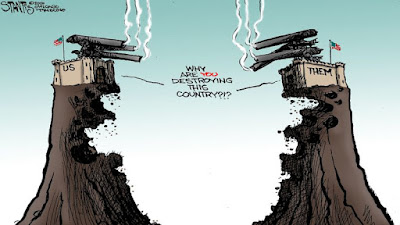
Political polarisation is not something new. All states around the globe practicing any form of government have had to deal with this phenomenon with varied degree of severity. Its undesired consequences (from varied examples) include societal division, communal anger, formation of hostile camps, violence against opposing groups, military coups, institutional delegitimisation, and erosion of democratic ethos. These make political polarisation a threat to the national, political, and social fabric of a country. This article is an attempt to examine the concept of political polarisation and its consequences in the context of diverse societies, like Pakistan.
‘Severe’ or ‘pernicious’ polarisation has been defined by Jennifer McCoy and Murat Somer as ‘a process whereby the normal multiplicity of differences in the society increasingly align[s] along a single dimension, cross-cutting differences become reinforcing, and people increasingly perceive and describe politics and society in terms of ‘us’ versus ‘them’’
According to McCoy and Somer, ‘pernicious polarisation’ has become a tool in the hands of political entrepreneurs to pursue their political interests and power game driven by declared perceived morals than actual values and morality. Such actors portray themselves and their opponents in highly contrasting terms of ‘good’ and ‘evil’. They use blame game tactics and push their opponents to the wall by holding them responsible for all the ills in society. This infusion of good and evil, moral and immoral, honest and corrupt activates ‘ethnocentrism’ in the population, according to Marc Hooghe – the belief that one’s own political ideology is superior to other existing ideologies and that one’s political ideology/strategy is the solution to all evils. This rising tendency can impact the social fabric and exacerbate social isolation and enmity amongst people with divergent political views.
Pakistan’s political history is replete with examples where political polarisation was used to achieve vested political results or to retain power. This has been evident since pre-partition when the anti-Pakistan Muslim polity labelled the idea of separate country with denigrating labels like ‘Paldistan’ and ‘Kafiristan’. Even the Founder of the Nation Quaid-i-Azam was belittled by them as ‘Kafir-e-Azam’. In the same vein, Mohtarma Fatima Ali Jinnah was drawn into controversies and labeled as a traitor during her election campaign in 1965. Unfortunately, such politically motivated controversies and blame games have dominated the country’s polity over decades. Even today, Pakistan’s political ethos has not improved, and the country is still vulnerable to controversies and conspiracies leading to political chaos.
A more current example is the ongoing party-political turmoil in the country in which various political parties are actively employing all kinds of polarisation tactics and engaged in disputes about who is a ‘patriot’ and who is a ‘traitor’. Such conduct of political leadership poses serious threats to the security and stability of the country and is inimical to the long-term national interests of the state.
This growing polarisation in our society calls for an effective ‘depolarisation mechanism’ based on four basic pillars, i.e., strengthening legal institutions, empowering the judiciary, independent election administration, and ensuring more civil participation in political affairs of the country. Other than this, there is need to deliberate and understand at the national level what has gone wrong over the past few years that has been slowly eating away at the political and social fabric of our society. Every political chaos leads to economic crises, and ultimately, it is the citizens of the land who suffer; thus, compromising the human security. Hence, for the same of the citizenry, there is a dire need of broader political and institutional reforms that will help overcome the current turmoil and crisis. This will help promote a more pluralistic democracy and restore the trust of people in the democratic process and institutes of the state.
Lastly, a political crisis of this nature calls for political acumen and a sense of responsibility from our political elites to minimise the negative effects of polarisation on society. At this point, the situation necessitates that both the ruling and the opposition parties should dispel antagonism towards each other in favour of collective national interests and join hands to detoxify and stabilise Pakistan.
Amna Tauhidi is a Researcher at the Centre for Aerospace & Security Studies (CASS), Islamabad, Pakistan. The article was first published in The News International. She can be reached at [email protected].



