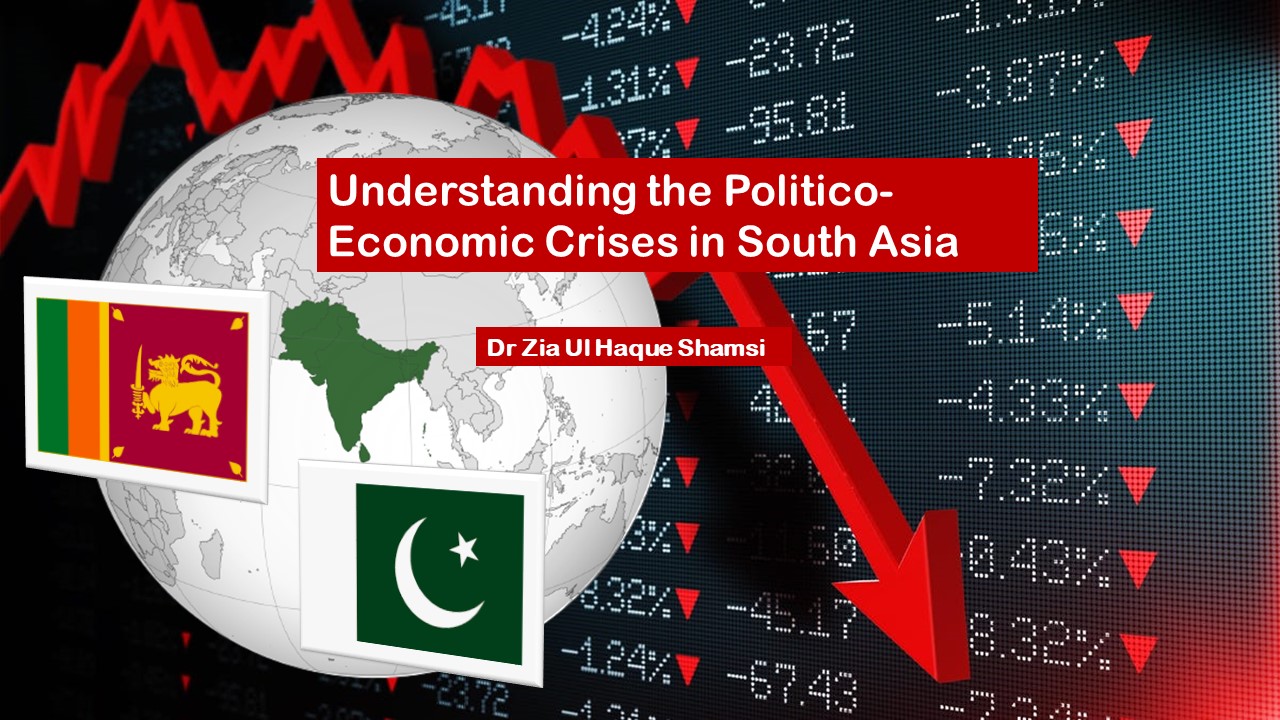
At this time, at least two South Asian states, Pakistan and Sri Lanka are facing serious political and economic crises. While comparing the difference between the two, Dr Abid Suleri has rightly concluded that the Sri Lankan economic crisis led to political turmoil in the island state, whereas a home-grown or perhaps externally-supported political crisis, has led to a serious economic crisis in Pakistan.
The Democratic Socialist Republic of Sri Lanka is a multi-religious and multi-ethnic island in the Indian Ocean. According to Human Development Report 2020, ‘Sri Lanka’s HDI value for 2019 is 0.782- which put the country in the high human development category- positioning it at 72 out of 189 countries and territories.’
Sri Lanka ranked first in South Asia due to its massive investment in human resource development, education, and health, due to which Sri Lankan workers are widely respected by host nations, particularly as paramedics. Sri Lanka has over three million-strong diaspora across the globe.
The island nation underwent some difficult times from 1983 to 2009, due to a civil war, which impeded its development and weakened its economy. However, the State showed resilience and consistency, with the support of international and regional states to crush the Tamil insurgency, and returned to peace and normalcy. However, the more recent COVID-19 pandemic had an extremely adverse impact on Sri Lanka’s economy, which was heavily reliant on tourism and foreign remittances. The country has already had a violent change in government and defaulted on its international obligations related to debt servicing etc.
On the other hand, the Islamic Republic of Pakistan, the fifth largest country with a population of over 220 million is also facing serious politico-economic crises. Pakistan’s economy has also been under stress due to the worldwide economic meltdown during the COVID-19 pandemic, even though the country is one of the few that has done exceedingly well to control the disease. Pakistan is heavily dependent on the support of international donor agencies and friendly states for its imports of petroleum products and industrial goods. Whereas, Pakistan does export a variety of items, including small industrial products, textile products, food items, and services, however, it heavily relies on foreign remittances from its nine million-strong diaspora across the globe.
A careful analysis of the current political turmoil in Sri Lanka and Pakistan clearly reflects the apathy of the ruling elite and its wrong priorities. For the same reason, the Sri Lankan crisis became violent and ruling elites were targeted and physically tortured by mobs whenever they were seen in public. A number of incidents of setting properties of ousted rulers on fire were also reported after which the President terminated the government and a new Prime Minister Ranil Wickremesinghe was appointed on 12 May 2022, after weeks of violent political unrest. The incumbent PM has appealed to international donor agencies and friendly nations for urgent financial assistance to buy essential food items and much-needed oil supplies to revive its bankrupt economy.
Whereas, in Pakistan, at the moment, the situation is not as volatile as it was in Sri Lanka, but is extremely uncertain. Pakistan is not only facing political and economic crises but also a kind of constitutional crisis. There are a number of legal proceedings at this time in the apex court as well as local high courts related to the legitimacy of the incumbent regime. The currency is in free fall and has devalued by at least Rupees 22.00 to a USD at the time of writing this article in a little under two months. The same is happening at various stock exchanges due to a lack of investor confidence. The present government in Pakistan has given up to the demand of the International Monetary Fund (IMF) and done away with the subsidy on oil, thereby increasing the prices of oil products to unprecedented levels.
To conclude this brief review of the current politico-economic crises in South Asian states, I would say that successive governments in both Sri Lanka and Pakistan have failed to formulate and execute people-friendly policies related to essential elements of human security so as to ensure the well-being of the people. Whereas Pakistan is still away from Sri Lanka-like violence, and therefore, efforts must be made to immediately resolve the ongoing constitutional and political crises, while economic recovery will understandably take longer if initiated forthwith.
Dr Zia Ul Haque Shamsi is the author of ‘Nuclear Deterrence and Conflict Management Between India and Pakistan’ (2020) and ‘South Asia Needs Hybrid Peace’ (2021). He is presently working as Director at the Centre for Aerospace & Security Studies (CASS), Islamabad, Pakistan. The article was first published in Daily Times. He can be reached at [email protected]