
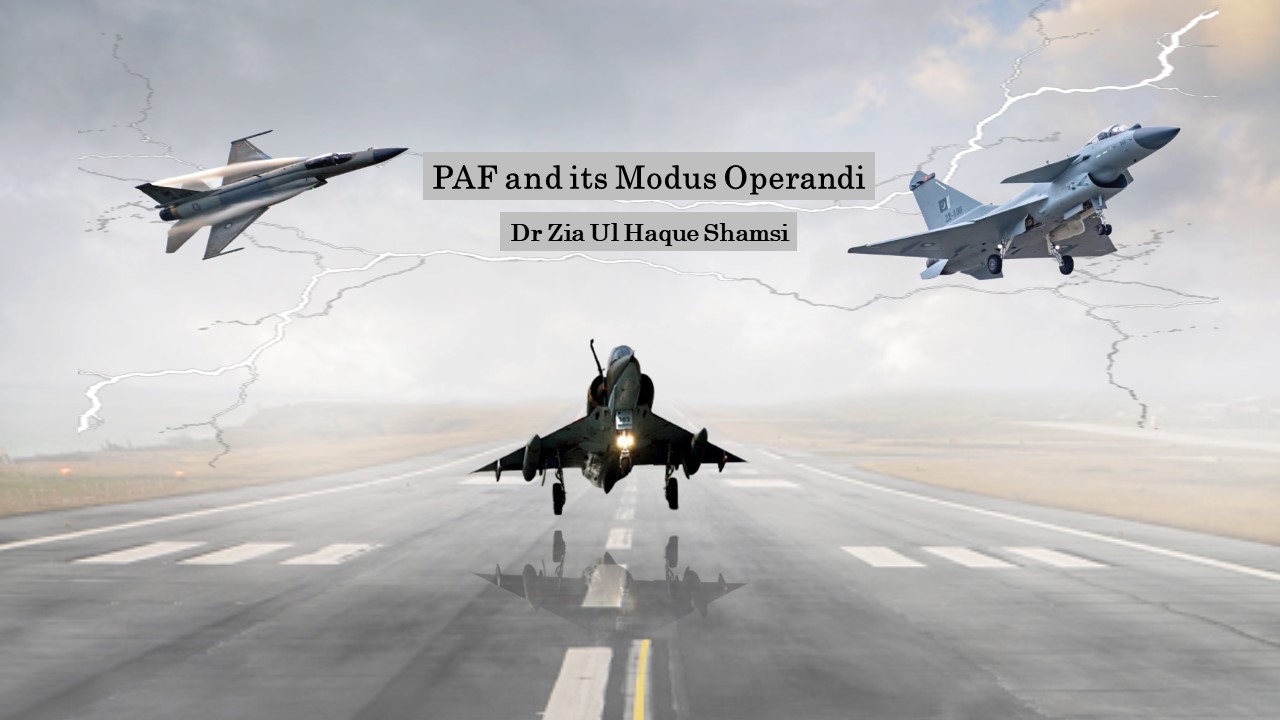
Pakistan Air Force (PAF), is the Pride of the Nation. The service believes that ‘Whether we fly, operate, maintain, or support sophisticated weapon systems, we are bonded by our common desire of serving the nation.’ It remains committed to the task assigned to it by Quaid-i-Azam Mohammad Ali Jinnah, the Father of the Nation, during his first visit to PAF Station Risalpur on 13 April 1948, during which he stated that, ‘A country without a strong Air Force is at the mercy of any aggressor. Pakistan must build up her Air Force as quickly as possible. It must be an efficient Air Force, Second to None.’
While one can write books on the contributions and achievements of the PAF since its inception, both in peace and war, this article is aimed at reviewing possible response options against the Indian Air Force (IAF)’s declaratory policy of being prepared for a short and intense war on short notice. Here, it is necessary to mention that Chief of the Air Staff, IAF, Air Chief Marshal Vivek Ram Chaudhari, while speaking at the inauguration of a national level logistics seminar of the Indian Air Force (IAF), LOGISEM VAYU-2022 in New Delhi on 28 April 2022, has stated that ‘IAF [should] to be prepared to operate over a wide spectrum of conflict, ranging from short duration intense conventional warfare to long-drawn strategic standoffs which may or may not culminate in actual hostilities.’ Evidently, CAS, IAF has laid great emphasis on two aspects: remain prepared for intense conflicts of short duration, and long drawn-out stand-offs.
Well, it is for the IAF to decide what they want to do, however, this statement at this time when Pakistan is going through a period of relative political uncertainty cannot be ignored. PAF has its own modus operandi to evaluate and be prepared for this kind of categorical statement by its known adversary. Historically, PAF’s response to IAF’s threats or verbal onslaughts, have been sober, measured, and in line with the state’s policy and people’s expectations. I am confident that this time as well it would be on the same lines.
PAF, like always, would not get intimidated and perhaps not even respond to CAS, IAF statement. However, it would certainly consider each and every part of his statement, and be prepared to respond in case of any eventuality.
The institutional memory of the IAF must be fresh from the debacle of 26 February 2019 events when it carried out an unsuccessful deep night strike in the general area of Balakot damaging a few trees only but claiming that it had destroyed a terror training camp killing over 350 terrorists. However, PAF’s surprise response came in broad daylight on 27 February, in which it shot down at least two IAF jets, one of which fell on the Pakistani side of the Line of Control and its pilot Wing Commander Abhinandan was taken into custody but released later as a gesture of goodwill. With this background, I do not expect that the new IAF Chief, who took over the command on 30 September 2021, will test PAF’s resolve yet again and that too so soon, but India’s fascist regime of Prime Minister Modi may force him to venture into another misadventure. This is primarily because PM Modi had publicly stated that if Rafael had come to IAF before February 2019, the result would have been different.
The most probable response of the PAF to IAF’s possible misadventure would again be proportional because the state policy remains unchanged. Pakistan does not want war with any of its neighbouring countries, therefore, it is highly probable that PAF would put up corresponding response to IAF’s isolated strikes. However, if IAF launches multiple strikes, even within a confined zone of operations, as per its recent declaration of being prepared for a short and intense war, then PAF would not hesitate to expand the conflict and respond at the time and place of its choosing. PAF’s response would be multi-layered, multi-domain, and highly disruptive. PAF would aim to cause heavy attrition on to IAF’s offensive strikes by creating regional imbalances that IAF leadership would not be able to cope with its planned short war of one week.
Historically, PAF has relied on everything but the quantity of combat aircraft. PAF relies on the concept of ‘Jihad’, the quality of its equipment, training of its personnel, and in its capacity to cope with adversity. Moreover, PAF has had leaders with vision and wisdom to read and respond to enemy designs. Its vibrant leadership has never failed in fulfilling Quaid’s direction of being Second to None, and peoples’ expectations to successfully guard the aerial frontiers of Pakistan.
Dr Zia Ul Haque Shamsi is the author of ‘Nuclear Deterrence and Conflict Management Between India and Pakistan’ (2020) and ‘South Asia Needs Hybrid Peace’ (2021). He is presently working as Director at the Centre for Aerospace & Security Studies (CASS), Islamabad, Pakistan. The article was first published in Daily Times. He can be reached at [email protected].



