
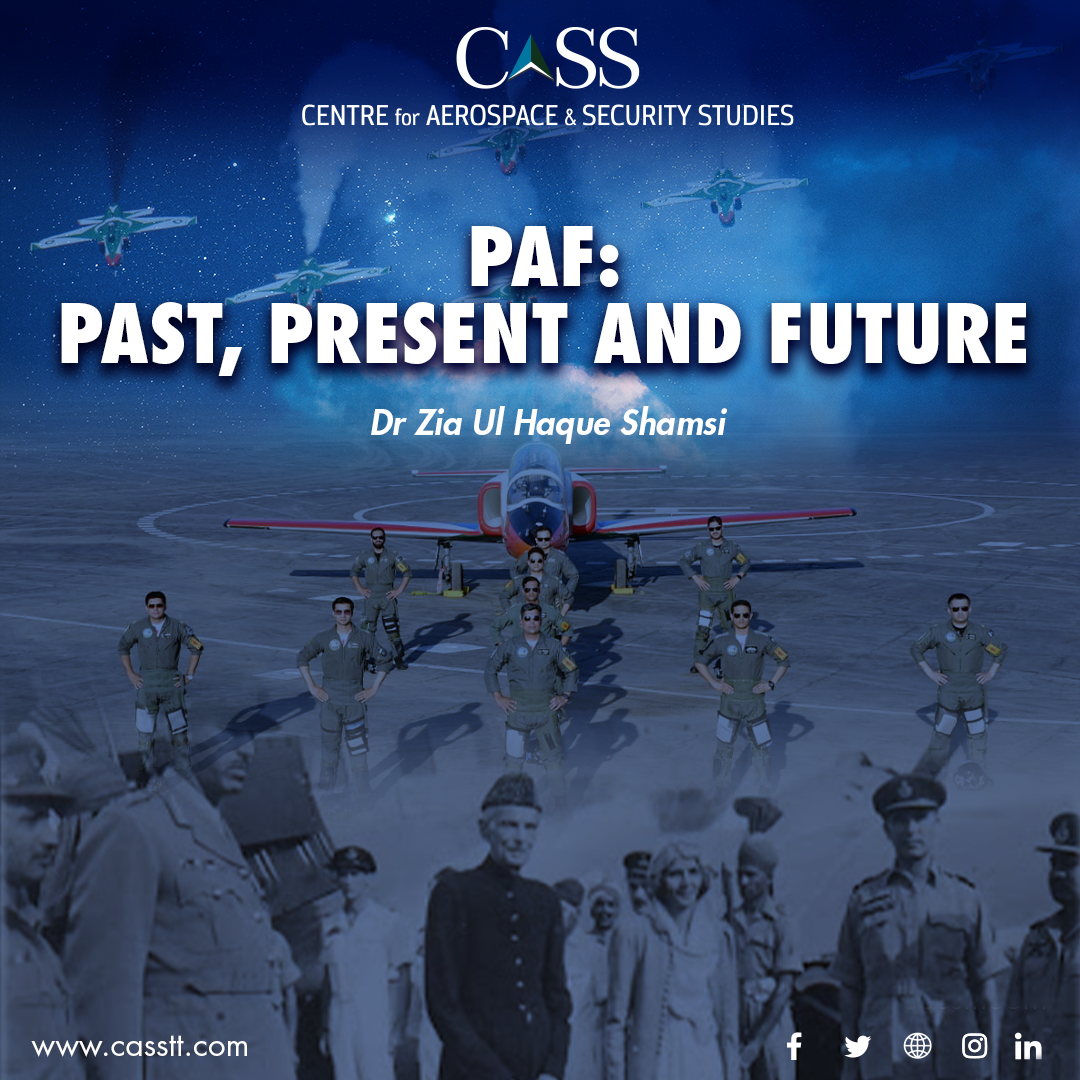
Within one year of Pakistan’s emergence as the largest Islamic state in the world; its founder, Quaid-i-Azam Mohammad Ali Jinnah defined a vision for the formation and development of the Pakistan Air Force. On April 13, 1948, while visiting the pilots’ training centre at PAF Station Risalpur, the Quaid asserted, “A country without a strong Air Force is at the mercy of any aggressor. Pakistan must build up her Air Force as quickly as possible. It must be an efficient Air Force, Second To None.” PAF has followed Quaid’s dictum in letter and spirit and maintains a high standard of professionalism, and discipline to prove itself as second to none.
The utmost operational preparedness remains a priority for the PAF, its leadership has had the ability to visualize the impending conflict right from the beginning. PAF anticipated the 1965 war with India at least six months earlier, and hence was fully prepared for it, when it finally broke out on the 6th of September, 1965. In fact, the PAF’s preparation had started in April 1965, when the Rann of Kutch conflict with India was unfolding in the southern extremities of Pakistan. However, PAF did not initiate any offensive manoeuvre and remained prepared to respond in case IAF appeared in the skies to support its land forces.
Air Marshal Asghar Khan, the first Pakistani to lead PAF, handed over the command to Air Marshal Noor Khan on July 23, 1965. However, this change of command just before an impending conflict did not have any adverse impact on PAF’s ongoing preparation, because the incumbent aggressively pursued the defined course of action, and personally supervised the operational preparedness.
The IAF, at the beginning of the first all-out war between India and Pakistan, had a numerical superiority of 3.8:1 over the PAF, however, the latter’s offensive and attacking strategy paralysed the much larger adversary right at the onset of air operations. PAF, in spite of numerical superiority, was able to overwhelm IAF, and the same has been successfully maintained over so many decades, and therefore, IAF has not been able to create any impression on the PAF during its enduring rivalry.
The 1965 war was the first ever all-out war that PAF was fighting against IAF. Therefore, its leadership concentrated on achieving surprise and adopted an air strategy of ‘offensive defence.’ Perhaps, IAF leadership did not expect that a small-sized air force would take that risk against a much bigger adversary.
PAF’s initiative proved to be a game changer and its support to the Pakistan Army in the battles of Chawinda and Chamb caused unbearable losses to India’s armoured formations. PAF’s heroics were acknowledged by the national leadership and the nation ever since.
PAF’s outright victory in the 1965 war, forced IAF to invest heavily in its fleet, however, PAF could not match the numbers due to its limited resources. Therefore, PAF decided to concentrate on acquiring quality equipment and developing critical infrastructure and operative systems. Moreover, PAF maintained its focus on training and utmost operational preparedness for any eventuality. Be it the fight against terror hideouts in the home-grown Swat operations, or the occasional faceoff with the Soviet Air Force during the Afghan War, the PAF operations always proved to be the game changer due to their professionalism, and responsiveness.
PAF’s hallmark has been its measured response to IAF’s gambits in the subsequent decades as well, primarily to ensure that the conflict does not expand horizontally or vertically and that the escalation ladder is not overstepped. The case in point is IAF’s misadventure on the night of 25-26 February 2019, when it violated Pakistan’s airspace and destroyed a few trees in past midnight airstrikes assuming that PAF would ignore its actions for the lack of capacity and the fear of escalation.
However, like always, IAF misjudged PAF’s resolved of ensuring territorial integrity and sovereignty of Pakistan and proved its professionalism by off-targeting enemy positions of critical importance because the purpose was not their destruction but to let the enemy know that next time these bombs will be directed on the target itself. Concurrently, it shot down two IAF fighter jets that were scrambled against broad daylight strikes by PAF that were launched staying well inside its own territory.
PAF, in spite of limited resources, is making an effort to indigenously develop modern techniques to fill the technological gap with the arch-rival, IAF, which has been collaborating with its western allies in the garb of preparing against China’s rising power. PAF continues its efforts and remains prepared through training, knowledge, and dedicated teamwork. The objective remains abundantly clear: actively defend the aerial frontiers of Pakistan to prove that PAF is Second to None.
Dr Zia Ul Haque Shamsi is the author of ‘Nuclear Deterrence and Conflict Management between India and Pakistan’ and ‘South Asia Needs Hybrid Peace.’ He is presently working as Director (Peace and Conflict Studies) at the Centre for Aerospace & Security Studies (CASS), Islamabad, Pakistan. The article was first published in The Nation. He can be contacted at: [email protected]
Image Credit: Online Sources



