The 20th-century race for space dominance that was ignited during the Cold War has been given a renewed competitive push recently. Not only states but private companies are flexing their innovative muscles to make advancements into space.
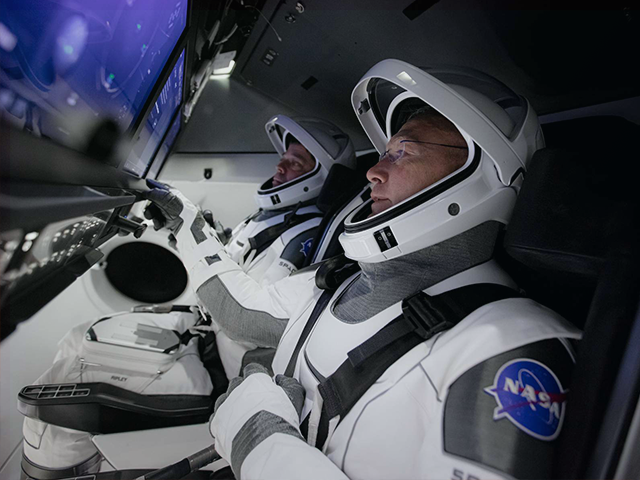
The recent SpaceX Demo-2 launch represents a new milestone for the larger U.S. space program, as the Dragon capsule, with two NASA astronauts, docked with the International Space Station (ISS).
The flawless launch of the SpaceX mission to connect to the ISS will deny Russia the status of being the only country to ferry astronauts into space at short notice. The event comes as a challenge to the Russian Space Agency, Roscosmos, which had held a monopoly in ferrying humans into space.
In 2011, the U.S. halted spaceflight missions, leaving Russia as the leader for transporting humans into space. Russia has been able to capitalize on this opportunity. Not only financially but also diplomatically. The development and possession of a large number of Soyuz spacecraft enabled it to have a firm position in the negotiations regarding the ISS. Moreover, American reliance on Russian technology also acted as a propaganda tool for Russia.
Sergei Krikalev, Roscosmos executive director for crewed space programs, congratulated Elon Musk, and his team for this milestone achievement by stating, “The success of the mission will provide us with additional opportunities that will benefit the whole international programme.”
That said, it should be kept in mind that Dmitry Rogozin, the Russian Space Chief, has previously mocked the U.S. for lacking American manned-flight systems, after the U.S. decision to impose sanctions against Russia, including certain space industries.
Rogozin quipped that the U.S. would need to employ trampolines to launch astronauts into space in the future. However, the recent SpaceX launch has marked the resumption of U.S. spaceflights.
Russia has previously been able to derive hefty revenues by ferrying astronauts into space. In the likely scenario of SpaceX taking American astronauts into space, U.S. reliance on Russia would diminish.
That said, the annual budget of Roscosmos is around $2 billion and it is bound to suffer if it is deprived of the revenue from the U.S. which constitutes around $200 million.
Russia is anticipating an emergent rival in the space industry with SpaceX becoming the first private company to launch astronauts into orbit. Moreover, SpaceX has also set a low price for ferrying astronauts into space, as compared to Roscosmos.
While a seat in the Russian Soyuz costs NASA around $80 million, Elon Musk announced that SpaceX would be charging $60 million. In addition, SpaceX Falcon 9 rockets are far cheaper than the Russian Soyuz rockets. The cost factor would serve as an incentive for other states to transition back to American suppliers.
The Russian space industry failed to take the required precaution when it was losing the launch market under the miscalculation that its monopoly would last indefinitely.
However, over time, China and now SpaceX, are displacing Roscosmos in taking astronauts into space in future launches. In addition, the Russian space sector is also marred with corruption; multiple scandals have surfaced regarding the construction of the new Vostochny launch pad in the Far East.
Furthermore, very little effort has been devoted to upgrading the Soviet technology. According to Andrei Ionin, an expert at the Tsiolkovsky Space Academy, Russia needs to establish a government body, independent of main players of the space sector akin to the National Space Council being heralded by President Trump.
Amidst all this, the significance of private companies in the space sector has been brought forth. The states who are striving for robust space programs should encourage and facilitate private entities which can later serve them in augmenting their national space capabilities.
Boeing, another private company, is also aiming to have its own launch facility and expecting to fly its Starliner capsule with a NASA crew on board in 2021. In the future, the horizon of the activities of private companies can be extended beyond satellite launches, with the prospects of sending private astronauts into space, deployment of private space stations, and private extra-territorial missions.
In the future, a more intense race in space would be observed by roping in private companies. Russia has been quite wary of the privatization of space, yet the recent events are the illustration of the potentials of collaborating with the private sector.
The SpaceX Demo-2 mission might serve as a crucial leap for NASA but for Roscosmos it is a stern warning to revamp its space capabilities and expedite its efforts in the respective sector.
Shaza Arif is research associate at Centre for Aerospace and Security Studies (CASS). This article was first published in International Policy Digest https://intpolicydigest.org/blog/spacex-demo-2-launch-implications-for-roscosmos/. She can be reached at [email protected]