Military diplomacy may be understood as a set of peaceful military activities and employment of resources and capabilities to promote national interests. It helps in building strong ties with regional and friendly countries and comprises joint military exercises and high-level military dialogues.
In this regard, Pakistan-Russia military diplomacy is crucial as it has significantly helped normalise relations between the two countries. Historically, high-level military dialogues between Islamabad and Moscow essentially paved the way for rapprochement.
The civil war in Afghanistan during the 1990s, Pakistan’s recognition of the Taliban-led political system in 1996, and Russia’s support to the Northern Alliance (a rebel coalition force against Taliban), in Afghanistan were the major irritants between Pakistan and Russia.
However, the worsening instability inside Afghanistan soon forced Russia to give up its support of the Northern Alliance and start engagement with the Taliban to bring stability. Meanwhile, the US’ imposition of sanctions on Pakistan under the Pressler and Glenn Amendments in 1990 and 1998, also made Pakistan reconsider its regional alignments.
In order to stop continued downslide in relations, Moscow sought Islamabad’s help in 2000 for establishing its contacts with the Taliban. Moreover, the latter also sent a military delegation to Moscow in September 2000 to ally Kremlin’s worries about Islamabad’s relationship with the Taliban. Mutual trust further improved following establishment of the Pakistan-Russia Joint Working Groups to facilitate counterterrorism efforts and a Consultative Group for Strategic Stability in 2001 and 2003, respectively.
Consequently, such engagements led General Musharraf’s official visit to Russia in February 2003 when he was President of Pakistan to seek an independent role in Russian foreign policy. Similarly, official visits by Col. Gen. Aleksandr Postnikov, then-Commander-in-Chief Russian Ground Forces to Islamabad in 2011; visits by former Air Chief Marshal Tahir Rafiq Butt in August 2012, and by the former Chief of Army Staff General Ashfaq Parvez Kayani in October 2012, to Moscow, respectively, further strengthened defence cooperation.
This also helped initiate the first Strategic Bilateral Dialogue in 2013. Pakistan’s former Foreign Secretary, Ambassador Jalil Abbas Jilani (currently Advisor Foreign Policy at CASS), who had led the Pakistani delegation is of the view that the dialogue was significant for several reasons. First, Moscow had great receptivity for Pakistan. Second, it led to developing convergencies on numerous regional issues.
The Dialogue also opened possibilities for weapons procurement, military exercises, and training in military institutes between the two countries. In 2014, Russia lifted its embargo on arms supplies to Pakistan to facilitate weapons acquisition. Islamabad and Moscow also signed a landmark defence cooperation agreement that same year. Consequently, Pakistan confirmed procurement of four Mi-35M attack helicopters from Russia in 2017, in a USD 153 million deal that was signed in 2015. It was Pakistan’s first-ever weapons purchase from Russia.
Moreover, they signed an unprecedented contract in 2018, allowing troops from Pakistan to receive training at Russian military institutes. The agreement was signed during the inaugural meeting of the Russia-Pakistan Joint Military Consultative Committee (JMCC). The deal came amid Islamabad’s deteriorating relations with Washington, which resulted in the halt of all military exchange programmes with Pakistan and left a void that Moscow filled.
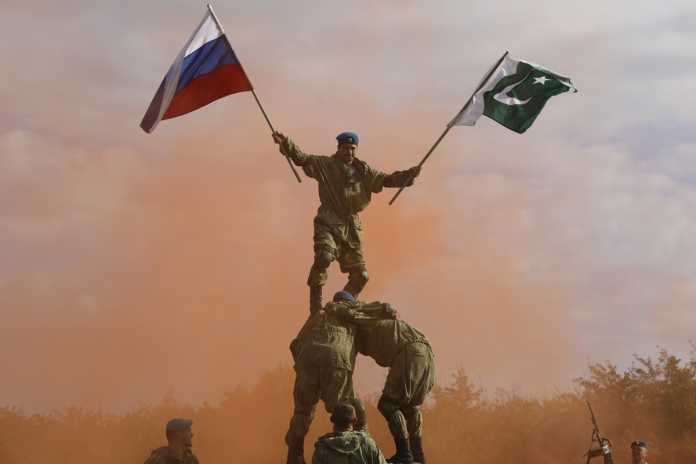
In the same vein, military diplomacy, in the form of military exercises, has also helped cement relations. Military exercises are geopolitical tools to enhance military cooperation; and are messages that complement official foreign and security policy narratives. Therefore, regular military drills are part and parcel of the larger geopolitical discourse.
Pakistan has been holding joint military drills with Russia in both bilateral and multilateral formats. These exercises include the Arab Monsoon, Kavkaz, Tsentr, AMAN, and Druzhba. Druzhba is of particular significance as an annual large-scale bilateral military exercise conducted since 2016.
The two countries conducted Druzhba-I drills in the Khyber-Pakhtunkhwa and Gilgit-Baltistan areas of Pakistan in 2016 in the face of strong opposition from India on the location of the drills and the accusation against Pakistan of being an accomplice in a terrorist attack on its forces in Indian Illegally Occupied Jammu and Kashmir (IIOJK). Notwithstanding, Russia did not postpone and chose to conduct the exercise on the decided time and locations. This position was indicative of warming ties between Russia and Pakistan.
Rapid rapprochement and improved relations has also been evident in Prime Minister Imran Khan’s February 2022 visit to Moscow – the first by a Pakistani premier in over two decades. In their Summit, the Prime Minister and Russian President Vladimir Putin exchanged views on regional issues and deepening economic cooperation, including the Pakistan Stream gas pipeline project. Pakistan termed the Summit a rare opportunity to make headway in economic cooperation.
Both Pakistan and Russia need to utilise their growing convergence of interests to put their relations on the trajectory of a strategic partnership. Currently, the Pak-Russo redux is in its infancy. However, one may argue that now, the road from Islamabad to Moscow is no longer via New Delhi, as was once thought.
Moiz Khan is a researcher at the Centre for Aerospace & Security Studies (CASS), Islamabad, Pakistan. The article was first published in Pakistan Observer. He can be reached at [email protected]
Image Source: “Druzhba-2021, Pakistan-Russia Joint Military Exercise Begins in Krasnodar Region”, (2021, September 29), Pakistan Observer, https://pakobserver.net/druzhba-2021-pakistan-russia-joint-military-exercise-begins-in-krasnodar-region/ .