
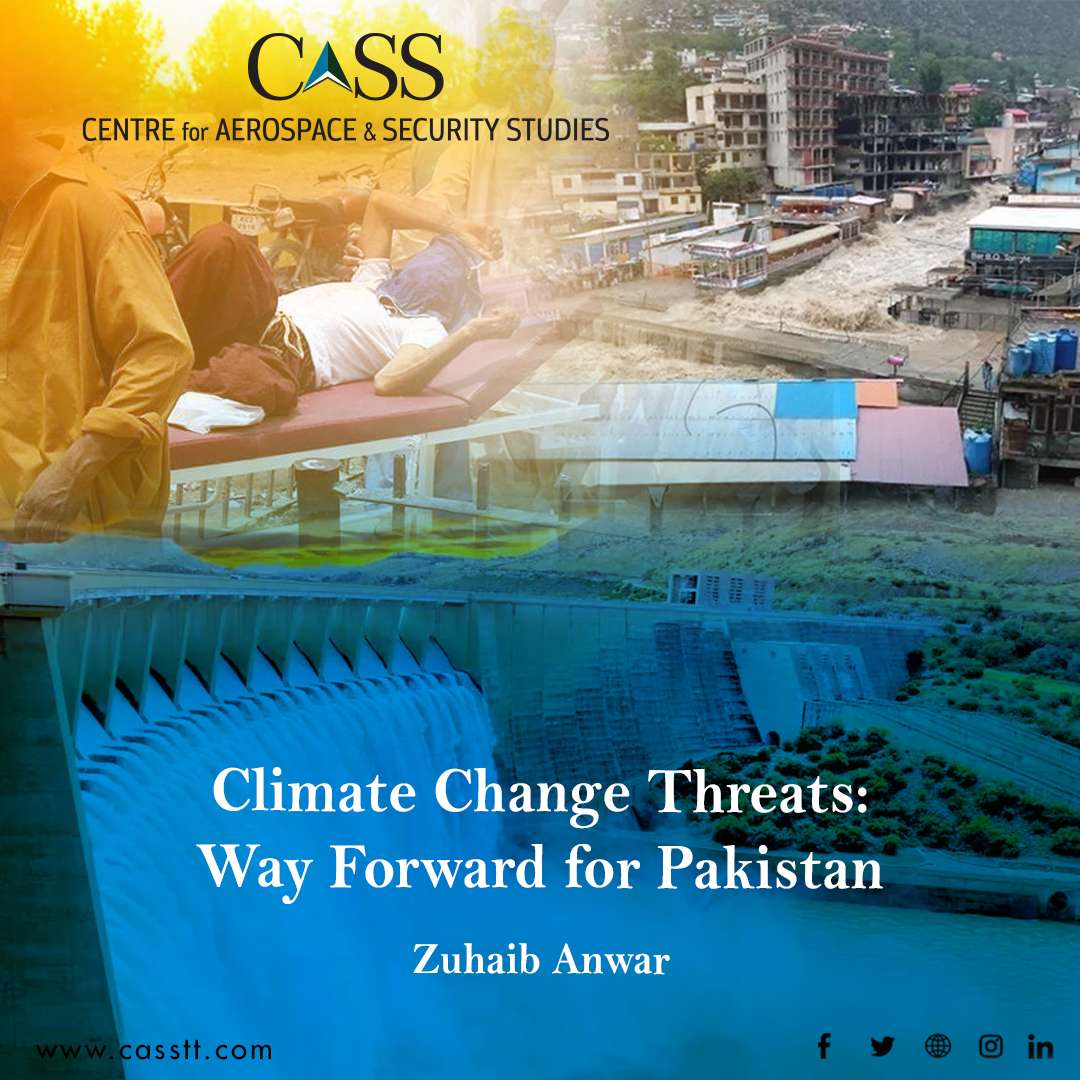
From the arrival of early summers to record monsoon downpours, i.e., 87 percent heavier than the average monsoon rainfall and the ensuing floods; this year Pakistan has witnessed unprecedented erratic climatic conditions. The recent floods have affected the landscape of the country submerging large swaths of land, destroying properties and infrastructure and killing more than 15,000 people. Overall, 116 districts have been affected and 66 of these have been officially declared as calamity hit. According to the National Disaster Management Authority (NDMA), more than 33 million people have been affected by the deluge. In financial terms, the damage is more than USD 30 billion. In addition to the loss of life and infrastructure, Pakistan’s agro-based economy has taken a significant hit. This year, due to climate change, the agricultural yield was first damaged by intense heat waves of the early summers and then, the remaining destruction came from the unparalleled floods. The major cause of these devastating ecological disasters is climate change.
According to the Global Climate Risk Index, Pakistan is among the top ten countries that are worst affected by climate change, although being amongst one of the lowest carbon emitters globally.
Climate change is considered a threat to humanity, yet global consensus on mitigating its impact has not been achieved. The United Nations Climate Change Conference (COP26) held in November 2021 was an effort to bring the world community together to agree on a comprehensive and balanced future plan to deal with climate change and resolve differences related to the Kyoto Protocol, Paris Agreement and the United Nations Framework Convention on Climate Change (UNFCCC). However, there has been a distinct lack of seriousness on the part of developed nations to honour their commitment of reducing Greenhouse Gas (GHG) emissions and providing the promised funds to the affected countries. This became evident from the fact that the commitment made by the developed countries in 2009 to provide USD 100 billion a year by 2020 has been extended to 2025.
The fate of international efforts to achieve GHG reduction targets and fulfilment of monetary commitments remains elusive. Therefore, affected countries must themselves chalk out their respective national strategies to deal with the impact of climate change. Globally, mitigation and adaptation are considered the viable strategies for dealing with climate change. Mitigation and recourse strategies are applicable for the countries and regions that are contributing large GHG emissions, like United States (US), India, China and the European Union (EU), which cumulatively contribute nearly 60% of the global GHG emissions. Unfortunately, the effects of these GHG emissions does not remain restricted to the countries of origin but extends beyond national borders and are felt globally. However, the immediate neighbours of GHG emitting countries are more prone to the adverse impact. For example, Indian farmers burning the residue of their crops at mass level, create excessive smog in Eastern parts of Pakistan causing severe respiratory, other health and administrative issues for people exposed to it.
The countries affected by climate change (which are not the direct contributors) should practice adaptation and remedial strategies. Pakistan should also focus on a cohesive and comprehensive adaptation policy. With the support of the UN Environment Programme (UNEP) and the Green Climate Fund last year, the government officially began the process of creating a National Adaptation Plan (NAP). NAP was established under the Cancun Adaptation Framework (CAF) with the objective to reduce vulnerabilities and climate impacts by creating comprehensive medium and long-term plans, and integrating adaptation measures into national policy. NAP can suggest both short- and long-term plans of action.
Through NAP, Pakistan can identify vulnerabilities and outline solutions that can help reduce climate change impact. For this purpose, the Federal and Provincial governments, and NGOs working in this domain, should work together to identify areas vulnerable to climate change at the local and national levels. While the plan should focus on adopting sustainable growth models, it should also focus on developing an emergency response strategy for climatic catastrophes such as heat waves, floods etc. The NDMA, PDMAs and other emergency response institutions should be adequately equipped and trained to respond to such situations. They should maintain a sufficient stockpile of food, shelter, medical and other supplies, and set in place a mechanism to continue the supply of goods during emergencies.
In the longer run, the new adaptation plan should build upon the existing national mechanisms to increase climate resilience. Pakistan has been considering ‘ecosystem-based adaptation’ and nature-based solutions. The Ecosystem Restoration Fund, the Ten Billion Trees Tsunami Program, and the Recharge Pakistan initiatives are a few examples of the nature-based strategies, being employed by Pakistan. The plan also needs to highlight the importance of construction of water reservoirs, which is important for Pakistan. The government should strive to create political consensus regarding the need for building new dams. Here, a national debate can be helpful, where water and environmental experts are invited to create awareness amongst the general public and political leadership to address their apprehensions.
Pakistan is already a water stressed country, and by 2025, it will become a water scarce one. Currently, Pakistan has 30-days water storage capacity against a desirable capacity of at least 120 days. By construction of new dams, the country can store ample water during the rainy season to cater for its needs during dry months season, thereby managing flood waters.
Severe heat waves, glacier outbursts, record monsoon rains followed by massive floods are a wake-up call for Pakistan, and the world at large. These events will likely increase in frequency and severity with each passing year. Pakistan needs to develop a robust adaptation plan with comprehensive policies and solutions to deal with the impact of changing weather patterns. Climate change has become an existential threat, therefore, we need to act before it is too late. Our response has to be quick, robust and comprehensive, only then can we reduce the adverse impact of climate change.
Zuhaib Anwar is a Researcher at the Centre for Aerospace & Security Studies (CASS), Islamabad, Pakistan. The article was first published on Scientia Pakistan. He can be reached at [email protected].
Image Credit: Online Sources



