Security, under the changed paradigm, embraces all aspects of individual, group, societal, and state affairs, including physical, territorial, economic, food, energy, and environmental. Though security often remains a contested concept, it needs clarity for its realisation at all levels because it is inextricably linked with domestic politics. The security of the state is dependent on domestic politics for its political independence, developmental strategy, economic prosperity, and human resource development.
The security dilemma of developing nations due to their political elite’s dishonest domestic politics often leaves the state and its people at the mercy of regional aggressors, because such states remain politically submissive, militarily weak, economically dependent, technologically backward, and diplomatically isolated. Bismarck’s golden words that ‘politics is the art of the possible’ are often utilised by the political elite in domestic politics to achieve self-centred objectives. Domestic politics overrides all policy decisions including those related to national security, particularly in developing countries and therefore, at times, these states end up compromising their sovereignty and political independence.
South Asia is unique in its domestic political sphere where we have an enduring rivalry between India and Pakistan fanned through domestic politics. In both states, the political elite of the two estranged neighbors projects each other as the ‘enemy’.
Let us first take Pakistan. For one, the country’s political elite see security through the lens of military security only and do not understand the transformed concept of the subject. Therefore, they do not take responsibility for other important dimensions of human security. Second, to make politics an art of possibility, Pakistan’s political elite do not hesitate in putting state security at risk for self-centred political agendas. Even in matters related to national security (including strategic matters), domestic politics plays a central role in political decision-making; and public institutions are left spineless and rudderless without the political elite being held accountable for their wrong-doings. However, the most unfortunate part of such reckless domestic politics has been that it has adversely affected the well-being of the people who elect them to power again and again.
Political parties, especially in India, use venomous slogans and media campaigns to win elections and then cannot go back on their stated stances to resolve regional disputes through dialogue or peaceful means. Successive governments and institutions alike, have put the state and the region at great risk through decisions under domestic political compulsions.
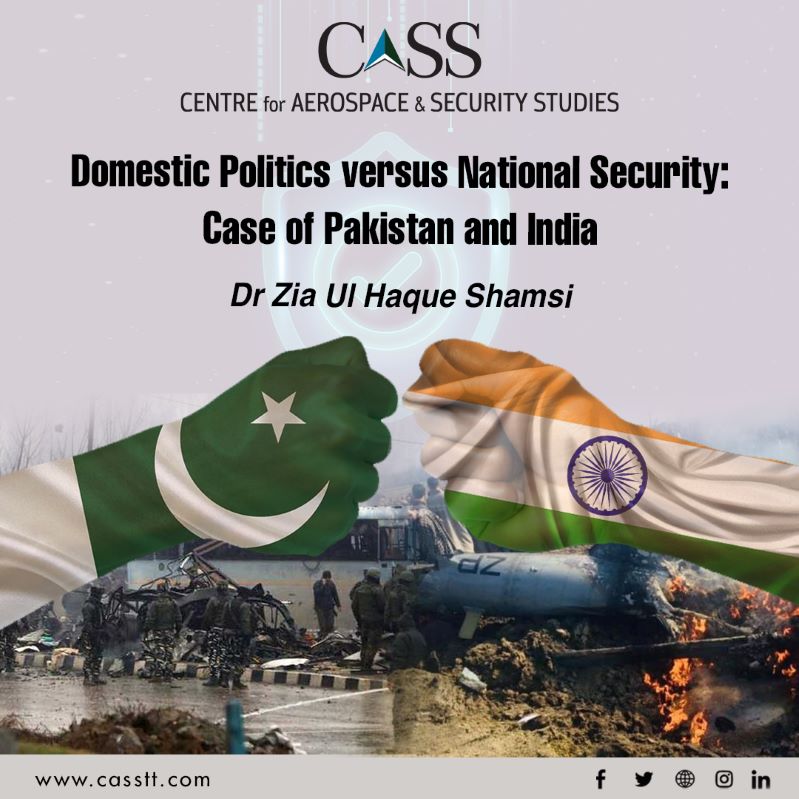
Without going too far back in the history of wars and conflicts between India and Pakistan, India’s Prime Minister Narendra Modi allegedly put regional security at risk to earn an election victory. On 14 February 2019, a Kashmiri youth carried out a suicide bombing near Pulwama in Illegally Indian Occupied Jammu and Kashmir (IIOJK), on a paramilitary convoy killing 40 Indian soldiers. India instantly blamed Pakistan without any inquiry or evidence. While rejecting India’s allegations, Pakistan counter-claimed that this was a false-flag operation by India to malign the former and gain sympathy for the purpose of elections. Pakistan’s then Prime Minister Imran Khan, sensing India’s nefarious designs, warned that if India ventured into any misadventure, the state would not think of retaliation but certainly retaliate without any delay.
However, India did not take this warning seriously and carried out dark night air strikes on 25-26 February 2019. Indian Air Force (IAF) destroyed a few trees close to the Pakistani town of Balakot but claimed to have destroyed a terrorist training camp killing some 300 terrorists, a claim New Delhi could not prove. However, Indian media gave a lot of hype to IAF strikes and PM Modi got the desired results for his electioneering across India, even after losing two fighter jets the very next day which were shot down by Pakistan Air Force (PAF) during an aerial engagement. One of the downed aircraft crashed in the Pakistani part of Kashmir and its pilot Wing Commander Abhinandan was captured. However, after the necessary documentation, Pakistan decided to return him to India primarily as a gesture of goodwill and for the want of peace and avoid escalation of the conflict between the two nuclear states. ‘Much later, it was learnt that Balakot strikes were pre-planned to take revenge for the Pulwama incident without considering the consequences of conflict escalation between the two nuclear neighbours. India’s PM Modi placed the entire region at risk of conflict escalation only to gain sympathy from his vote bank and then declared victorious in Balakot strikes, without accepting the loss of two fighter jets of the IAF, including a captured pilot.’
The above cases clearly show how domestic politics overpowers policymaking, at times at the cost of national security in developing countries, where the political elite’s corruption and ineptness have become a norm. Democratic institutions in both Pakistan and India are fragile, unassertive, and corrupt and because of this human security indices continue to decline or remain abysmally low. National and regional development continues to suffer. However, at the end of the day, power lies with the people of these nations. They must learn not to fall prey to the lies and deceit of their political leaders, and choose wisely.
Dr Zia Ul Haque Shamsi is the author of ‘Nuclear Deterrence and Conflict Management Between India and Pakistan’ and ‘South Asia Needs Hybrid Peace.’ He is presently working as Director (Peace and Conflict Studies) at the Centre for Aerospace & Security Studies (CASS), Islamabad, Pakistan. The article was first published in Daily Times. He can be contacted at: [email protected].