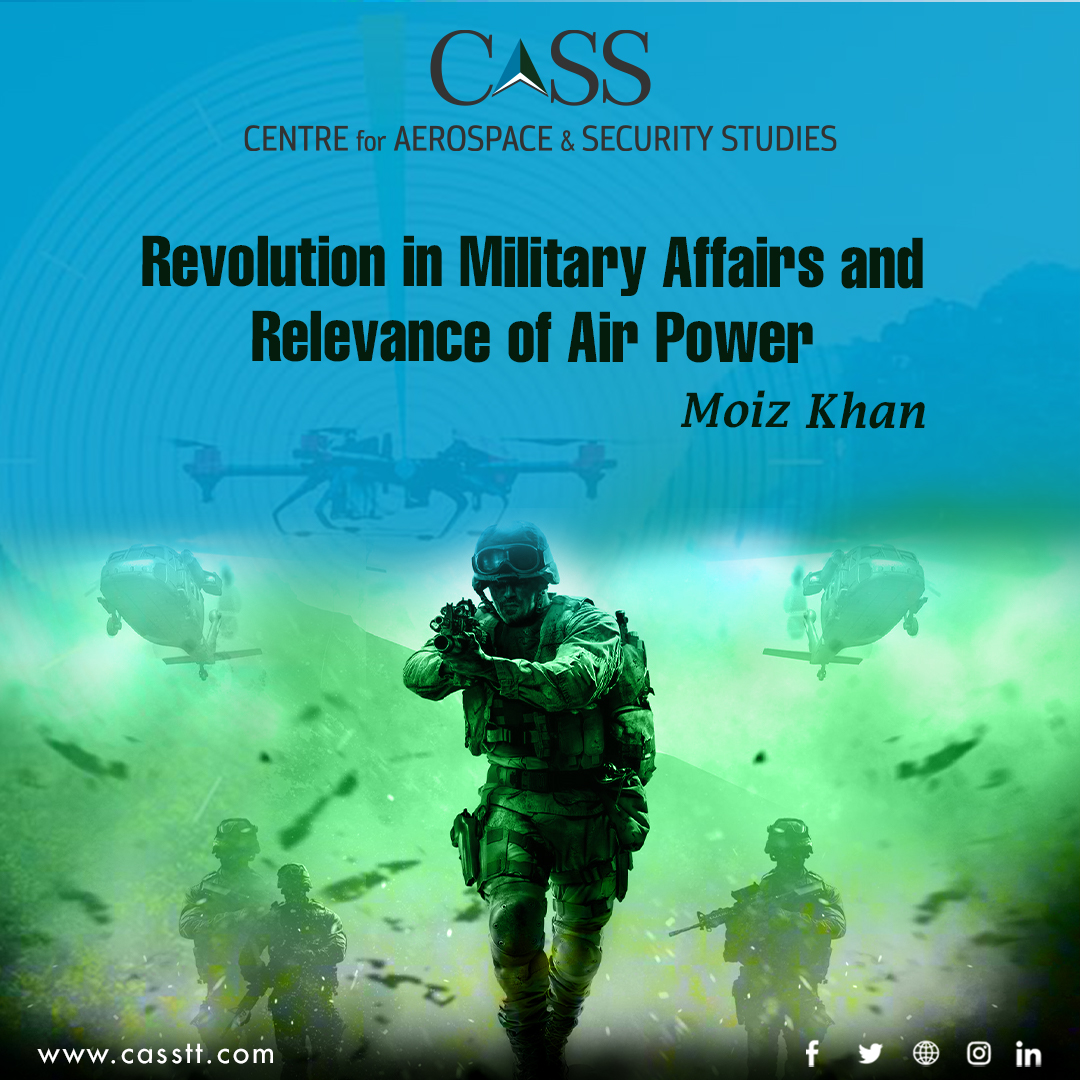
Revolution in Military Affairs (RMA), theoretically, serves as a disquisition on the connection between technological advancements and their effect on the conduct of war. More precisely, RMA accentuates the ‘discontinuous military capabilities arising out of change in technology, supportive operational framework, and related organisations.’ It implies that RMA not only alters the modalities of warfare, deterrence, and conflict resolution but also affects peace-time military competition. Over centuries, RMA has either deflated the dominance of certain elements of military power or has further enhanced its relevance.
According to Dr Andrew Krepinevich, former Director at the US Centre for Strategic and Budgetary Assessments, RMA‘occurs when the application of new technologies into a significant number of military systems combines with innovative operational concepts and organisational adaptation in a way that fundamentally alters the character and conduct of conflict.’ This implies that any new technology is not a manifestation of RMA. Besides technological advancement in weaponry, its incorporation within new doctrines and its execution by an organisation are critical requirements for RMA to happen.
Based on this qualification, scholars have divided RMA differently into various stages. For convenience, one may divide RMA into four broad overlapping and transitive phases. For example, the land, air, and sea-based combat weaponry used before and from 1914 to 1945 constituted the first phase of RMA. Irregular warfare, through insurgencies and terrorism, constituted the second phase, with its roots in ‘Maoist Revolutionary Warfare’ concepts. While the third phase appeared with the advent of nuclear weapons, and the fourth, or the contemporary, phase of RMA has been characterised by advancement in precision-guided munitions (PGMs), technological headway in C4I (command, control, communications, computers, information); intelligence, surveillance, target acquisition and reconnaissance (ISTAR); and joint operations, which continue to evolve in terms of both innovations and capabilities.
The amalgamation of these technologies is a manifestation of contemporary RMA as a genuine reconnaissance strike and fire complex able to swiftly detect and target, near or far, limited or wide range tactical and strategic assets with involvement of fewer weapons/ platforms and less destruction. The reconnaissance strike and fire complexes constitute network-centric warfare: military power derived through information advantage and networking of sensors, command and, control and firepower to allow rapid synchronisation, high-tempo operations, and increased survivability.
In this context,air power, undoubtedly, has been a major component of previous and as well as contemporary RMA. Air power involves all critical prerequisites including technological advancements, organisational setups, and evolving strategies to be termed as an RMA. In its earlier stages, air power was able to make strategists believe in high-intensity conflicts and achievement of ‘total victory’, while remarkably reducing the cost of attrition. The employment of air power during the World War I (1914-18), Italian military campaigns against Ethiopia (1935-36), and the Spanish Civil War (1936-39) had been quite experimental and small-scale; limited to support ground and naval forces. It was during World War II that air power attained prominence and a decisive role on the battlefield. Generally, the offensive and defensive role of air power, and particularly, strategic bombing (conventional civilian targets), allowed the Allied Powers to disintegrate the Third Reich. In 1945, the offensive air operation with nuclear weapons against the Japanese cities of Hiroshima and Nagasaki proved to be the deathblow that left Japan with no option but all-out surrender. During and after the Cold War, air power has been entrusted with two roles: support nuclear deterrence and effectively wage conventional wars.
Meanwhile, air power came under the direct impact of latest innovations including nuclear weapons, guided ballistic and cruise missiles, space-based assets, advanced computers, wireless communications, GPS, and PGMs. These advanced technologies led to the re-conceptualisation of air power experience to play a dominant role in ‘integrated or joint military operations,’ instead of linear, serial, or sequential operations. Air power, being a part of joint operations, constitute a textbook example of network-centric warfare, with sensors, PGMs, fire power, and C4I2SR systems. The use of these components in a network minimises vulnerability and provides information dominance over the adversary by shortening the decision-making cycle for the leadership. The Iraq wars demonstrated high-intensity conflict, shock-and-awe, changing relationship between ground and air forces, suppression of adversary defences and efficient use of PGMs. Thus, during and the after the Cold War, air power not only supported nuclear deterrence but also remained indispensable in execution of effective conventional campaigns in both regular and irregular conflicts.
In the coming years, emerging technologies, especially Artificial Intelligence, big data processing, quantum computing, and hypersonic weapons will help the network-centric RMA to attain maturity. These technologies will also influence key characteristics of air power including speed, range and elevation. Generally, emerging technologies will help in improving aircraft performance, stand-off capability, shorten the target location, acquisition and destruction loop, and C4ISR. Though these technologies are yet to attain maturity in their own right, it remains quite difficult to map unforeseen impacts on air power. However, one may still ascertain the impact of emerging technologies by analysing Unmanned Aerial Vehicles (UAVs). While being used as an ISR or combat platform, the UAVs’ undertaken role in air power remains quite similar to the traditional manned aircraft. Their applications have been increasing as UAVs provide significant pay-offs in terms of affordability and persistence. As UAVs have played a critical role in both irregular and regular conflicts, these platforms would prove to be a major instrument used for air control in the future.
Hence, one may conclude that early assertions of prominent strategists including General Giulio Douhet, Hugh Trenchard, and Billy Mitchell that the air power had fundamentally ‘changed the conduct of warfare’ stands true today. Mitchell’s words that ‘the world stands on the threshold of the aeronautical era,’ continue not only to show prescience but also indicate air power’s immense and enduring potential in warfare. Air power will continue to be a decisive factor in victory or defeat; however, triumph would be determined by how well a country applies it in ever-integrated and networked battles across air, land, sea, space and cyber domains, in advance of adversaries.
Moiz Khan is a Research Assistant at the Centre for Aerospace & Security Studies (CASS), Islamabad, Pakistan. He can be reached at [email protected]