
Artifiacial intelligence

Abstract

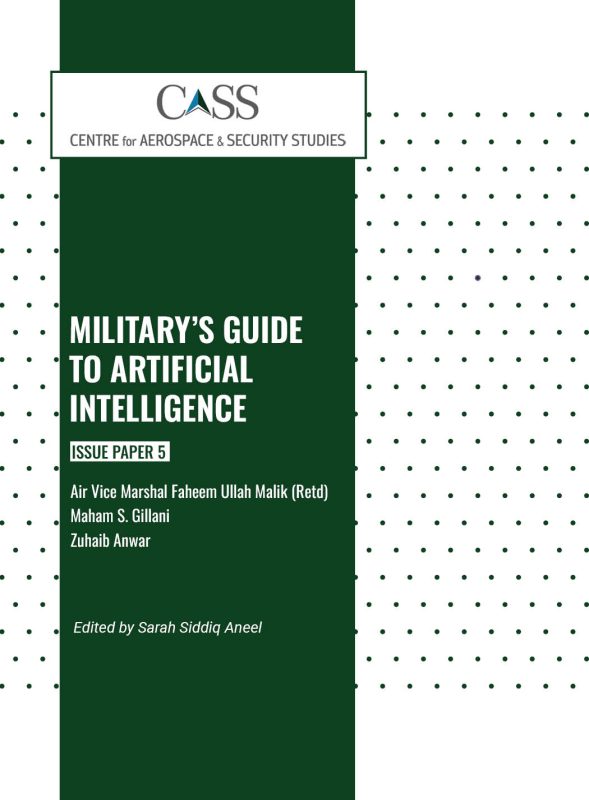
This study explores the manifold domains in which Artificial Intelligence (AI) is having profound impacts in the contemporary world. AI is penetrating virtually every aspect of human life and changing the way we travel, use smartphones, and even interact on social media. Most of the applications of AI are dual-use, implying that they may be employed in both civilian and military settings. The huge potential of AI in the military domain has sparked competition for AI dominance and data control among key players in global politics such as the United States (US) , China, Russia and Israel etc.

AI has a plethora of applications in the aerospace industry such as real-time testing, safety monitoring, predictive maintenance, stimulation, air traffic communications and other combat related aerospace programmes. In Pakistan, the government, academia, and industry are all taking several initiatives to join the AI wave in order to remain competitive in a rapidly AI-evolving world. Using secondary data, this study highlights the current state of AI in general and in Pakistan in particular, and at the end puts forth recommendations for Pakistan to bridge the AI gap it has with the leading scientific and technologically advanced nations in the civilian as well as military landscape.


Issue paper


Share this article

Facebook
Twitter
LinkedIn

Recent Publications

Browse through the list of recent publications.

The West: The History of an Idea

The world is witnessing the collapse of the Western order, if not the emergence of an alternative one. The idea of ‘West’ as against the rest is still at the root of contemporary understanding of world politics. Georgios Varouxakis, a remarkable voice on Modernity and Nationalism, has provided the historical origins and modern connotations attached with the idea of ‘West’. In his book ‘The West: The History of an Idea’, Varouxakis has argued that the West is not an eternal entity, rather it is a modern socio-political construct that emerged in the political philosophy of the early 19th century and evolved with the passage of time. The book provides an in-depth historical analysis of the idea to determine the roots of its modern interpretation.

Read More »

Space-Enabled Warfare in the 21st Century: Pathways for Developing States

Space has emerged as a distinct domain of warfare alongside land, sea, air, and cyber. Developed countries like the United States, Russia, and China possess offensive and support capabilities in space. In the shadowed expanse of Low Earth Orbit (LEO), where satellites operate like silent custodians, the 2022 Russian invasion of Ukraine transformed the nature of modern conflict. As Russian troops marched forward, the commercial satellites like Maxar and Planet, which are operated by Western firms, captured high-resolution imagery of Russian troops, providing real-time intelligence to Ukrainian commanders, unlike ever before.

Read More »

