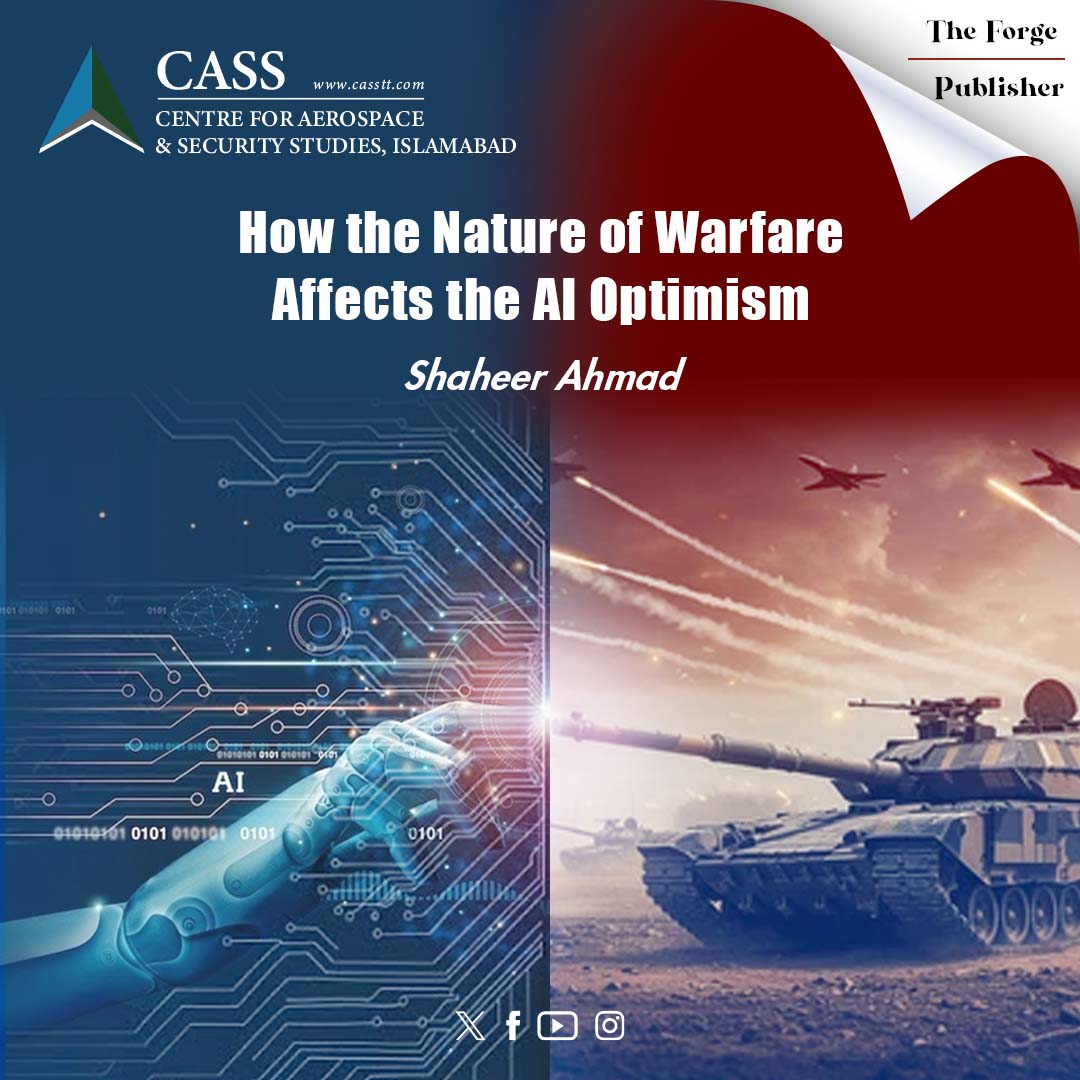
Since the advent of Artificial Intelligence (AI), a pressing question is being asked: Is Clausewitz still relevant? The game-changing potential of AI and the idea of human-machine teaming (centaur systems) have led many to doubt the seemingly unchanged nature of war. Apparently, it has given rise to the belief that AI-powered systems will replace humans (generals) in the command loop. However, this view is detached from the complex nature of warfare, which remains fundamentally a human endeavour guided by violence, chance and friction.
Just like other social institutions, war is generally an interpretivist paradigm rooted in complex human nature. It is a non-linear phenomenon whose conduct and outcomes cannot be determined by analytical predictions or algorithmic patterns. In other words, war usually does not proceed on pre-determined rules of engagement, prescriptive manuals, established patterns and predictive modelling. Instead, it is fought on judgment, adaptation to changing realities, commander’s intuition and paying attention to the unfolding of the unknown.
At the apotheosis of algorithmic dominance, it is widely assumed that AI is seemingly poised to drive humans out of the loop and alter its Clausewitzian nature. However, the optimism is otherwise. Contemporary AI relies on inductive reasoning based on drawing insights from existing data. It employs the methodology of ‘deep learning’, which learns from statistical and probabilistic inferences to draw patterns and establish causal relationships. This enhances AI’s capability in target selection and information processing at a speed inconceivable with human ability. Based on these factors, the AI optimists argue that it can facilitate swift information processing, target selection and bridging the Observe-Orient-Decide-Act (OODA) loop faster than humans.
However, war is not a bounded enterprise which can be resolved with immense computing power and datasets alone. It is generally a Zweikampf, which implies a duel between two opponents having competing political wills. Being inherently abstract and non-linear, it cannot be dealt simply with the oversimplified machine logic. Rather, it relies on abductive logic, which relies on dealing with the unknown circumstances, unintended chaos and the adaptation to sudden changes in the battlefield landscape.
While dealing with the fog of war, the role of commander is significant in interpreting and visualising the changing dynamics. Amidst fog and friction, a military leader’s competence is central to making sense of the events when the first shot is fired (which AI cannot do). Especially the commanders operating in GPS-denied environments or submerged in depths rely mainly on their intuitive judgement, professional competence, and interpretation of the events to guide formations or sometimes entire bureaucracies, which goes beyond the Crisis Action Planning (CAP) and Deliberate Planning (DELPLAN) frameworks.
Moreover, the AI algorithms generally consider reality as ideally stable. This assumption is well-suited to guide linear systems such as automated weapon systems, radars, and missile guidance systems. Nevertheless, war is not a hermetically sealed phenomenon, narrowly confined to operating weapon systems, firing bullets and executing minor tactical engagements. It is the employment of violence which occurs in a political context, and its outcomes are entirely unpredictable. According to James Clerk Maxwell, a renowned statistician of the nineteenth century, the real-world structures are inherently unstable, which render pattern-driven algorithmic logic unfit to predict the course of future events. Meanwhile, political objectives mainly rely on the intersubjectivity of humans. The same objective can elicit different responses from different people and even from the same people at different times.
Between two states, small perturbations could result in unanticipated outcomes, making routes to victory infinite and fundamentally unclear. This is evident from the recent India-Pakistan military crisis, where both forces deviated from the established rules of engagement. Pakistan’s downing of numerous top-of-the-line Rafale jets, along with Sukhoi and Mirages, triggered a dramatic climb on the escalation ladder. It was the first time in history that both states fired surface-to-surface missiles (SSMs) and launched kamikaze drones at each other’s military-grade infrastructure.
Sudden preemptive strikes by India demonstrated a visible departure from the punitive retaliation to counterforce posturing, marking a significant disruption in the existing linear models of the escalation ladder. In response, Pakistan’s multi-domain response went beyond the traditional retaliation mechanics towards an instant deep strike engagement. This made the strategic calculus and risk tolerance of both actors entirely unpredictable.
The uncertainty, coupled with organised violence, makes war a true ‘chameleon’ which exhibits a different nature and outlook in every instance. Out of bounds from the restrictions of linear fashion, the nature of war unmasks the pitfalls associated with AI and other technologies. When digital screens flicker and communications are dead, the commander’s intuition and troops’ morale decide the outcome. The non-linear reality of war makes it a different enterprise for the intelligent systems, which present ‘analytically simple solutions.’ Therefore, relying solely on algorithmic logic fundamentally contrasts with the nature of warfare.
Shaheer Ahmad is a Research Assistant at the Centre for Aerospace & Security Studies, Islamabad. The article was first published by The Forge. He can be reached at [email protected]