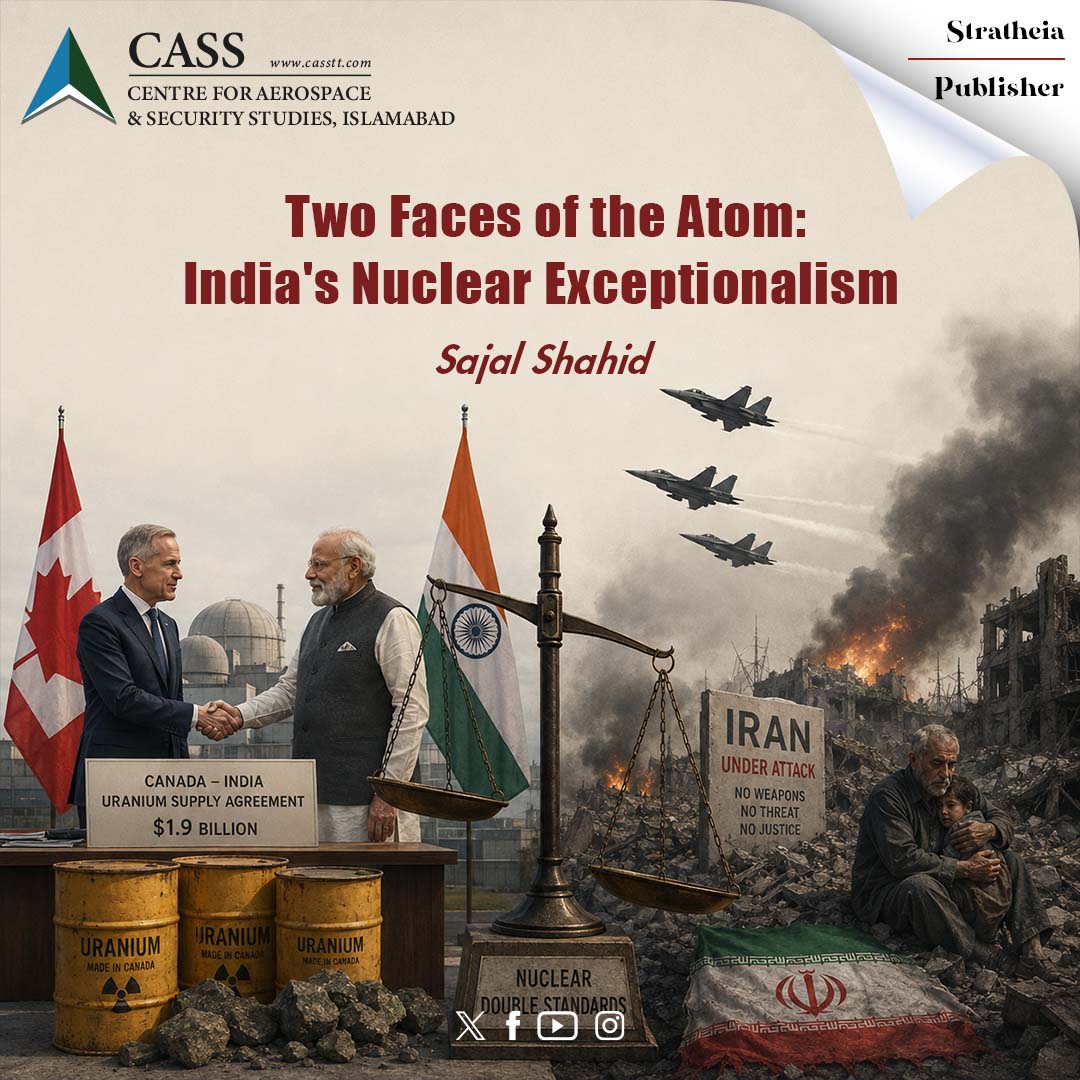
Few examples capture the inconsistencies of the nuclear world order more starkly than the events of 2 March 2026: as Prime Ministers’ Mark Carney and Narendra Modi signed a landmark 1.9 billion USD uranium supply deal for India’s civil nuclear sector, Iran was subjected to the third day of indiscriminate airstrikes by the US and Israel under the banner of nuclear non-proliferation, despite Iran agreeing to zero stockpiling of enriched uranium just days prior. This event, unfortunately, was not an isolated one, rather it reflects a pattern of nuclear exceptionalism where certain states such as India, continue to be rewarded for non-compliance with international regulations, while others such as Iran, are censured and even subjected to military action based on hypothetical realities.
The latest deal would see Canada sell close to 22 million pounds of uranium concentrate to India over 8 years, starting in 2027, a sale more than ten times the last Canada-India uranium agreement of 2015, which supplied 7 million pounds of concentrate over 5 years. The unprecedented scale of this arrangement has been justified as an essential step to enable the civil nuclear industry in India to address the increasing energy needs of the country.
However, it also has the rather convenient effect of allowing India (a non-signatory to the Nuclear Non-Proliferation Treaty) to dedicate its limited domestic uranium reserves exclusively for military purposes. Unlike most other states with access to global nuclear trade, India is not required to have all its facilities under international inspection. India, under a 2008 waiver issued by the Nuclear Suppliers Group (NSG), is merely obliged to have 14 of its 24 nuclear reactors covered by the International Atomic Energy Agency (IAEA), and therefore, a considerable amount of the enrichment infrastructure remains outside international supervision. As a result, India is free to utilise its newfound Canadian uranium to power its safeguarded civil reactors, and redirect its own supply to its unmonitored military installations simultaneously.
While this outcome may seem improbable, India has already demonstrated the capacity to do so in the past. India’s first nuclear test in 1974 titled ‘Smiling Buddha’ was fuelled by plutonium (a fissile by-product) derived from the CIRUS reactors supplied to India by Canada and the US with the clear stipulation that it may only be used for civil purposes. Currently, India is estimated to have around 180 nuclear warheads, a number that can go up given its current modernisation efforts in the military and the implicit encouragement by Western suppliers.
Conversely, Iran, a ratified signatory to the Non-Proliferation Treaty (NPT) since it came into force in the year 1970, has been repeatedly censured and sanctioned over its civilian nuclear programme, even though its enrichments have never exceeded the 90 per cent threshold of weapons grade material. The most recent strikes by the US follow this trend and have been justified under the pretext of preventing nuclear proliferation, even though IAEA reports confirm no indications of prohibited enrichment. Yet civilian sites and national leadership continue to be targeted in Iran, while India receives fresh fuel supplies for its unsafeguarded programmes.
This marks a glaring double standard in the global non-proliferation regime, which utilises moral framing to mask broader geopolitical interests. Instead of adherence to international laws, the system instead relies on a manufactured moral divide by separating states into ‘responsible’ or ‘rogue’ categories based on their perceived utility to dominant powers. Under this lens, India’s position as a counterweight to China supersedes any proliferation concerns, while Iran’s status as a dominant Middle Eastern power that refuses to bend to external pressure renders it a threat. This is made all the more apparent by the US’s greatest ally in its bid to rid Iran of its ability to develop nuclear weapons: Israel, a state that is estimated to possess at least 90 undeclared nuclear warheads, and one that steadfastly remains outside the bounds of the NPT.
Such discrepancies undermine trust in non-proliferation systems in general, and, by extension, encourage weaker states to develop nuclear weapons as the only effective tool of security. These dynamics threaten to trigger a security dilemma whereby the acquisition of nuclear capability by one state will lead to other states following the same path, which can result in unchecked proliferation. The recent Canada-India deal just marks the continuation of these double standards, which it left to perpetuate, could very likely lead to dangerous consequences.
Sajal Shahid is a Research Assistant at the Centre for Aerospace & Security Studies (CASS) Islamabad. The Article was first published by Stratheia. She can be reached at [email protected]