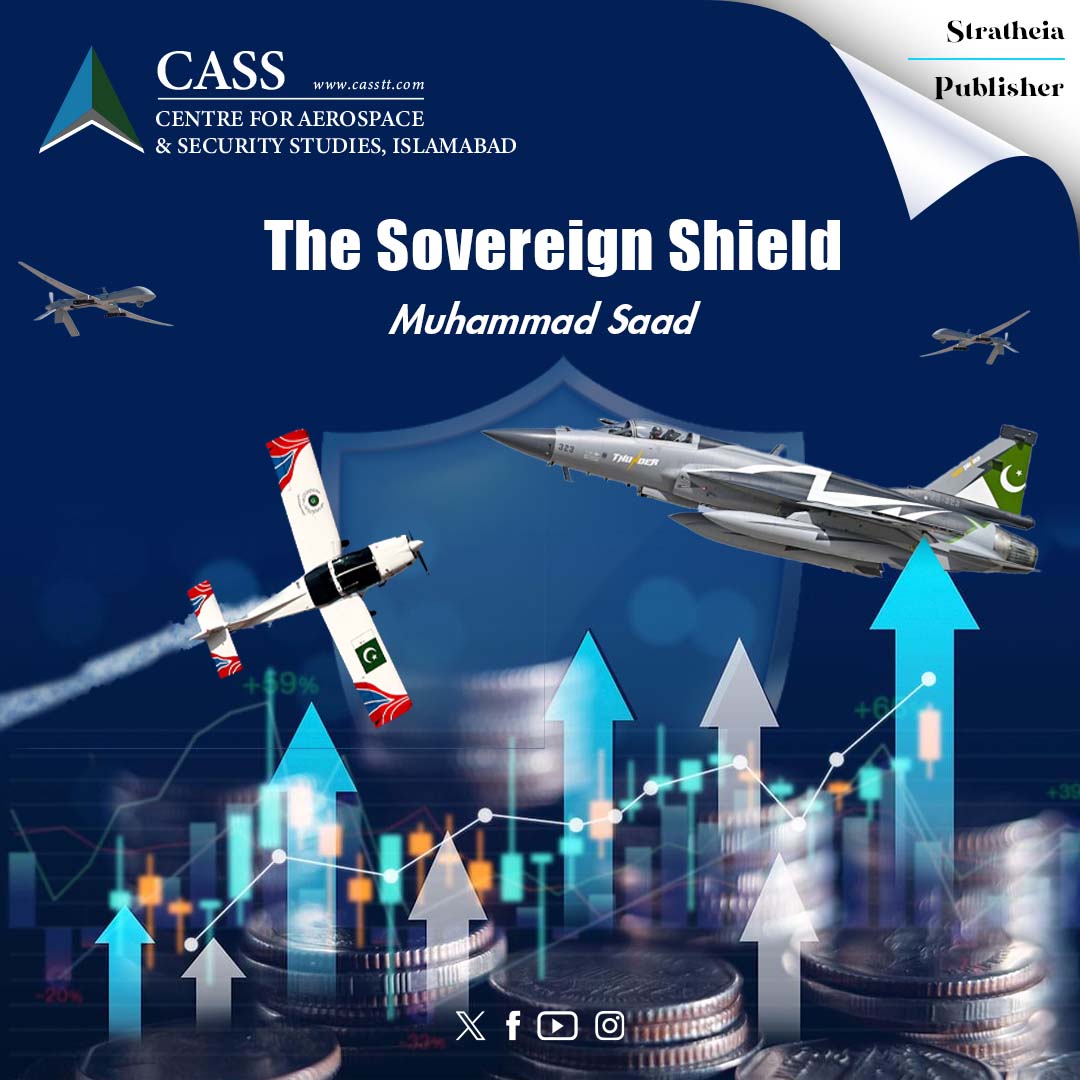
Pakistan’s defence industry is gearing up from a localised purchase requirement to a globalising high-tech export industry. For long the military-industrial complex of Pakistan had been dominated by military needs of the border security and the costly importation of foreign technology. This tendency, however, seems to be reversing slowly. Pakistan is attempting to edge closer to a model of self-reliance in this regard in terms of tactical security and geoeconomic rebalancing that is spearheaded by the JF-17 Block III, the Super Mushshak, and the unmanned systems. This is very clear in its international defence contracts of between 10 to 13 billion dollars.
But export headlines simply aren’t enough to succeed. The defence ecosystem of Pakistan is built on the basis of a strategic triangle in which the PAF is the challenging end-user and technological enabler of the defence ecosystem, a nascent domestic defence sector with focus on platforms such as the JF-17 and the overall economy that will have to eventually underpin and benefit of the activity. The first two legs have demonstrated great strength. The most challenging one is the economic leg, however. Export spikes can be short lived unless structural reforms are adopted. It is the work to be done by chance, that is to assemble these three factors in a self-sustaining system.
We have obvious lessons taught us by the world experience. The defence sector, which is import-dependent even in its glorious past (some 80 per cent foreign content only 20 years ago), has benefited from a sustained policy focus on indigenous design, the engagement of the private sector and export orientation to bring that figure down significantly. By the start of 2020s, it has 4 billion dollars of annual defence exports of which their most successful systems are Bayraktar TB2 drone. South Korea is not an exception as the state mediated R&D, technology transfer transactions and long-term investment in human capital become a game changer in becoming a competitive exporter of advanced platforms. There are certain similarities in the course of Pakistan. The co-development of the JF-17 has already made some provision for local assembly and incremental upgrades. Recent deliveries of Super Mushshak trainers to Turkey itself is to show credence to the reverse flow. But to catch up, it is necessary to speed up the shift from assembly and licenced production to actual self-sufficiency in key subsystems.
This is precisely where different institutions such as the National Aerospace Science and Technology Park (NASTP) come in handy. Established as a project of strategic national importance under the leadership of the PAF, with sites in Rawalpindi (Alpha) and Karachi, NASTP is designed to act as a fusion of research, academia, industry and government. It hosts organic PAF R&D set ups in the areas of aircraft designing, space technologies, radars, simulators, AI and Cyber domains. Collaborations with Turkish companies, such as Baykar and TAI have already proven to be indigenous achievement. By nurturing the startups through incubators such as NICAT and public-private partnerships, NASTP is the mechanism to develop the industrial and economic legs at the same time in practise: to generate high-value jobs, to attract private investment, and to make sure the export revenues are used for further R&D, not to compensate for imports.
Indigenization has to be the guiding thread. Not as a slogan, but as a measurable doctrine, including steadily increasing the percentages of local content, giving priority to dual-use technologies that have spillover effects into civilian aerospace and IT industries and enforcing tech transfer requirements in future collaboration. Guiding principles should include strategic selectivity and ensuring sales create sustainable economic multipliers in terms of local supply chains and skilled workforce development. Short-term export windfalls are valuable but the real test is whether those lead to lower vulnerability to outside supply disruption and a defence industrial base which pays for itself.
The challenge of the economic leg is not insurmountable. It is a call to action. Thousands of jobs and technical skills in Karama, Rawalpindi and Karachi are already under the supports of Defence production. This leg can be boosted through specific incentives to the entry of the private-sector, simplification of regulations and continuous investment on R&D. The recent indication of 13 countries express interest in development process is a testimony to market approval of Pakistan battle tested and cost-effective platforms. If handled in disciplined manner, these opportunities have the help for bridging the interest spikes to the structural transformation.
Pakistan is at a critical juncture. Geoeconomic rebalancing has ceased to be a figment of imagination. Defence exports provide a singular opportunity for high technology value addition in a world market which is in need of cheap and reliable solutions. By way of amicable integration and clear indigenization road map the nation can overcome episodic success. The upshot of this would be an effective defence ecosystem contributing to the country’s national security, to provide a steady stream of foreign exchange, plus having a major role in the overall self-sufficiency of the economy.
It is a hard road to travel but the possibilities triumph over the pessimism. Pakistan defence industry proved itself to be able to perform on the battlefield. It is time to ensure that it is also feeding in a sustainable and strategic way to the economy. The triangle is back to waiting for integration and the dividends to be generational. Interpreting the work of Ibn Khaldun to our day, it is imperative to “make the kingdom a fortress not of stone, but of commerce and craft.”
Muhammad Saad is a Research Assistant at the Centre for Aerospace and Security Studies (CASS), Islamabad. The Article was first published by Stratheia. He can be reached at [email protected].