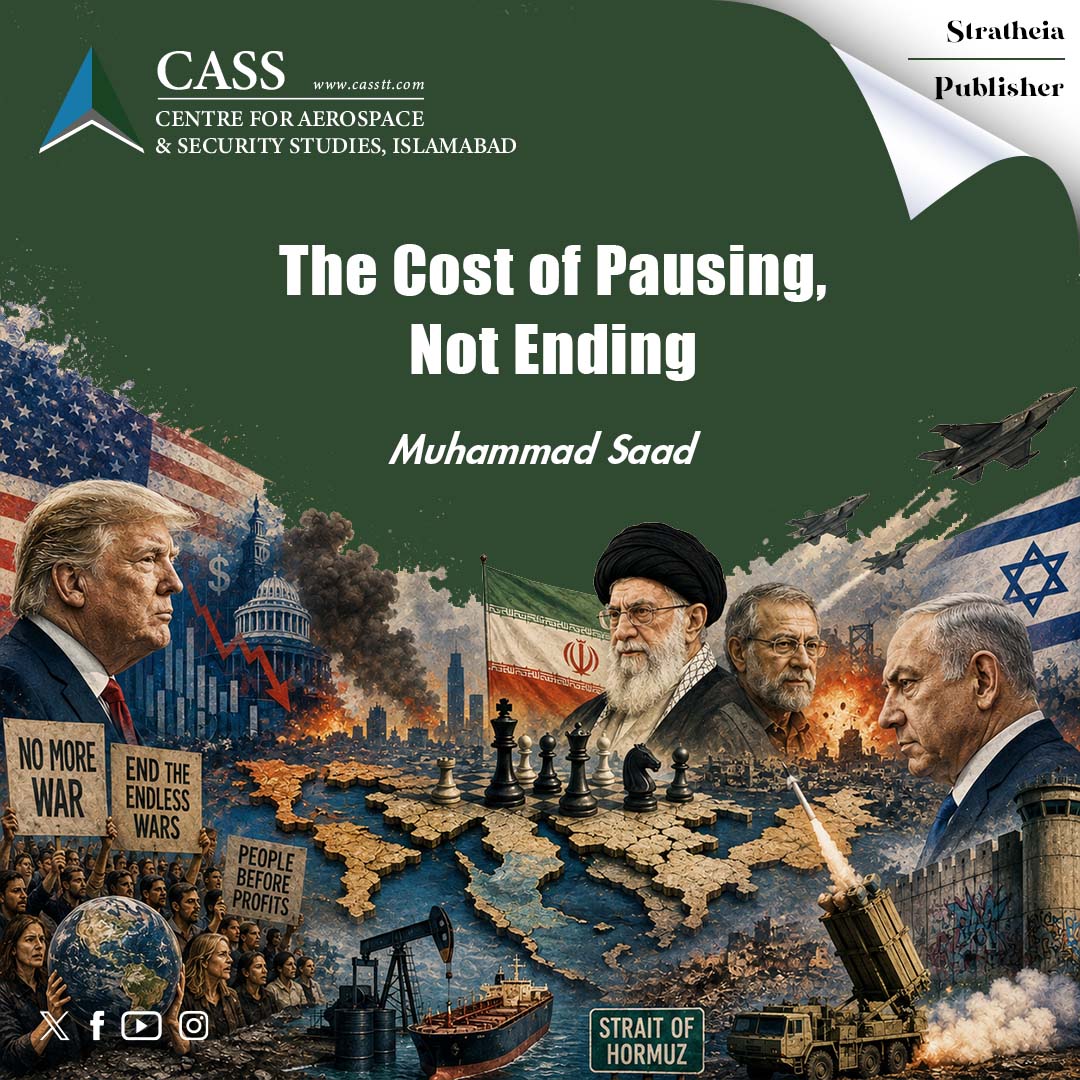
Weeks after concerted United States and Israeli attacks assassinated Iran’s Supreme Leader Ayatollah Ali Khamenei and hit the country’s military and civilian infrastructure, the conflict continues. Iranian retaliatory strikes persist, although at a reduced pace. The recent assassination of senior pragmatist Ali Larijani points towards further escalation. While Iran has successfully expanded the conflict, neither side have been able to deliver a decisive blow. This moment of impasse begs reflection on how the war may end. History has shown that even the most determined campaigns eventually run into insurmountable obstacles. These barriers are financial haemorrhage, mounting attrition, vocal discontent from allies, and the erosion of domestic support. This conflict is no exception to these barriers.
The pressure for ending the war is increasing with every passing day. Israel is spending billions on air defence and offensive operations. Oil markets are volatile because of threats to the Strait of Hormuz. Casualties on all sides continue to mount and allies are quietly urging restraint. Moreover, in democratic societies, there are definite limits to public tolerance for long and expensive military campaigns. Vietnam, Afghanistan, and the Korean armistice are all examples of wars that ended because the collective economic, human, and political costs were simply too much to be endured.
The objectives of the parties involved in this war are entirely diverging. The United States and Israel want to permanently end Iran’s nuclear threat, dismantle its missile program, and cut off its support for regional proxies, all to ensure lasting security for Israel. Iran, in contrast, seeks regime survival and maintenance of adequate military capacity to ward off any aggression in the future. Against this backdrop, a few plausible off-ramp mechanisms stand out. Each would have to be assessed based on five important criteria: financial and material cost, expected duration, projected human losses, pressure from international allies, political risk to the leaders who have publicly pledged “total victory,” and the ability to provide real, long-term security for Israel.
The first pathway contemplates regime change in its entirety through sustained military action towards the full overthrow of the Islamic Republic. On paper, this approach offers the most comprehensive resolution of the threat. In practice, however, it runs the risk of precipitating a power vacuum that could create new extremist factions even more dangerous than the present leadership. Historical precedents illustrate how such vacuums breed protracted insurgencies, regional spill-over, and enormous reconstruction burdens. Costs would amount to hundreds of billions of dollars, the timeline could last for years, and human loss would be catastrophic. Allied pressure, especially from European capitals concerned at the wave of refugees and at supply chain disruption, would rapidly increase. For leaders who have made the campaign an existential necessity, any retreat from absolute victory would be a severe political liability.
The second pathway is Iran prolonging the conflict in a survivalist way. Tehran would rely on asymmetric tactics to impose cumulative costs until external fatigue compels the adversaries to disengage. This scenario, although superficially plausible in the light of Iran’s proven resilience, is the least desirable for the US. It maximises duration and cumulative losses, with costs to Israel already running into billions every week and mounting American casualties. Allies, facing high energy costs and domestic unrest, would apply significant pressure for de-escalation. Political dangers to both American and Israeli leadership would continue to be acute, as prolonged stalemate is antithetical to the promise of swift, decisive victory. A bloodied but intact Iranian regime would retain both motive and capacity for future conflicts.
The third path is limited precision strikes followed by a victory and a transition to indefinite containment. Under this model, the United States and Israel would claim degrading Iran’s most dangerous capabilities, proclaim the mission accomplished and rely on sanctions, naval patrols, and occasional targeted operations to prevent rehabilitation. Superficially attractive for its brevity, this approach contains fatal flaws. Iran would almost certainly use any breathing space to work on rebuilding its nuclear and missile programmes. Costs and duration may be moderate initially but would increase over time due to the fragility of containment. Human losses would be less than in cases of complete collapse or interminable attrition, but allied frustration (especially of Gulf partners who could come under the renewed attacks) alarmed by continued instability would increase. The U.S and Israel would face the accusation of premature withdrawal.
The fourth and most realistic path to de-escalation is driven by pressure on the United States, not by changes in Iran or Israel. With surging oil prices and Western economies showing clear recession signals, President Trump faces growing backlash from advisors and voters over rising costs and endless entanglement. In response, Washington could unilaterally declare its core goals accomplished, halt most direct strikes on Iran, and offer limited sanctions relief in exchange for Tehran reducing its missile and proxy attacks. This would not be a formal treaty but a quiet backchannel deal, likely brokered by a third party, creating a temporary cooling-off period.
Israel, however, refuses to join the pause and continues its unilateral campaign of targeted strikes on any Iranian or proxy efforts to rebuild. The United States will never cut back on military resupply and diplomatic support for these operations. This is due to the influence of the Israeli lobby and strong bipartisan backing for Israel, especially when Netanyahu frames the conflict as a matter of existential struggle. Iran, economically exhausted and now under a hardened IRGC-dominated leadership, accepts the respite because outright victory is still not possible and total collapse is not an option.
This is exactly in line with Israel’s deeper strategic calculus. As the game theorist Professor Jiang Xueqin has argued in his analysis of Middle Eastern power dynamics, Israel’s ultimate goal is to become the region’s sole hegemonic player. By allowing the United States to bleed and die while Iran is crippled for good and Gulf economies are devastated, Israel gains the fragmented regional landscape it needs. In this environment, no rival state or outside patron has the strength to limit its freedom of action. The American pivot is, thus, not a concession but the subdued realisation of a long-term vision. Israel has the instruments of enforcement which it considers necessary, freed from the periodic American restraint.
When measured against five key metrics, the fourth scenario stands out as the most believable option. Financial costs to the United States are minimised through a four-to-eight-week drawdown, far less than the multi-year burdens of regime change. Projected human losses are also the lowest among feasible alternatives, since escalation is capped before civilian casualties spiral and power vacuum violence is avoided. Allied pressure eases immediately, with European and Gulf partners welcoming the de-escalation after being strained by energy shocks. Political risk for American leadership is manageable, as President Trump can credibly claim to have delivered strategic objectives without getting bogged down in a quagmire. Netanyahu’s exposure is also diffused by continuing independent operations that sustain his domestic narrative. Long-term Israeli security is optimised because Iran emerges permanently weakened and deterred, without the risks of containment or the chaos of total collapse. Israel’s calibrated enforcement campaign serves as a sustainable deterrent mechanism, less costly than occupation and more reliable than sanctions alone, while the American exit prevents the alliance from being locked into an unwinnable perpetual conflict.
In an environment characterised by maximalist rhetoric on all sides, global economic realities and American self-interest have become key determinants. The American pivot provides an escape that may not subject the region to the worst of all-out war but would enable the United States to withdraw. However, this pathway is far from a just or stable resolution. It successfully solidifies Israeli regional hegemony, and its settler colonial and expansionist agenda is not checked as the roots of conflict are not addressed.
Iran comes out fatigued and the rest of the Muslim world would not benefit much out of this arrangement. The ceasefire provides a temporary reprieve of bloodshed, while solidifying the underlying injustices that are the root of this conflict. For the region, this is just a swap of open warfare with a controlled stalemate that benefits the mightier.
Policymakers in Washington may call this a prudent exit, but it is practically a quiet acceptance of a region built on imbalance. That order is held in place by ongoing violence used selectively against those who resist. The most realistic path forward is not the same as the most just one, and whether this pause will last is far from certain.
Muhammad Saad is a Research Assistant at the Centre for Aerospace and Security Studies (CASS), Islamabad. The Article was first published by Stratheia. He can be reached at [email protected].