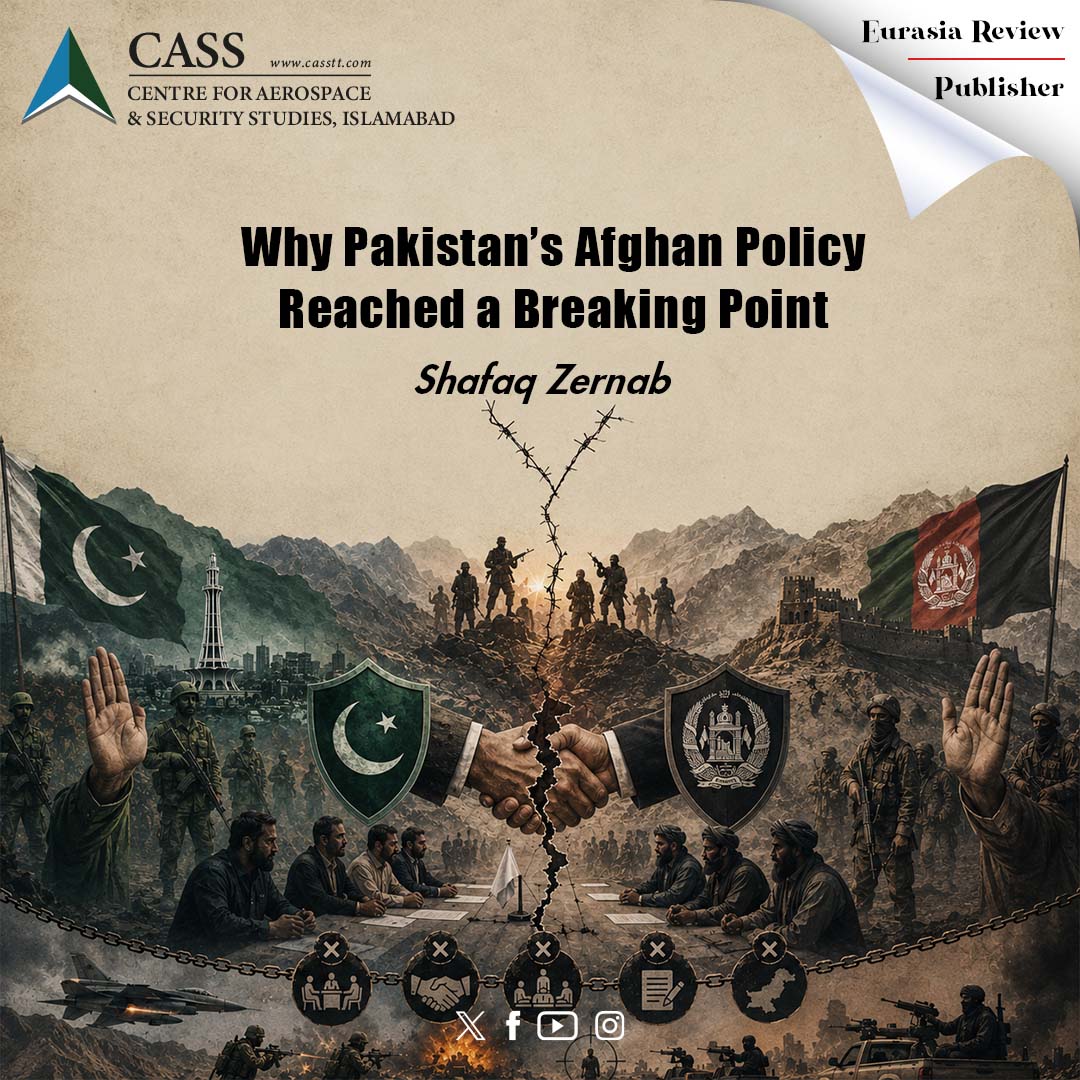
The ongoing war between Pakistan and Afghanistan is the result of a gradually worsening security situation along the Durand Line rather than a sudden strategic shift. The core issue was not the absence of dialogue, but its inability to deliver binding results to the foremost security concern of for Pakistan: the use of Afghan territory by militant groups to attack Pakistan. When Pakistan in response switched to cross-border strikes in February 2026, the state had already gone through several years of attempted accommodation without securing any meaningful restraint from the Tehreek-e-Taliban Pakistan (TTP) by Kabul.
Contrary to the global perception of treating Afghanistan as a client state, Pakistan’s initial response after the Afghan Taliban’s takeover in August 2021 was, in fact, guarded and restrained. The immediate political aims of Islamabad concerning the fledgling Taliban government were to facilitate a stable transition, and prevent Afghanistan from falling into a new civil war. Pakistan also sought to safeguard its western border against militant spillovers and Indian ingress, and maintain the prospect of regional connectivity via Afghanistan to Central Asia. These objectives aligned with Pakistan’s cautious stance at the time, as earlier outbursts of unrest in Afghanistan had already demonstrated how easily instability across the border turned into a refugee crisis, contrabands, and even terrorism in Pakistan.
Pakistan’s Afghanistan policy still had an inherited assumption that historical contact, sectarian and tribal linkages, geographic interdependence, and the language of ‘brotherhood’ will yield reciprocal Afghan sensitivity to the fundamental security interests of Pakistan, but it did not. Contrary to what many believed in Islamabad, the Taliban were never ideologically oriented towards Pakistan. Engagement was conditional and interest-based. The socio-economic power structure of Afghan society is fundamentally neo-patrimonial in nature, where institutions exist but power continues to flow through personalities (warlords/ tribal chiefs), patronage networks, and armed militia. External players have historically exerted influence in Afghanistan by investing and militarizing the respective factions, and those power structures, in turn, dictated the central Afghan governing authority. These structures do not respond to sentiments; they are responsive to resources, incentives, and coercive balance. India identified these patronage structures before Pakistan did. Instead of relying on presumed affinity, India employed aid, infrastructure, and political access to consolidate its influence across several Afghan nodes. Since 2001, India has invested approximately $3 billion in Afghanistan. By the end of 2025, New Delhi also announced the re-opening of its embassy in Kabul.
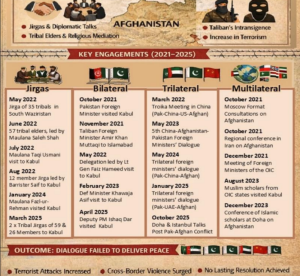
Meanwhile, Pakistan had exhausted multiple non-military options since the Taliban took over. The pattern showed how Pakistan moved from concern, to negotiation to mediation. However, the negotiations collapsed due to contentious demands of parties, including the Durand Line issue, TTA’s refusal to hand over TTP leaders to Pakistan, and TTP’s demands to reverse the FATA merger. The trust further deteriorated as escalation persisted even during negotiations.
In parallel, the terrorist incidents surged in Pakistan, making it the most affected country in the world with a record 45 per cent increase in 2024 as per the Global Terrorism Index. The decisive moment came in February 2026 when a series of high-impact incidents, including the Bajaur checkpoint attack, the Bannu convoy bombing, and a suicide attack on a mosque in Islamabad, compelled Pakistan to take kinetic action. Pakistan carried out intelligence-based limited airstrikes on TTP infrastructure (militant bases such as centres associated with leaders like Maulvi Abbas and Mullah Rahbar) in Nangarhar, Khost, and Paktika on 21-22 February.
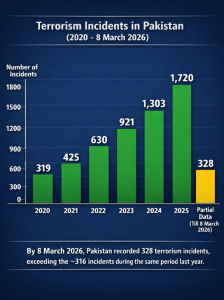
Source: South Asian Terrorism Portal
26 February 2025 marked the start of direct confrontation between Taliban and Pakistan when the Afghan forces attacked border posts in Pakistan and also severed trade ties. On 27 February, Pakistan declared an ‘open war’ with Afghanistan by launching operation Ghazab Lil-Haq, targeting 313 Corps in Kabul, the Tarawo training camp in Kandahar, and the Sher-e-Nau camp in Paktia, along with other targets. The operational logic was clear: since militant forces operate within an enabling ecosystem, hitting forward cells would not be enough. The campaign was thus augmented to command and control, training, ammunition depots, and logistical nodes, which eventually compelled the Afghan Taliban to call for a ceasefire. As a result, terror incidents significantly reduced during this period. Pakistan thus transitioned from risk management to dealing with the environment from which the risk originated.
While the operation has yielded significant tactical gains, the limitations of force as a standalone instrument cannot be disregarded. The war imposed a staggering cost on Pakistan, which is not trivial for an economy whose foreign-exchange reserves are constantly under strain. But the reasoning of the current coercive stance is that the cost of sustained terrorist incursions would be ever greater. A frontier vulnerable to militants erodes sovereignty, discourages investment, and connectivity initiatives like CPEC, and places Pakistan in a perennially reactive position. Similarly, with the humanitarian condition worsening in Afghanistan, war is not the optimal choice. Since the issue is both geographical and territorial, it brings the discussion to its most critical point.
Coercion alone cannot offer a lasting resolution, unless it is linked to a political framework premised on four factors. Since TTA ideologically coincides with TTP, they can accommodate them according to custom; Kabul has to bear sovereign responsibility to ensure that the TTP does not use Afghan soil to wage war against Pakistan. This flexibility is crucial to alleviate worsening humanitarian conditions in Afghanistan. Second, Pakistan must shift from episodic signalling to a steady Afghanistan policy (debated in Parliament) to curtail Indian influence against Pakistan through confidence-building measures and border management. Third, a monitoring system of credible regional powers such as China, Qatar, or Turkey should be established to ensure compliance. Fourth, economic incentives, such as phased reopening of trade, access to transit routes, revenue-sharing, and refugee management, can also strengthen the commitment to adherence. It is paramount for Pakistan and Afghanistan to have a stable relationship. Pakistan requires a western frontier that is not a platform of anti-state violence, and Afghanistan requires market access, transit, and at least a non-hostile neighbourhood in order to get out of isolation and frailty. The key is to seek a political settlement not on the basis of sentiment, but reciprocity, verification, and uniform state policy.
The writer is a Research Assistant at the Centre for Aerospace & Security Studies (CASS), Islamabad. The Article was first published by Eurasia. She can be reached at: [email protected].