Even after one year since the India-Pakistan May war of 2025, the Indian discourse regarding Operation Sindoor remains uncertain under its pretence of restraint. The Pahalgam attack on 22 April, which killed 26 people, triggered an escalatory spiral. New Delhi quickly accused Pakistan-linked elements, while Islamabad refuted the allegation and demanded an independent investigation. On 7 May, India launched attacks deep inside Pakistan under what it later termed as Operation Sindoor. The political motive was intended to turn the crisis into coercive signalling by shifting the blame onto the enemy and projecting a sense of military superiority.
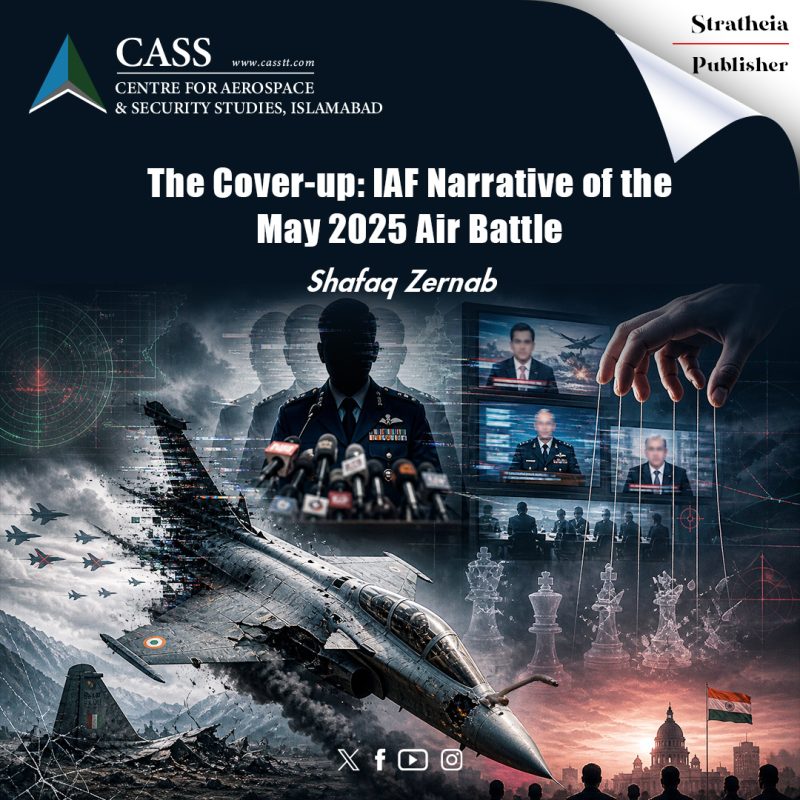
This episode, however, began to fray immediately as war seldom follows the intended script. Within minutes PAF shot down 7 IAF aircraft including 4 Rafales. On 8 May, Reuters reported that at least two Indian aircraft were shot down by a Pakistani J-10C, while the local government sources reported other aircraft crashes in Indian-occupied Jammu and Kashmir as well. Following a well-worn pattern, India’s initial response was immediate dismissal of the unprecedented losses, labelling it as disinformation and outright deflection of the narrative. A few days later, Indian Deputy Chief of the Air Staff, Air Marshal A.K. Bharti, appeared in the media with a slightly altered official story. Without delving into details, he acknowledged that losses are a part of combat, but shifted the focus toward the fact that all their pilots were back home safe.
This shift mattered. IAF’s narrative shifting from initial denial of losses to partial acceptance, without empirical support, not only raised suspicions regarding the platform but also put institutional credibility into question. India had branded Rafale as the symbol of regional airpower superiority. Thus, any setbacks were not merely tactical but carried psychological, organisational and political implications as well. The dissonance became even more pronounced when the Indian Chief of Defence Staff, General Anil Chauhan, admitted that there had been losses in the initial phases of war, although he denied Pakistan’s numerical claims. He too focused less on aircraft losses and more on rectifying tactical errors, signalling a classic move of damage control.
On the contrary, Pakistan adopted an assertive counter-narrative. During the tri-service briefings following Operation Bunyan-um-Marsoos, DG ISPR projected a retributive, comprehensive and decisive account of Pakistan by presenting a transparent sequence, targets and results. The question to accept or to reject this narrative is secondary, but what matters is how Pakistan occupied the information vacuum presenting the truth before ambiguity could set in. At the same time, India’s passive approach gave way to speculation where restraint became obfuscation. New Delhi’s narrative was further undermined when the US President Donald Trump, France’s Air Chief, General Jérôme Bellanger and a Dassault executive mentioned the loss of multiple Indian aircraft. New Delhi could neither fully support nor effectively deny the cumulative weight of this external validation. However, two months later, much to the amusement of the aviation community, the IAF Air Chief stated that his air force had shot down numerous PAF aircraft. The claim, probably meant to lift the sagging morale of the IAF, did not even resonate with the Indian public. If at all such frivolous claims had to be made, they would have been presented in the Indian Parliament’s Monsoon session, where the government faced intense grilling on the subject by the opposition.
After the conflict, India tried to recover from such disaster by procurement-based signalling. In April 2025, the $7.4 billion Rafale-M agreement with France was an effort in that regard, followed by the push to procure another 114 Rafales. However, such attempts were mere theatrics by a service bruised in combat, which needed to reassure both public and foreign partners that its wider airpower capability is still intact.
Procurement is, however, only a palliative, not a cure to conceal structural problems like India’s indigenous aspirations. One such notable instance was the absence of Tejas (a platform symbolic of self-reliance) on key showcases, combined with incidents like its crash-related inspection at the Dubai Airshow, which has heightened the need to focus on issues of reliability and programme maturity. Around the same time, India’s own Chanakya Defence Dialogue offered some introspection. Senior military and industrial stakeholders highlighted bureaucratic inertias, fractious doctrines, and a lack of integration as structural hiccups. They indicated that it is not solely an issue of acquisition, but of coherence, as a whole, of the Indian military ecosystem.
This is where the idea of commitment trap becomes analytically salient. The Indian government pre-emptively framed the operation as decisive and controlled. Expectations were therefore pre-loaded. The outcome just had to conform to the story. However, when reality deviated, the government faced a structural dilemma; either publicly accept the losses and incur reputational costs or control the narrative for political gains. It opted for the latter, which backfired. Recalibration becomes politically fraught once a state bases its legitimacy on a superiority narrative. Institutional rewards favour those who promote this narrative rather than substantial solutions. Over time, this creates a distance between perception and reality.
Even a year later, the IAF is treading through this very disjuncture of evasion or assertion. Officially, it has tried to project the narrative of success, but the ambiguity prevails regardless. Therefore, a question still remains unanswered. When Operation Sindoor had been a scripted tactic of control, how come India remains ensnared in its own commitment trap? The answer lies in the evolving nature of warfare itself, where results are no longer evaluated by pure kinetic engagements, but by the narrative that follows it. When that interpretive process falters, even a limited engagement may gain inappropriate momentum.
Shafaq Zernab is a Research Assistant at the Centre for Aerospace & Security Studies (CASS), Islamabad.The article was first published in Stratheia. She can be reached at: [email protected].