
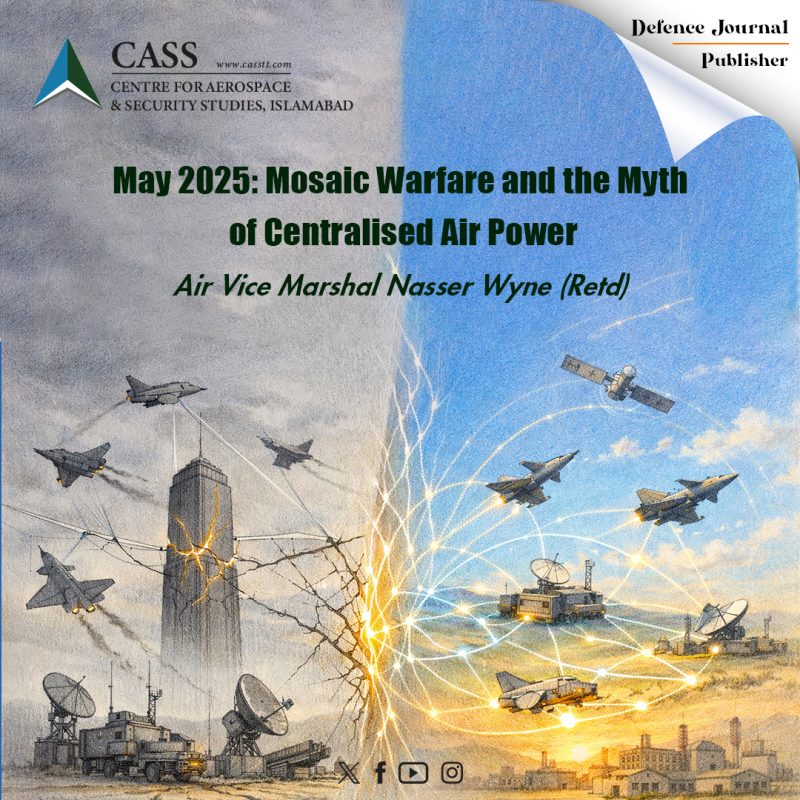
Visualise a modern-day Air Force commander sitting in the operations room, miles away from the combat zone, overseeing every friendly and enemy aircraft and all assets involved in the campaign. In a split second, he can task a fighter, reposition a drone, and authorise a strike. In today’s promising technological era, he does not even need an operations room; a laptop on his desktop will suffice. The situation looks promising as it offers efficiency, precision, and control. The term used for such operational control is ‘centralisation’, which has been made possible with advanced networking, integrating space, cyber, surveillance, artificial intelligence, and seamless communication, enabling a single commander to manage an entire campaign from a single node. Centralised command and control, championed by the Western air forces and then adopted by many others, has thus been seen as a pinnacle of modern military power.
The concept of centralisation, enabled by state-of-the-art networking, may seem promising, but it is nothing more than a myth.
The myth first unravelled last year when the Pakistan Air Force (PAF) confronted the Indian Air Force (IAF) in a brief, but consequential conflict. Iran mirrored the PAF’s performance in its war against the U.S. and Israel in 2026. Iran applied this strategy across domains and withstood the most sophisticated decapitation campaign. These two conflicts have changed the world’s understanding of how air power must be employed. Mosaic warfare (decentralised warfare or distributed resilience) captured global attention in 2026, but was amply demonstrated by the PAF in May 2025. For a smaller air force facing an adversary three times larger, decentralisation is not a luxury; it is a necessity.
IAF, in its modernisation drive, invested heavily in networking. Advanced IAF AWACS were integrated with sophisticated ground-based radars, and IAF’s command philosophy was organised around centralised control, assuming that superior networking would translate into superior combat power. It was apparently a strong system, but its strength was also its weakness. The entire system rested on a few critical nodes, command centres, communication, and senior leadership, offering an ideal counterattack option to the PAF. Disrupt any of these, and the structure would not bend but would fracture. Centralisation creates a single point of failure, which in a high-tempo operational environment can be suicidal.
How PAF Conducted Mosaic Warfare in May 2025
When the conflict erupted in May 2025, many military observers were taken by surprise by PAF’s formidable performance despite the force ratio of 1:3 in IAF’s favour. What did PAF do differently?
Firstly, understanding that it would not be able to match the IAF in numbers, PAF adopted a different philosophy by moving away from a rigid, centralised command structure. Significant autonomy was delegated to Squadron Commanders, air defence controllers and flight leaders. These mid-tier commanders are the backbone of PAF combat power, and they were given a clear understanding of the strategic objectives. In the Air Force’s operational terminology, this is termed as ‘commander’s intent’. After receiving the intent, these commanders are trusted to carve out the best possible way to achieve objectives in dynamic situations.
Secondly, PAF operates from dispersed locations. Instead of concentrating assets at a few bases, making them tempting targets, it operated from a network of smaller airfields and forward operating bases. This provided adequate redundancy to PAF; even if one base was hit, the rest would continue to function.
Thirdly, PAF employed redundant, resilient and secure communication systems. A single, centralised network has risks of jamming or destruction. PAF thus built layers of communications, including links with low intercept probability, and where necessary, incorporated low-tech back-ups. The results were striking. IAF’s centralised command nodes (AWACS, ground radars and command centres) were prioritised as high-value targets by the PAF, forcing IAF to employ them with extreme caution, negating their operational advantage. PAF, on the other hand, continued to operate without interruption, as its distributed structure meant that no single loss was catastrophic. IAF had to fight a coherent adversary that could not be decapitated. It was confronted with a constellation of highly capable, independently operating units that maintained cohesion through shared intent rather than real-time orders. The conflict culminated with an important lesson for air power analysts; a smaller air force, employing Mosaic principles, could effectively neutralise a numerically superior, more centralised adversary.
How does the PAF trust the independent decision-making of mid-tier leaders and even that of a flight or section leader in the air? How is the whole institution tuned to operate from the dispersed locations and communicate seamlessly in a decentralised manner? This does not happen overnight. The Air Force ‘commander’s intent’ has to be followed in letter and spirit. But it is the commander himself who chalks out the plan, provides resources and trains his combat force to the highest standards so that each person understands and implements his intent even in an adverse communication environment. Such leadership was central to the PAF’s effective conduct of operations against the IAF in May 2025.
PAF-IAF conflict of May 2025 and the ongoing U.S.-Israel-Iran conflict have exposed the fundamental flaw in the centralisation myth ‘that technology alone cannot replace human judgment’. The centralisation myth assumed that superior networking would allow commanders to control more, but the fact is that networking tempts the commanders to overcontrol. Decentralisation is even more important when confronted with an adversary possessing highly advanced and superior jamming capabilities. PAF should not only be prepared against the Indian Air Force alone, but against any regional or extra-regional military threat, for which Mosaic is a must.
It is emphasised that Mosaic warfare does not mean abandoning technology. While technology remains essential, it must be employed to enable decentralisation rather than reinforce centralisation. This aspect requires a doctrinal shift. Mission command, the principle of giving subordinates clear intent and the authority to execute, must become a culture, not an exception. To master this culture, a significant investment in personnel training is required, whether in the cockpit or an air defence command post; these airmen must thrive on autonomy, enabling them to make sound decisions under pressure, with incomplete information and in the absence of direct orders.
Air Vice Marshal (Retd) Nasser Wyne is a Director at the Centre for Aerospace & Security Studies (CASS), Islamabad. The article was first published in the Defence Journal Magazine.Email: [email protected]



