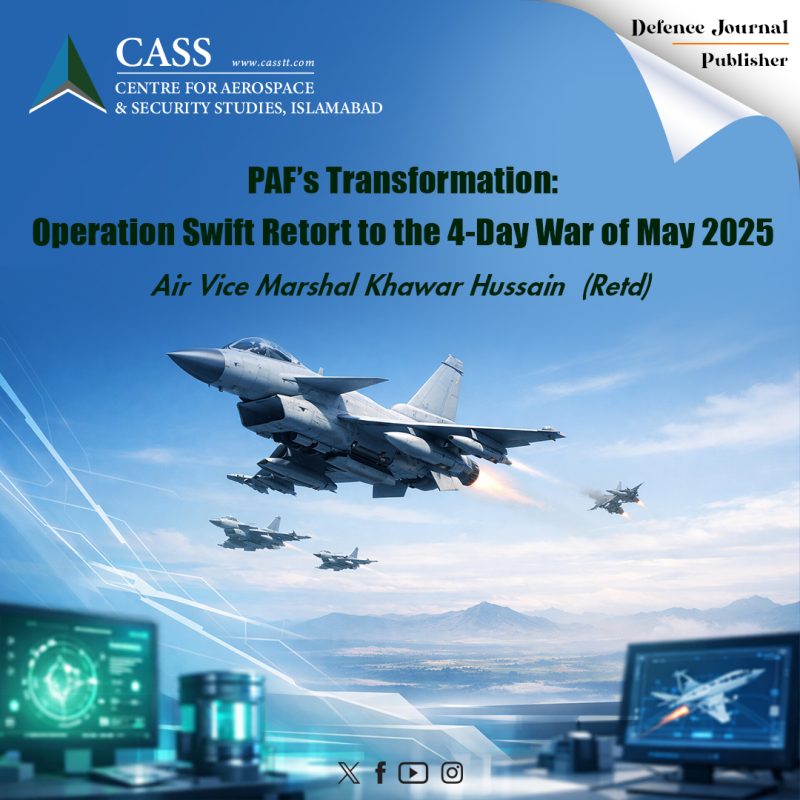
The Air Force is an inherently technology-sensitive force, and without adopting emerging technologies, concepts, and doctrines, it risks falling behind in effectiveness and relevance. Aware of this eventuality, the leadership of Pakistan Air Force (PAF) has always remained open to change and ready to embrace the evolving character of warfare. The PAF’s success in the “4 Day War of May 25” lies in its transformation during the period from Operation Swift Retort in 2019 to the May 25 war.
Prior to ‘Operation Swift Retort’ in 2019, the air power balance between the PAF and the Indian Air Force (IAF) was defined by distinct yet comparable capabilities. The IAF operated a technologically diverse fleet that included SU-30 MKI, while the remaining fleet comprised older legacy fighters, such as Mirage-2000, MiG-29, MiG-21, and Jaguars. The PAF, meanwhile, had in its inventory the F-16 Fighting Falcon in the high-tech category, armed with AIM-120 AMRAAM BVR missile, one of the most advanced air-to-air missile in the world at that time. The induction of JF-17 enhanced PAF’s capabilities in mid-tech category. Alongside this, PAF had spent years developing and refining its electronic warfare (EW) capabilities and integrating them into air operations. The stage was thus set for the first direct aerial encounter between the PAF and the IAF since the Indo-Pakistan War of 1971.
In the wake of the Pulwama incident, during the night of 26-27 February 2019, a package of 12 IAF Mirage-2000’s carried out an airstrike against alleged terrorist camps in the vicinity of Balakot. However, the munitions fell aimlessly in open terrain, failing to hit any intended target. This outcome indicated a serious deficiency in both the weaponry and professionalism of the IAF pilots.
In response, the PAF executed a carefully planned and coordinated retaliatory operation, ‘Operation Swift Retort,’ on the morning of 27 February 2019. The strike package, comprising Mirages carrying stand-off glide bombs, was escorted by JF-17s, while the F-16s provided air cover and maintained forward Combat Air Patrol. The DA-20 EW aircraft equipped with an electronic countermeasures (ECM) suite supported the package by degrading communications. PAF Mirages successfully dropped bombs while remaining cis-frontier, against Indian military installations deep across the LOC.
All this while, F-16 fighters protected the strike package by engaging multiple IAF aircraft. During air-to-air combat, the F-16s employed AMRAAM BVR missiles and successfully shot down two of the IAF’s aircraft, including a MiG-21 and a SU-30, demonstrating superior air combat skills, effective employment of advanced technology, and unwavering resolve. The PAF EW support was a significant factor in degrading communication between IAF ground air defence controllers and fighters, thus enabling the shooting down of IAF aircraft. The ‘fog of war’ created by PAF’s EW operations further compounded the confusion on the Indian side, leading to an IAF air defence operator mistakenly locking and shooting down a friendly helicopter that had gotten airborne from Srinagar.
The MiG-21 wreckage fell inside Pakistani territory. The pilot, who had ejected and landed within Pakistan’s border, was taken into custody. In a display of professionalism, goodwill, and adherence to the Geneva Conventions, Pakistan subsequently handed over the IAF pilot to the Indian authorities, further underscoring its commitment to responsible conduct even amid heightened tensions.
In the aftermath of PAF’s ‘Operation Swift Retort,’ the IAF recognized its deficiencies in the BVR domain and accelerated the induction of the Rafale fighter jets, armed with the METEOR BVR and SCALP air-to-surface missiles. Historically, the induction of Rafale by the IAF had been highly controversial and politically contentious because of corruption charges against PM Modi’s government. According to the original deal, India was to acquire 126 Rafales, along with the transfer of technology, enabling production of 108 aircraft by Hindustan Aeronautics Limited. In 2015, the plan was changed, and according to the new agreement, instead of 126 aircraft, only 36 Rafales were to be procured, all built by Dassault Aviation in France. The first batch of Rafales arrived in India in July 2020, and by late 2022, delivery of all 36 aircraft had been completed. The addition of the Rafale, coupled with the SU-30, gave IAF an edge over PAF in the BVR domain and shifted the airpower balance in IAF’s favor, albeit temporarily.
Fully aware of the evolving threat environment, the PAF leadership swiftly moved to restore air power balance. In 2020, PAF ordered the cutting-edge PL-15 BVR and short-range PL-10 air-to-air missiles that were considered a credible counterbalance against the METEOR. In March 2022, PAF inducted the J-10C multirole fighters in the shortest possible time, i.e., eight months after signing the contract. It is noteworthy that pilots with only three to four hours of experience on the type successfully ferried the aircraft from China to Pakistan.
For the new platform, comprehensive tactical doctrines and operational employment strategies were rapidly developed and refined through intensive training and exercises. PAF sought rapid integration of these platforms to counter the evolving Rafale threat. Resultantly, by early 2023, J-10 C equipped with the PL-15 missile were fully operational within nine months of their induction in PAF and took part in an international-level exercise ‘Indus Shield’ the same year.
The J-10 Cs, fitted with KLJ-10 Active Electronically Scanned Array (AESA) radar, offered greater detection and engagement ranges than the existing avionics suite of PAF’s fighter fleet. Similarly, PL-15 had a 40 km greater range than its counterpart, the METEOR Missile. Thus, PAF regained its technological edge in the high-end air combat domain and established a credible ‘First Shot’ advantage, a critical factor in any BVR air combat engagements.
Simultaneously, the PAF began integrating multi-domain operation (MDO) concepts in its doctrine, combining air, space, EW, airborne warning and control system (AWACS), and cyber capabilities to create a synergized air power structure. These elements were systematically networked to provide commanders and pilots with a comprehensive and real-time operational picture, thereby enhancing situational awareness of the pilots in the air, an indispensable factor for success in a complex and high-intensity air environment. This doctrinal evolution laid the operational foundation ensuring that the PAF was fully prepared to conduct integrated MDO by the time the May 2025 conflict unfolded.
In the backdrop of the Pahalgam incident, on the night of 7 May 2025, India launched unprovoked aggression on Pakistan, targeting nine locations across multiple Pakistani cities and LOC, thus plunging the whole region into crisis. The Indian strikes targeted mosques/madrassas, schools and homes, resulting in the killing of 26 civilians.
PAF would not let this unprovoked aggression by India go unpunished and when the moment arrived for the PAF to respond, the world witnessed an unprecedented aerial confrontation, the first and largest BVR air combat engagement between two nuclear-armed rivals. Within the first 52 minutes of the engagement, despite being numerically outnumbered, the battle space was reshaped entirely by the PAF pilots. Operating in darkness over the northern highlands, J-10Cs, JF-17s, and F-16s executed coordinated attacks supported by EW and cyber-enabled disruption. These enablers degraded hostile sensors, communication, and prevented the IAF from achieving missile employment. The result was unambiguous: seven IAF aircraft were shot down, including four Rafales. Despite carrying METEOR missiles, no Rafale aircraft managed to fire a single missile at PAF fighters.
Nothing could have been more demoralising for the IAF leadership than losing the most advanced weapon system in IAF inventory, the Rafale. The operational impact was immediate: the IAF withheld air operations for two days, acknowledged later by India’s own military leadership. Yet, even at the height of its advantage, the PAF demonstrated restraint. Further kills were possible; however, escalation was deliberately avoided.
India attempted to regain lost pride through long-range strikes, launching SCALP, and BrahMos missiles from within its own territory. The trajectory of several incoming missiles was disrupted by Pakistani EW elements. In return, PAF launched long-range drones and precision stand-off missiles to demonstrate PAF’s reach to the Indian airfields from North to South. The urban centres of Dehli, Gujarat and the Kandla energy sector were also attacked. However, PAF withheld its loitering munitions from striking sensitive or civilian sites, communicating capability without affecting escalation. Simultaneously, in a major PAF strike two Indian S-400 sites were destroyed by employing stand-off weapons launched by JF-17s.
The air combat of May 2025 proved that PAF’s transition to MDOs was not a theoretical concept but an established reality. Over four days of intense war, every layer of PAF’s doctrine, i.e., leadership, training, and networked operations, was tested. Air superiority was achieved through BVR dominance while air defence networks remained resilient. Intense EW shaped the fight, and cyber operations provided additional friction. And above all, the integration of all these effects produced the cognitive superiority that allowed Pakistan to restore deterrence rapidly and decisively. The results, achieved without triumphalism, confirmed that the PAF stands as the most potent contemporary air force in the region, ever ready to defend the aerial frontiers of its homeland, with discipline, courage, and absolute confidence in its human resource.
Air Vice Marshal (Retd) Khawar Hussain is a Director at the Centre for Aerospace & Security Studies (CASS), Islamabad.he article was first published in The Defence Journal. Email: [email protected]