The Treaty of Westphalia is considered to be the foundation and a reference point for the conceptual establishment of the idea of a “Nation State”. It solidified the notions of territorial sovereignty, state autonomy, and the structure of the international system. Signed in 1648, the treaty stabilised patterns of interstate conduct it reinforced. Since 1648, various other treaties, pacts and arrangements have been signed at international, regional, and bilateral levels. These were aimed at streamlining state-to-state relations and the movement of people and goods across geographical borders. Under “Schengen States” arrangement, for example, citizens of member states can cross over to other member states without visa or border checks. Today, the Schengen area covers over 4 million square kilometres with a population of over 450 million people and includes 29 countries. Even with this relaxed arrangement, state sovereignty and state laws are held inviolable and military activities are governed by international law, if not specifically covered in mutual or regional arrangements.
Another milestone was achieved with the establishment of the concept of “ADIZ” (Air Defence Identification Zone). It is defined as an area of airspace in which civil aircraft are required to identify themselves. These zones are established above the exclusive economic zone (‘EEZ’) or high seas adjacent to the coast, and over the territorial sea, internal waters, and land territory. Accordingly, an aircraft approaching national airspace can be required to identify itself while seaward thereof in international airspace as a condition of entry approval. While national airspace was defined by the territorial borders, the concept of ADIZ plugged the gap originating from the sea.
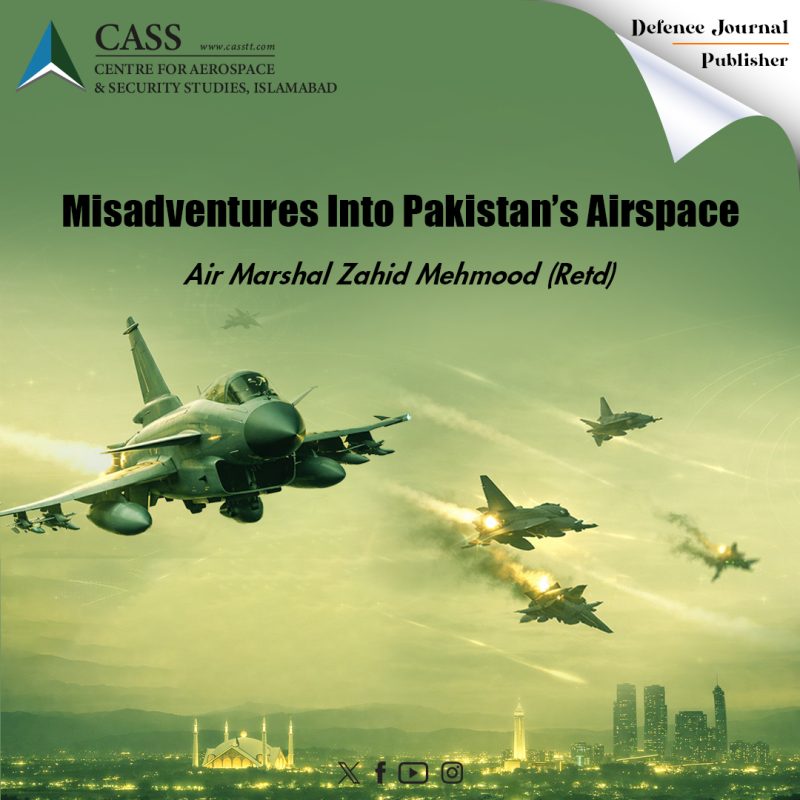
Overflight of civil and military aircraft is governed by specific laws and procedures. Violation of national airspace automatically grants a nation the right to defensive and subsequent legal action against the violator. A violation of airspace by a military aircraft thus assumes a more dangerous dimension, with stern reaction and graver consequences. Military aviation, therefore, pays special attention to peacetime aerial activities with a view to respecting the international and territorial airspace of other countries. When military aircraft violate the airspace of a sovereign nation having a potent Air Force, such as Pakistan, the event can at best be described as a “Misadventure”.
The IAF (Indian Air Force) has been undertaking these misadventures for a very long time and meeting catastrophic results on every occasion. The first incident involved an IAF English Electric Canberra B(I)58, belonging to No. 106 Squadron. On April 10, 1959, which was the day of Eid-ul-Fitr, the aircraft entered Pakistani airspace on a high-altitude photo-reconnaissance mission. Two F-86F Sabres from PAF’s No. 15 Squadron (the “Cobras”) were scrambled from PAF Base Peshawar to intercept the intruder. The mission was led by Flight Lieutenant M. N. Butt, with Flight Lieutenant Muhammad Yunis as his wingman. While the Canberra was flying at over 50,000 feet—beyond the Sabre’s normal operational ceiling—it lost altitude during a turn over Rawalpindi. Flight Lieutenant Yunis seized the opportunity and shot it down at 47,500 feet over Rawat. Both Indian crew members, Squadron Leader J.C. Sengupta and Flight Lieutenant S.N. Rampal, ejected safely and were captured. They were repatriated to India a day later. Flight Lieutenant Yunis was awarded the Sitara-i-Jurat for his achievement.
Pakistan claimed that the Canberra’s mission was to take aerial photographs of strategic installations between Lahore and Rawalpindi, and that the aircraft had been warned by hand signals and warning shots in front of the plane. The Foreign Office of Pakistan published a press note allegedly with a written statement of Sqn Ldr. J.C. Sengupta, which revealed the hostile nature of his mission to photograph certain military targets in Pakistan. The press note emphasized the fact that the incident took place on the Eid when the Indian Air Force expected that the Pakistani defence personnel, like the rest of the nation, would be celebrating Eid and it would consequently make their espionage mission less risky and more promising on that day.
The PAF was challenged by IAF during the wars of 1965 and 1971. Facing an enemy three times its size, the PAF came out of these wars with superior kill ratios. During periods of relative calm, PAF continued its vigil and remained steadfast in defending the airspace. PAF’s unflinching resolve to defend the national airspace continued during the period when the erstwhile USSR had occupied Afghanistan. Between 1981/82 and 1988, the PAF intercepted and shot down 10 Soviet aircraft, without a single combat loss.
During the 2001-02 standoff, the IAF again violated Pakistani airspace and met the same fate. On June 7, 2002, the Pakistan Air Force (PAF) intercepted and shot down an Indian Unmanned Aerial Vehicle (UAV) that had violated Pakistani airspace. The UAV was identified as an Israeli-made Searcher-II drone operated by the Indian Air Force (IAF) on a reconnaissance mission. The drone was shot down near the Raiwind-Kasur Road, roughly 30 km inside Pakistani territory. A PAF F-16B aircraft, flown by Squadron Leader Zulfiqar Ayub and Squadron Leader Afzal Awan, engaged the drone at night using a heat-seeking missile (AIM-9L Sidewinder). The wreckage was recovered and displayed by Pakistani officials, who cited it as evidence of Indo-Israeli collaboration.
On June 19, 2017, the Pakistan Air Force (PAF) shot down an Iranian unmanned aerial vehicle (UAV) in the Panjgur area of Balochistan, near the Pakistan-Iran border. The drone was targeted after flying 3-4 kilometers inside Pakistani territory. Pakistani officials confirmed it was an unmanned aircraft operating in their airspace. The Pakistan Foreign Office confirmed the event and notified Iranian authorities, citing that it was an unmarked, unidentified drone. This incident occurred during a period of high tension between the two neighbors, following security concerns along the border.
In recent history, the IAF continued with its misadventures and met disastrous results. In 2019, the IAF attacked an alleged terrorist camp near Balakot. During the reciprocal action “Operation Swift Retort” the PAF attacked Indian targets on a quid-pro-quo basis. During the IAF defensive air operations, PAF shot down two IAF aircraft and one IAF helicopter was lost due to fratricide. Wing Commander Abhinandan, who had violated Pakistani airspace, was shot down, captured and later handed over to India as a gesture of goodwill.
Failing to learn any lesson, the IAF attempted the same mistake on a much larger scale in 2025. During May 2025, the IAF attacked multiple targets inside Pakistan. The PAF responded aggressively, and during one hour, the IAF lost seven aircraft, including the highly publicized Rafales. This unprecedented and unexpected result shocked IAF into silence and it did not fly any aircraft for the next two days. Failure to learn from history remains the hallmark of IAF. “Insanity is doing the same thing over and over again and expecting different results.”, the statement is widely attributed to Albert Einstein, yet remains unknown to IAF planners.
Air Marshal (Retd) Zahid Mehmood is a Senior Director at the Centre for Aerospace & Security Studies (CASS), Islamabad.The article was first published in the Defence Journal Magazine. Email: [email protected]