
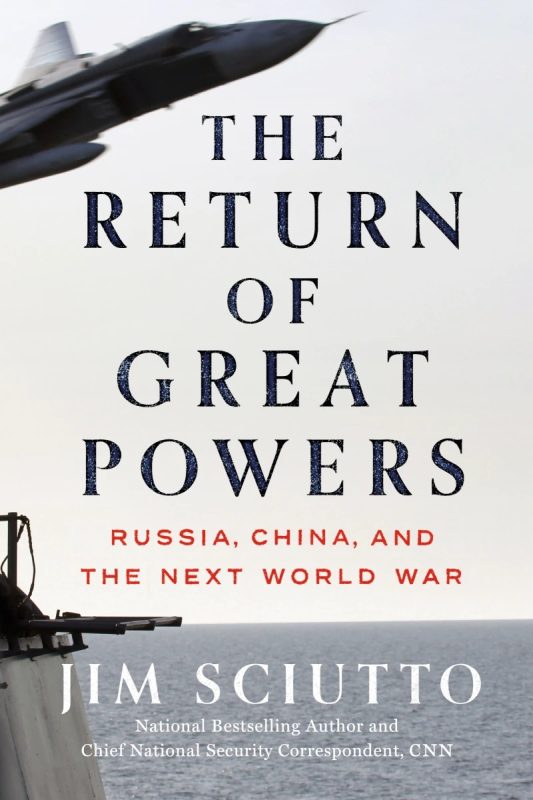
The Return of Great Powers: Russia, China, and the Next World War (New York: Dutton, 2024).
Reviewed by Saba Abbasi
The Return of Great Powers: Russia, China, and the Next World War is a comprehensive guide that seeks to understand the major global shifts in contemporary times. It provides an analysis of the state of international politics and acts as a guide to navigate the intricacies of the current geopolitical landscape. With an understanding of the role, motives, and aspirations of the key actors involved, the book offers a detailed, nuanced, and in-depth commentary on the current world order and where it is headed.
The book’s author, Jim Sciutto is CNN’s Chief National Security Correspondent, who also served as Chief of Staff to US Ambassador Gary Locke in China from 2011 to 2013. The analysis in the book is drawn from interviews with the USA’s senior policymakers and military figures. The book incorporates extensive use of the primary data drawn from those interviews.
In his book, Jim Scuitto discusses the ‘flash points’, which are the source of heightened tension among the major global powers – the USA, Russia and China. He also provides a historical perspective on these flash points, explaining how the relations of global powers strained over these flashpoints and how they approach these conflicts according to their doctrines.
The three flash points around which the author builds the framework of the current international relations are the Baltic Sea, Taiwan and Ukraine. After establishing an understanding of the flash points, Scuitto analytically deliberates about the factors that make each great power adopt a specific doctrine regarding a particular flash point and how these powerful states communicate their aims and intents nonverbally when it comes to their theatres of interest or concern.
The author notes the inconsistent guarantees by the USA with respect to Taiwan and explains that America’s posture and statements for this particular flashpoint are driven by the intent of preventing any possible Chinese invasion and for the objective of a broader doctrine of deterrence. However, the book also questions the efficacy of the USA’s signalling for the Taiwan issue, questioning if such a strategy will be viable in the long run.
Scuitto discusses the unusual and unique cooperation between the United States, India and China in 2023, when the three states collectively aimed to deter Russia during a sensitive period of heightened tensions. From that instance, he tries to deduce a deeper understanding of the states’ strategic goals and how they cooperate and manoeuvre their otherwise strained relationship for the achievement of common objectives. The volume states the Baltic Sea as another flashpoint and notes that it serves as a point of contention between NATO and Russia. It examines that both entities engage in small, potentially conflict-inducing actions from time to time in order to gauge how far they can push against each other.
In the later part, Jim Scuitto terms the Russian invasion of Ukraine as not the start of global order, but rather a global disorder. He also claims that apart from the Russian invasion of Ukraine, another factor that played a role in the commencement of this global disorder was the US’s own abdication of role and responsibility of a great power since the Second World War.
He theorises that three global powers–the USA, Russia and China–were already strategically manoeuvring around the different flashpoints, but for Russia to initiate an offensive against Ukraine established that the relative global peace that persisted since the 1991 Soviet disintegration is a thing of the past.
Moreover, The Return of Great Powers places considerable emphasis on the role of leadership in shaping contemporary great-power rivalry. Sciutto shows that strategic outcomes are not driven by structural forces alone, but by the judgments, perceptions, and risk-calculations of political and military leaders. Drawing on insights from senior officials and commanders, the book illustrates how leadership decisions whether in maintaining deterrence, managing alliances, or responding to crises like the war in Ukraine can either stabilize competition or push it toward escalation
The book also addresses how technological innovation and digital warfare are becoming central to military strategy. For example, drones and electronic warfare on the Ukraine battlefield suggests that technological changes complicate deterrence and escalation management. The book explores modern battlefields that reach beyond traditional land, sea, and air to include near-space, outer space, cyberspace, and emerging technologies like AI.
Jim Scuitto’s method of observing great power dynamics through the vantage points of global flashpoints is unique, and his extensive use of primary sources adds a nuanced perspective to geopolitical areas that are not considered beyond face value. Owing to its accessible narrative style and reliance on insider perspectives, The Return of Great Powers will resonate with students of international relations, policy practitioners, and military professionals alike. However, there are seemingly two limitations to the book.
The first is that the title of Sciutto’s book, The Return of Great Powers, is misleading to an extent. The book does not, in fact, focus on the return of great powers. It is primarily about the interactions among these great powers, with respect to the navigation of the mentioned flashpoints. Hence, book’s main focus remains on how these powers engage with one another on the international stage.
Moreover, the book also overlooks the role of smaller regional powers in this book. Focusing solely on the strategies and relations of the global powers such as the USA, China and Russia would be incomplete without factoring in the smaller regional power that play a role in shaping the relations of these global hegemons. Although not central to the flashpoints, but states such as Iran, Saudi Arabia, India and South Africa etc. play a critical role in the broader analysis of how the bigger states interact.
The book’s focus on three particular flashpoints around which the entire spectrum of global powers is analysed. This framework could seem restrictive to some readers, but overall, the book employs a clear and thought-provoking analyses of the evolution and future projection of the global order, significantly dependent on the relations of global hegemons.
Saba Abbasi is a Research Assistant at the Centre for Aerospace & Security Studies (CASS), Islamabad. She can be reached at [email protected].



