Group Captain Muhammad Naeem Khaliq (Retd)

Director

Group Captain Muhammad Naeem Khaliq (Retd)

Professional Experience

Group Captain Muhammad Naeem Khaliq (Retd) joined the Centre for Aerospace & Security Studies as Director in December 2025. He served in the Pakistan Air Force for 26 years in the GD(P) Branch, building extensive operational and professional experience. During his career, he flew a wide range of fighter, trainer, and AWACS aircraft, and held key command and staff appointments. He holds a Master’s degree in War Studies from the National Defence University, Islamabad. He holds an Airline Transport Pilot Licence (ATPL) from Pakistan Civil Aviation Authority and is a Qualified Flying Instructor certified by both PAF and PCAA. Additionally, he possesses multiple professional qualifications in Aviation Safety and Aircraft Accident Investigation.


Publications

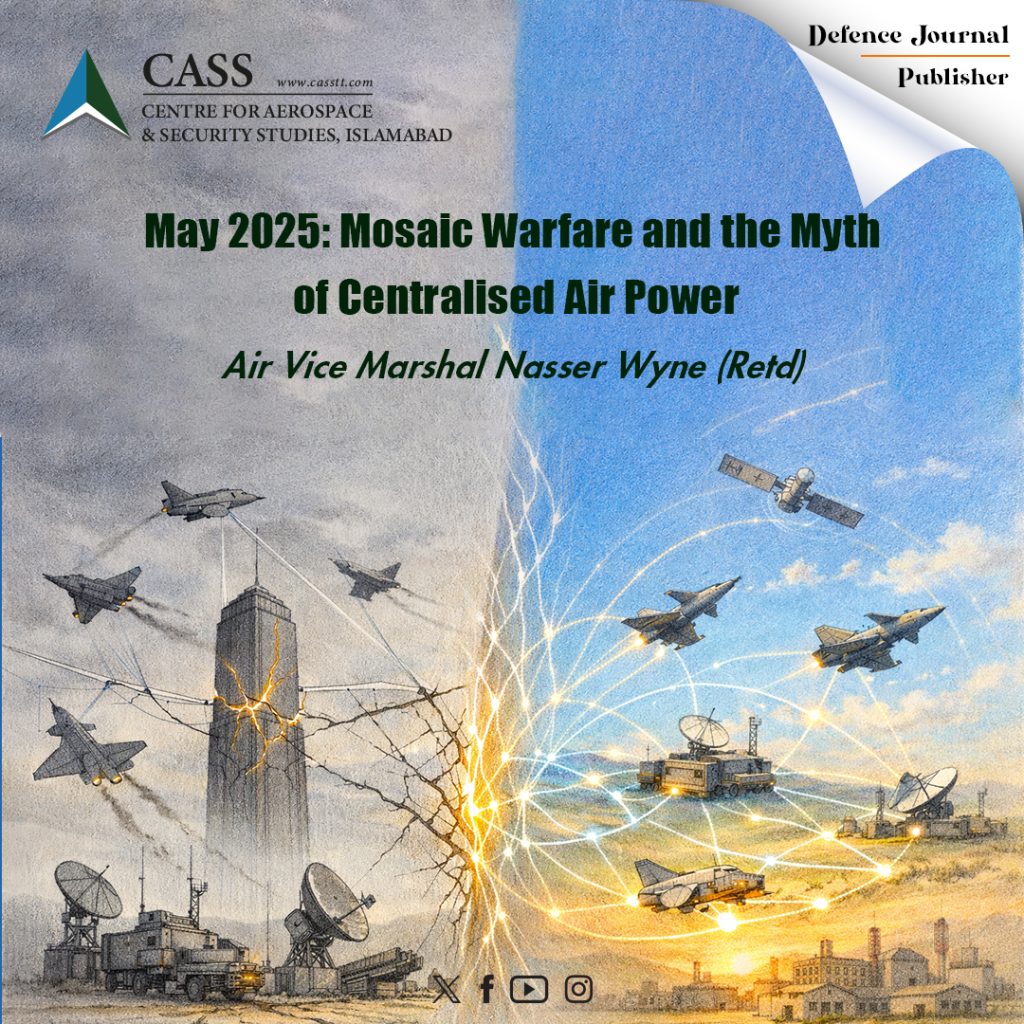
May 2025: Mosaic Warfare and the Myth of Centralised Air Power

Visualise a modern-day Air Force commander sitting in the operations room, miles away from the combat zone, overseeing every friendly and enemy aircraft and all assets involved in the campaign. In a split second, he can task a fighter, reposition a drone, and authorise a strike. In today’s promising technological era, he does not even need an operations room; a laptop on his desktop will suffice. The situation looks promising as it offers efficiency, precision, and control. The term used for such operational control is ‘centralisation’, which has been made possible with advanced networking, integrating space, cyber, surveillance, artificial intelligence, and seamless communication, enabling a single commander to manage an entire campaign from a single node. Centralised command and control, championed by the Western air forces and then adopted by many others, has thus been seen as a pinnacle of modern military power.
The concept of centralisation, enabled by state-of-the-art networking, may seem promising, but it is nothing more than a myth.
Read More »

PAF’s Transformation: Operation Swift Retort to the 4-Day War of May 2025

The Air Force is an inherently technology-sensitive force, and without adopting emerging technologies, concepts, and doctrines, it risks falling behind in effectiveness and relevance. Aware of this eventuality, the leadership of Pakistan Air Force (PAF) has always remained open to change and ready to embrace the evolving character of warfare. The PAF’s success in the “4 Day War of May 25” lies in its transformation during the period from Operation Swift Retort in 2019 to the May 25 war.
Prior to ‘Operation Swift Retort’ in 2019, the air power balance between the PAF and the Indian Air Force (IAF) was defined by distinct yet comparable capabilities. The IAF operated a technologically diverse fleet that included SU-30 MKI, while the remaining fleet comprised older legacy fighters, such as Mirage-2000, MiG-29, MiG-21, and Jaguars. The PAF, meanwhile, had in its inventory the F-16 Fighting Falcon

Read More »

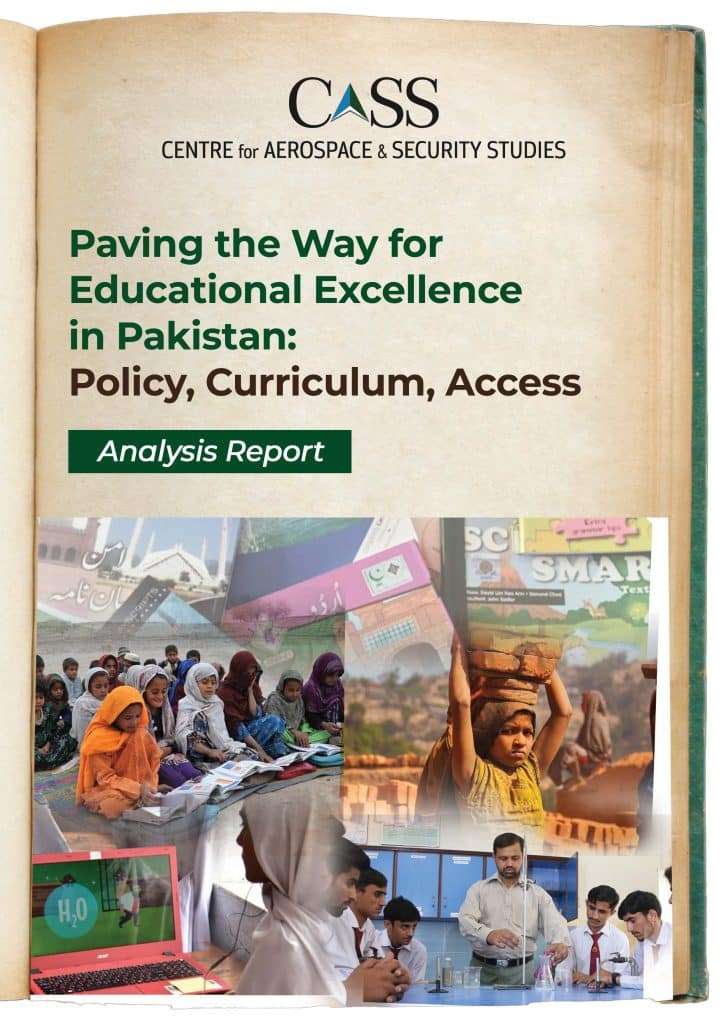
Paving the Way for Educational Excellence in Pakistan: Policy, Curriculum, Access

The Centre for Aerospace & Security Studies (CASS), Islamabad has a tradition of initiating timely, well-informed and policy-relevant debates on subjects of national and international importance through publications, conferences, seminars, webinars and guest lectures by leading diplomats, policy experts, senior civil and military officers, scholars and media.  These policy debates are closely followed not only by policymakers/experts, relevant institutions, academia and media but also by the international community.

4 views

Read More »