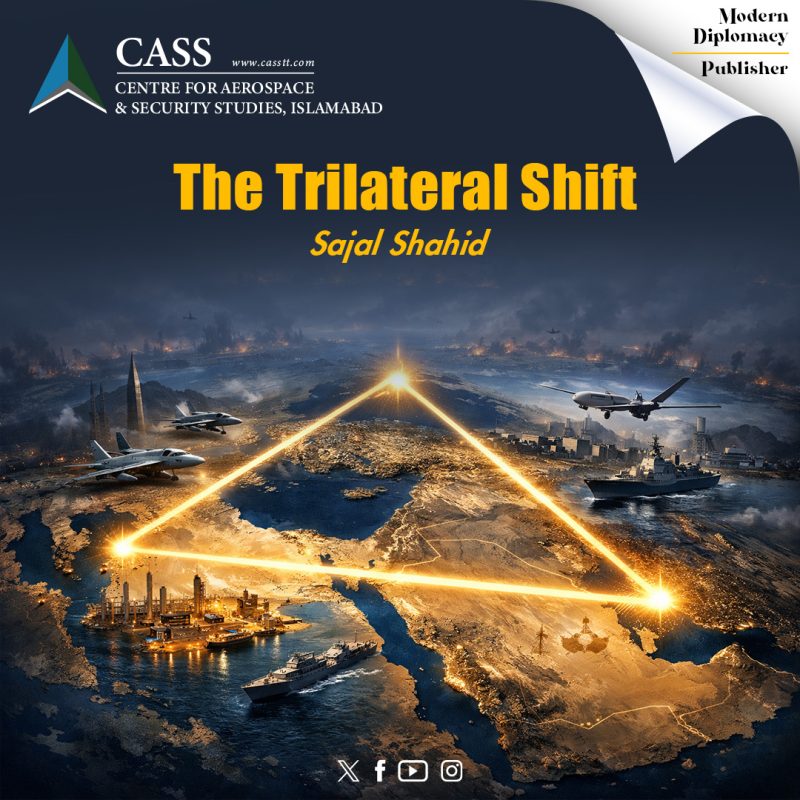
On 15 January 2026, the Pakistani defence production minister confirmed that an agreement for a new trilateral defence deal between Pakistan, Saudi Arabia, and Türkiye is in the pipeline, other than the Pakistan-Saudi bilateral deal announced last year. Though no formal accord has been signed as yet, nor have any terms been made public, the countries’ acknowledgement of the long-discussed deal has nonetheless inspired considerable discourse regarding its potential. While it is expected that the agreement would primarily focus on defence, it is also important to view this as a broader part of alliance-building as well as examine its potential implications for Pakistan.
The year 2025 and early 2026 have been marked by sustained tension and volatility. Despite a fragile peace accord, Israel continued to wage war in Palestine for more than two consecutive years. South Asia also witnessed a new standoff between two nuclear-armed rivals, with India’s BJP-led government still asserting that Operation Sindoor remains active. Elsewhere in West Asia, Iran found itself a target of Israel and the US’s combined aggression, halted through a brittle ceasefire on the verge of crumbling. Amidst this instability, as US-China competition deepens and American engagement in the western hemisphere rises, new alignments and alliances are to be expected. Under these circumstances, it is no longer an option for any rational state to limit its choice of alliances or even to be dependent on powers like the United States.
The new trilateral shift is a logical development within this geopolitical context. The increasing disappointment of Türkiye with the ‘semi-peripheral’ position in the NATO alliance forces it to diversify its allies. Whereas, the growing destabilisation in the neighbourhood causes Kingdom of Saudi Arabia (KSA) to find allies with whom it shares common interests. Likewise, Pakistan, which is aware of the changing geopolitical configuration, strives to guarantee its own security. The three states bring in different strategic values to the alliance.
Türkiye, which fulfils 70 per cent of its defence requirements by means of local industrial projects, provides the opportunity of having a well-trained and knowledgeable partner with the possibility of cooperation in the sphere of defence production. KSA, boasting a GDP of more than USD 1 trillion and being bordered by the Red Sea and the Persian Gulf, offers not only capital power but also direct control of key sea shipping routes and naval bottlenecks. Moreover, with its symbolic importance in the Muslim world, Saudi Arabia adds political weight and influence to the alliance. Pakistan, the sole nuclear state in the group, augments the general capacities of the bloc with its seasoned and tested military that has proven itself many times against bigger enemies, including the recent May 2025 confrontation with India. Together, the personal resources and geographical position of these states herald the establishment of a new security route connecting the Red Sea, Indian Ocean and Eastern Mediterranean.
Besides the successful establishment of a triangular connection between three distinct geostrategic points, this new defence deal also presents new prospects to Pakistan. The fact that Türkiye announced its interest in becoming a member of a tripartite alliance shortly after the formalisation of the Pak-Saudi Strategic Mutual Defence Agreement (SMDA) places Pakistan in the position of acting as a bridge between defence ecosystems, which can only be reinforced should other states join the alliance, as it has been theorised. Moreover, it provides new opportunities to be pursued, especially in the fields of trade, technology and the defence industry that could uplift the role of Pakistan. The possibilities of this arrangement have already been observed at the international level with the UAE and India signing a Letter of Intent (LOI) to enhance their security relationship soon after the news, creating speculation about a potential reinstatement of the India, Israel, UAE, and US (I2U2) alliance as a counter-bloc.
Nevertheless, each development is associated with risks. Although the speculation about the further expansion has prompted many to make comparisons to NATO, it is necessary to comprehend the major differences. Where bilateral arrangements need minimal effort to reach consensus on leadership positions and decision-making processes, larger groupings necessitate broader coordination. In contrast to NATO, an enlarged Pakistan-Türkiye-Saudi Arabia alliance would lack a superpower to steer and anchor the arrangement, and the states would have to tread carefully between competing interests to achieve coherent operation. In the same manner, a more expansive bloc casts doubt on decision-making procedures. Will the expansion of the alliance require the initial states to have veto power, or can equal voting be preserved? Will it be rotational leadership among the members as in BRICS, or will a single state take over permanently? All these are some of the considerations that have to be addressed in order to make any alliance effective. In any case, this new configuration is an indication of a wider change in geopolitics wherein the breakdown of international rules, the emergence of greater instability, and a more interest-driven superpower are causing states to reevaluate their alliances in the world.
Sajal Shahid is a Research Assistant at the Centre for Aerospace & Security Studies (CASS) Islamabad. The article was first published by Modern Diplomacy. She can be reached at [email protected]