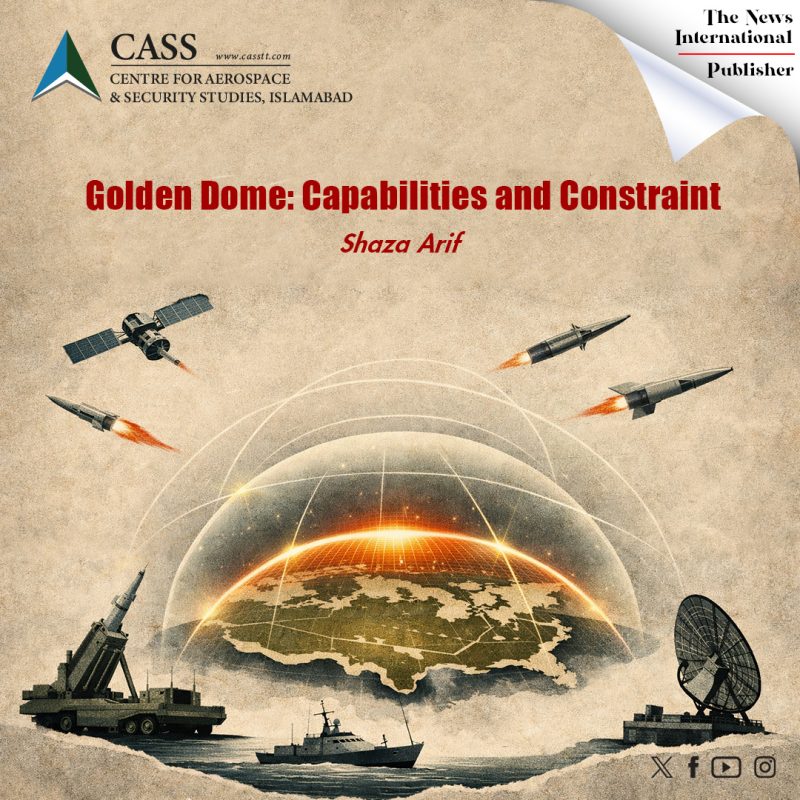
In an era of novel threats, a layered defensive shield is once again at the centre of US strategy. The announcement of the Golden Dome by President Trump shortly after assuming office has given rise to new expectations, questions, and concerns regarding the project.
The capability is envisioned as a comprehensive missile shield for the continental United States (CONUS) against ballistic missiles, hypersonic vehicles, cruise missiles, and UAVs. Conceived as a multi-tiered system, it aims to integrate existing missile defences with new space-based platforms. The layered system, combining land, sea and space-based sensors and interceptors, reinforced by a robust command and control network, addresses missile threats in multiple phases – launched from anywhere in the world. It is capable of dealing with both terrestrial and space-based threats. Amongst others, the space-based dimension of the Golden Dome is arguably the most ambitious feature of the initiative. Apart from persistent orbital coverage, the continuous tracking and interception capability over CONUS significantly exceeds the scale of any existing missile defence systems. Given the scope of the system, it has the potential to impact deterrence calculations and threat perceptions, leading to systemic global security implications.
Despite its claimed capabilities, the initiative also faces a range of challenges. In the operational domain, there will be challenges against concentrated saturation attacks, without exhausting defensive assets. Principally, the initiative underpins the same concept as the Israeli Iron Dome, yet the area to be defended is nearly 450 times larger than Israel. Equally challenging is the development of an effective Battle Management Command Control and Communication architecture capable of addressing advanced threats. Deployment of a sufficient number of space-based interceptors and sustaining them at an affordable cost further compounds the challenges. In addition, the long-term success of the initiative will rely on maintaining an open architecture – one that is capable of integrating existing technologies while simultaneously having the capabilities to address future capabilities. All of this has to be done in a complex institutional setup that involves multiple and diverse stakeholders, including the Army, Navy, Air Force, Space Force, Missile Defence Agency and a diverse pool of private space companies – with Congress having an overarching role.
Cost offers a major obstacle in the operationalisation of the capability. As per the Trump administration, the current estimated cost of the initiative is claimed to be USD 175 billion. However, a recent Congressional Budget Office Report suggests a cost as high as USD 542 billion, depending on scale and technological assumptions. Experts suggest that the cost could potentially reach USD 3.2 trillion over next 20 years. Hence, the political and budgetary prioritisation of the system across different administrations remains uncertain, particularly in the absence of an immediate impact of the technology. Beyond fiscal considerations, the logistical aspect of such an initiative would require specialised supply chains and enhanced industrial capacity.
Technological constraints also present numerous challenges to the initiative. The US military’s ground-based Midcourse Defence (GMD) system’s ability to destroy incoming missiles before their entry into US airspace has a success rate of 60 percent. Likewise, the US currently has 44 ground-based interceptors. While such capability might be sufficient against threats such as a potential attack from North Korea, it may not suffice for the scope of the Golden Dome. Hence, meeting the envisioned scope of the Golden Dome would require a substantial increase in human resource, interceptor numbers, enhanced kill-vehicle reliability, integrated sensor–command architectures capable of countering large-scale, complex missile salvos and protection of deployments. Moreover, the space-based layer is likely to be the most technologically complex stage. While the US Space Force is investing notably in Space-based interceptors (SBIs), they are not in the operational stage. Apart from breakthroughs in orbital missile defence technologies, new satellites would require to be deployed in the low-earth Orbit (LEOs) for robust surveillance in space. Similarly, multiple systems requiring integration add more complexity to the success of the system.
While the Trump administration has shown its intent to field some form of the system by 2028, the optimum employment of a fully operational system is improbable. Nevertheless, even if partially deployed, it is likely to deliver meaningful incremental capabilities. Realistic and achievable goals include upgrading radars, advancing mid-course surveillance and demonstrating early space-based capabilities. In contrast, high-level threats such as saturation and hypersonic capabilities will require more time, investment and technological advancement beyond the projected timeframe.
The system is envisaged to ensure the US maintains a deterrent capability; the chances of a global power arms race run high. This is particularly relevant in the space militarisation vis-a-vis major space powers, triggering countermeasures and expansion of offensive capabilities. Hence, the scale, cost and associated complexities risk reproducing the vulnerabilities that the system intends to mitigate. In the regional context, Pakistan is not directly impacted by the project. However the system will shape the missile and space trends that impact the strategic environment in which Pakistan operates vis-a-vis India. Indian access to US military capabilities could complicate the deterrence stability in India-Pakistan equation. In this context, Indian ambitions vis-à-vis its advanced layered defence, Sudarshan Chakra, are increasingly relevant for regional dynamics. Historically, such trends incentivise buildup in offensive capabilities such as multiple independently targetable re-entry vehicle (MIRVs) rather than fostering restraint. Similarly, the militarisation and a more congested space inadvertently leads to normalisation of space as an operational warfighting domain. Resultantly, pursuing cost-effective deterrence and diplomatic engagement vis-à-vis cooperation in space governance will be crucial.
The Golden Dome initiative is not new, rather it echoes similar discourse emerging from the Cold-war era. The concept revives President Ronald Reagan’s once-famous Strategic Defence Initiative (SDI). Although operationalized in an era where technology is much more advanced, it is encountered with similar realities. The real test of the technology is its ability to align technological optimism with operational realities.
Shaza Arif is a Senior Research Associate at the Centre for Aerospace & Security Studies (CASS), Islamabad. The Article was first published in The News International. She can be reached at [email protected].