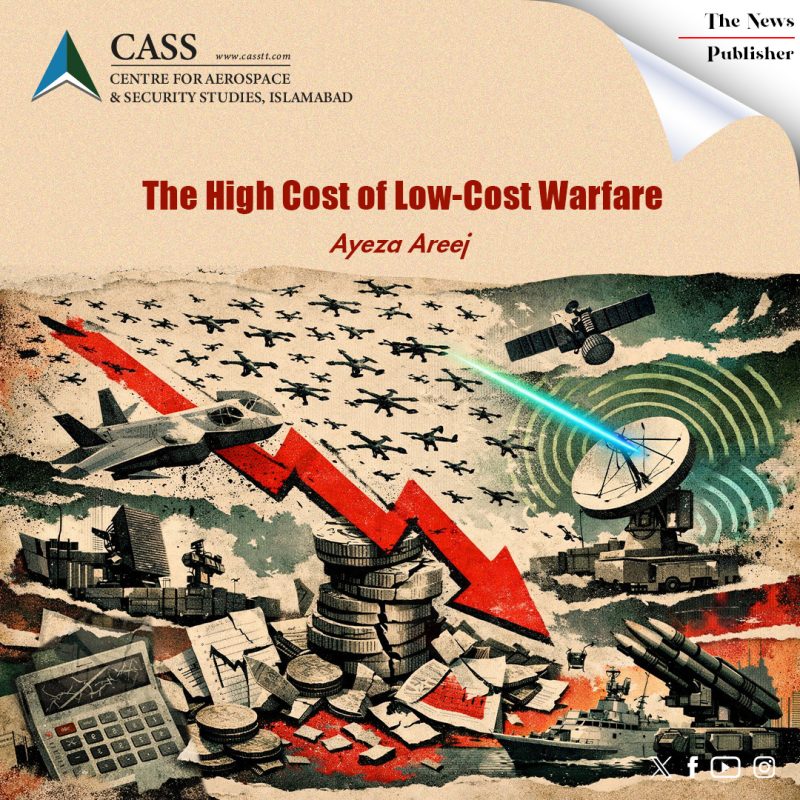
‘If we don’t figure out a way to fight far more cheaply, we won’t be able to afford to win a single battle.’ This warning from Peter W. Singer, an American strategist, reflects a reality that the arithmetic of warfare has inverted. The economic equation of conflict has changed so rapidly that a USD 500 drone can now target billion-dollar assets of state-of-the-art militaries. Meanwhile, the cost of counter-drone technology has risen to an absurd level. This cost curve has become a greatest vulnerability and a critical weakness for major powers. Consequently, states are indulging in a race not just to build cheaper and expendable drones but also affordable counter-drone capabilities because the economic cost of the conflict is now as decisive as the firepower itself.
States, worldwide, are revamping their operational framework producing and acquiring advanced and AI-enabled drone fleets for surveillance, intelligence, reconnaissance, strike and swarming missions. Russia and Ukraine produce approximately four million drones every year by using local manufacturing units. Simultaneously, China is emerging as an industrial base of drones by manufacturing about 12 million Unmanned Aerial Vehicles (UAVs) per year. On the other hand, United States, which has historically relied on sophisticated and expensive platforms, is producing only 100,000 drones every year. However, it is planning to cover this gap by expanding its annual production to one million before 2028. This evident surge in production, introduces new challenges, allowing UAVs to destroy high value assets.
Operation Spider Web, launched by Ukraine against Russia, is a clear manifestation of how inexpensive unmanned drones with first person view can be weaponized to hit strategic nerve centers. In the operation, Ukraine destroyed Moscow’s USD 7 billion defense related assets, including early warning and control aircrafts and strategic bombers, damaging Russia’s second-strike capability. The disruption and destruction of Russia’s top-tier defense systems by adapting low-cost drones boosted Ukraine’s warfighting potential.
Meanwhile, Iran’s Shahed 131 and Shahed-136 have proven effective to the extent that U.S. has reversed engineered them. Recently, Tehran has also announced its inexpensive, radar evasive jet-powered Hadid-110 suicide drones, which can travel at the speed of 510 Kilometres per hour, inspiring other states to invest in such technological innovations. Apart from that, the low-cost drones also enabled weaker entities like Hamas and Hezbollah to bypass advanced Israeli air defences. By incorporating cheaper and adaptable battlefield frameworks, technological advantage of highly sophisticated and advanced militaries can be counteracted using UAVs.
Yet, the proliferation of unmanned aerial systems pushed states towards developing anti-Unmanned Aircraft System (UAS) capabilities. Ironically, many countries including the U.S. kept relying on expensive platforms to counter aerial threats. However, this approach is strategically flawed, unsustainable and ineffective as spending billions on missiles and interceptors to mitigate unmanned aircrafts is counterproductive. In the contemporary era, battlefield victories not only depend on superior weapon systems alone but also on how effectively pervasive aerial threats are neutralized through affordable tactics.
By internalizing this strategic reality, the U.S. and United Kingdom have launched Project Flytrap in Germany, which highlights a transformation in counter-drone posture of North Atlantic Treaty Organization (NATO). In this exercise, a flexible layered counter-drone network was created by using both NATO and non-NATO technologies. Wingman detection systems and portable jammers were used to detect and disrupt incoming projectiles at the frontlines. U.S. soldiers tested advanced and innovative ways to counter drones. For instance, net shooting, hunter drones, 0.50 calibre machine guns and modified 5.56 rifles have been presented as cheaper and faster options to shoot drones. The U.S. Army accepted that they are shifting towards more affordable and efficient tactics ‘from shooting USD 4 million missiles at USD 20,000 drones.’
Globally, states are moving towards acquiring layered and responsive air defence systems considering the proliferation of low-cost drones. Israel, for instance, has developed 100 KW combat laser system, called laser beam, at a fraction of the cost. Israeli defence officials claim that this system can intercept rockets, mortars and other aerial threats with high precision and reliability by spending only few cents of electricity. What further makes this system special is the ability to intercept low-flying aircrafts and UAVs, which is an area of vulnerability for traditional interceptors guided by radars. Furthermore, the deployment of Dragon Fire laser by U.K. demonstrates this cost calculus. This Directed Energy Weapon (DEW), known as Dragon Fire laser, is capable of hitting the target with a cost of GBP 10 per shot. Apart from that, London has recently tested a DEW, which disables the enemy drones using radio frequencies. These cost-effective and advanced drone neutralization systems are bringing a paradigm shift in the overall economics of warfare.
The drone revolution offers profound strategic lessons. Border security and Intelligence, Surveillance and Reconnaissance (ISR) can be enhanced through development of cheaper and expendable drones. Despite this, large-scale production of UAVs alone is not enough. States should strategically invest in adaptive battlefield architectures by producing low-cost anti-UAS systems, such as laser weapons, electronic jammers and radio frequency DEWs, to achieve tactical superiority at a substantially lower cost.
Ultimately, drone and counter-drone technologies are altering the economic calculus of warfare. In future wars, victories will be achieved not by the deployment of expensive platforms, but through inexpensive defense and offence at operational level. Adaptability and affordability are not only pertinent elements but the ultimate weapons in the modern warfare.
Ayeza Areej is a Research Assistant at the Centre for Aerospace & Security Studies (CASS), Islamabad, Pakistan.The article was first published in The News. She can be reached at [email protected]