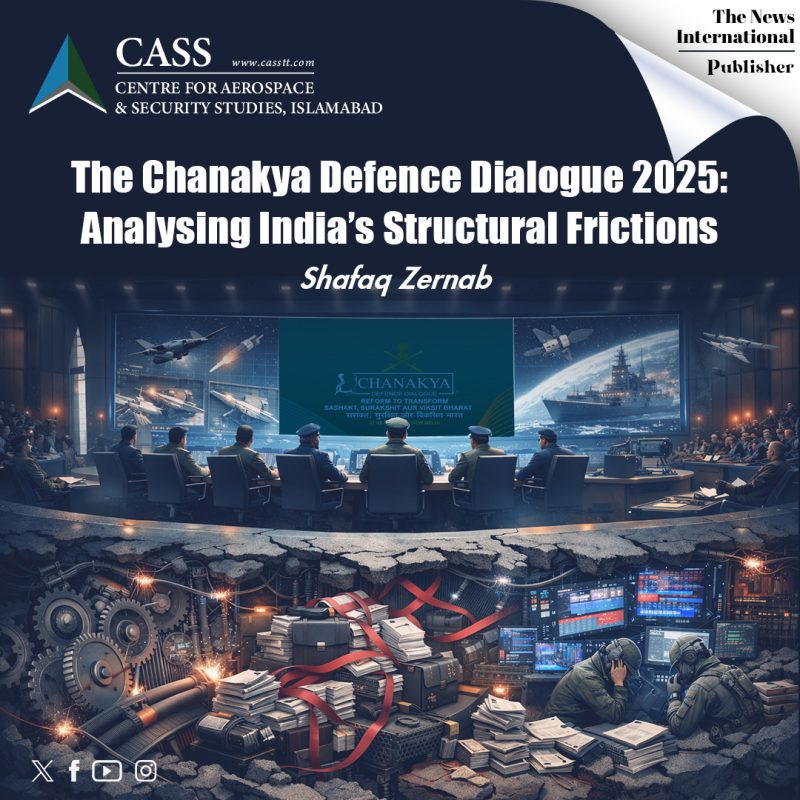
On 27-28 November 2025, India hosted its flagship high-level strategic forum known as Chanakya Defence Dialogue (CDD). Since it was convened in the strategic backdrop of Operation Sindoor, an event that India claimed, ‘shattered Pakistan’s sense of invincibility’ and established a new ‘strategic grammar,’ naturally caught the attention of strategic minds in Pakistan. Yet, ironically the event exposed the vulnerabilities in India’s defence ecosystem. The confessions from senior military and industrial leadership revealed that internal frictions like bureaucratic inertia, cognitive warfare vulnerabilities and operational capability gaps are the real ‘monoliths’ that prevent India from becoming the ‘future-ready’ force that it claims to be under ‘Vision 2047.’
The theme of CDD 2025 was ‘Reform to Transform: Sashakt, Surakshit aur Viksit Bharat,’ comprising 5 sessions, setting an agenda around Indian military Vision 2047. It is a strategic culmination of 4 springboards, including self-reliance, accelerated innovation in emerging technologies, civil-military fusion and cross-domain synergy, aiming to establish a fully-integrated force capable of carrying decisive multi-domain operations in a sustained and systematic way.
However, the dialogue exposed the internal impediments to realising this vision. The most striking revelation of the Dialogue was the consensus among the majority of military leaders that slow bureaucratic processes have undermined strategic aspirations. Mr Ankit Mehta highlighted that administrative lethargy puts India at a disadvantage, citing that technology delays risks obsolescence before deployment. Shri Baba Kalyani, Chairman & MD, Bharat Forge Ltd, criticised the absence of a regulatory mechanism for the procurement of single-vendor innovations. Former CNS, Admiral Karambir Sigh (Retd), posited that several layers of ‘process-oriented’ bureaucracies are the ‘biggest monolith,’ which could potentially undermine India’s goal of achieving ‘tempo-dominance’. Reform proposals to tackle this challenge include a Defence Technology Council to override slow cycles and shared accountability for finance controllers.
At CDD, regarding the doctrinal and operational flaws within the institutions, there was a shared albeit covert recognition from industrial and military officials, necessitating an immediate paradigm shift. As Ms. Prabha Goel, Executive Director (Marketing), BEL claimed that recent conflicts have unravelled India’s own capability gaps, which was endorsed by Admiral Singh. He argued that stove-piped organizational systems are incapable of delivering fifth-generation warfare capabilities. India’s structural deficiencies demand a leap from ‘jointness’ to ‘fusion,’ integrating intelligence, logistics and HR.
Failure to react will trap India in precarious retrofits; patching old systems and ceding advantage in a domain where future readiness hinges on embedded AI and sensors integration. This urgent shift to ‘Less steel, more sensors’ was aptly captured by Dr. Adrian Haack, Director, KAS. Lt Gen Raj Shukla (Retd), Member UPSC, pressed upon the issue of ‘obsolescence’ due to failure of integration, citing the challenges faced in the Russia-Ukraine war. This suggests that India is keen to address this critical flaw, realising that operational success hinges on an all-encompassing doctrine to achieve success on conventional, cognitive and algorithmic fronts.
The dialogue exposed a core contradiction in the Atmanirbharta (self-reliance) drive, rooted in procurement failures and inadequate financial commitments, stifling indigenous innovation. Ambassador Pankaj Saran, Former Deputy NSA criticised the unrealistic short deliveries provide India ‘screwdriver technologies’ and discourage R&D. This highlights that India’s military procurement manuals that prioritise process over results are outdated. Moreover, Indian claims of technological superiority are also stalled by large capital requirements, co-creation and testing support.
Perhaps the most important aspect was the emphasis on training of personnel. According to an article published in Dawn, a total of ten Indian Air Force jets were destroyed between 2020 and 2025. The major reasons were system malfunction, on-board emergency, but most importantly, training of personnel, where IAF lacks significantly as compared to Pakistan.
Lastly, the VCOAS (Lt Gen Pushpendra Pal Singh) designated strategic communication and narrative building as mission critical. However, during the dialogue, Palki Sharma tried to set the pace for toxic narrative but her initial outburst failed to excite the audience, which reveals the fragility of Indian domestic cognitive ecosystem. In a country where 98% of WhatsApp users treat forwards as authentic news show how BJP’s shallow narratives provide a ripe territory for manipulation. This renders India prone to AI-driven psychological operations and misinformation.
The CDD, intended to project India’s decisive victory, turned out to be an exposé of its internal friction points. The sane voices within Indian military, diplomatic and industrial cadre noted that bureaucratic bottlenecks, doctrinal and operational discrepancies and delayed technological inductions are the most formidable challenges that derail the materialisation of Vision 2047 of Indian military.
An analogy accurately captures the essence of India’s defence transformation. It is akin to an aspiring marathon runner, who invests heavily in high-tech shoes i.e., acquiring new platforms but does not train the core muscle i.e., the bureaucracy and R&D systems. The gear looks impressive at the starting line but without the foundational strength, the runner cannot perform in the gruelling race for strategic superiority.
Shafaq Zernab is a Research Assistant at the Centre for Aerospace & Security Studies, Islamabad. The article was published in The News International. She can be reached at [email protected]