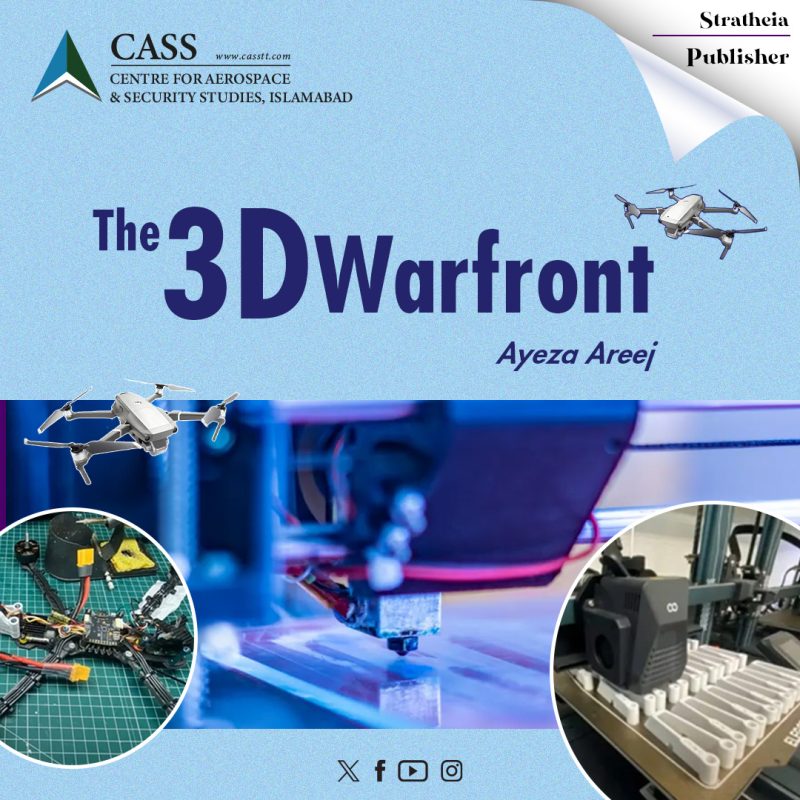
While traditional defence manufacturing depends on heavy industries and lengthy supply chains, 3D printing or additive manufacturing creates the desired object by adding layers upon layers using a digital file. 3D printing acts as a catalyst for rapid defence production even on the rough terrains or on the frontlines. This is no longer a futuristic fantasy but a cutting-edge technology that is already transforming military strategies of states.
The debut utilization of this advanced technology is manifested in the Russia-Ukraine conflict and provided Ukraine an operational edge. Ukraine has mostly acquired its military hardware from western entities; however, it is outdated and has limited spare parts. Their supply chains are under consistent attacks, which pushed Ukraine to revolutionize its tactics. The expanded version of the Component Library, announced by Ukraine’s Defence Minister, offers advanced manufacturing services like additive manufacturing. This secure digitized platform, accessible only to verified local defence manufacturers, can produce up to 170 components including batteries, First Person View (FPV) frames and antennas. It aims to boost fast indigenous production and supply delivery directly to the frontline forces.
In the current war, Ukraine has evolved as the ‘nation of drone makers’ as it can now produce more than 60 drone variants ranging from reconnaissance to kamikaze. A secret drone factory under Skyfall Company has been developed in Ukraine, which prints Shrike and Vampire UAVs at massive scale. The factory reportedly prints one FPV drone in just 23 seconds, which is closer to 4000 drones daily. The most striking point is that the 3D printers can fix the design or technical failure on the frontline in a short duration when a critical flaw gets exposed. Apart from that, Print Army has printed more than 10 million 3D printed parts in the year 2024 and it continues to produce munition fins, drone components and other essential supplies in workshops, apartments and backyards. Therefore, 3D printed munitions help sustain warfare in the long-run, as modular components can be repaired instantly and digital designs of weapons can be produced anywhere. Standardized motors, swarm capabilities and advanced batteries enable speedy and coordinated operations. It portrays that operational resilience no longer requires vast industrial set ups but technological literacy, coding skills and resolve.
Ukraine focused on FPV and interceptor drone production enhancing adaptability. For instance, a volunteer group, known as Wild Hornets, use additive manufacturing for printing low-cost sting interceptor UAVs, enhancing decentralized fabrication and expediting decision loops. A closer comparison reveals that the sting interceptor drones costing around USD 1000 to USD 5000 are a much cheaper alternative in contrast to Moscow’s Shahed drones and Washington’s Patriot drones costing USD 35000 and USD 3.3 million. A notable illustration is the use of 117 FPV drones by Ukraine during Operation Spider Web. These low cost drones targeted Russian AWACS and bombers, destroying USD 7 billion worth of Russian assets. Thus, the conflict is changing the battlefield calculus.
Apart from the drones manufacturing, 3D printing has vast applications on the battlefield. Historically, damaged or degraded armored and artillery components were sent back to maintenance facilities; however, Ukraine can now rapidly replace parts using metal 3D printers such as SPEE3D. These printers use cold spray technology to repair components in no time, enhancing operational flexibility. Alongside, 3D printing also has pertinent medical applications. Under project Diamond, it prints low-cost medical tools, prosthetic limbs and implants on site. Therefore, additive manufacturing is not only used for fighting the enemy but is also being used to save lives on the frontlines.
These developments suggest that Ukraine has adopted a crisis resilient production approach. Hence, developing countries can draw important lessons from this conflict to take subsequent actions. Firstly, countries should focus on indigenous decentralized systems of defence manufacturing, where additive manufacturing would be distributed across multiple platforms for operational efficiency. It will enhance their strategic autonomy through these sovereign production models and by lowering states’ dependence on imported defence hardware. Moreover, smaller states should focus on budget friendly weapon fabrication by working on AI-integrated UAVS for fighting asymmetric threats. This technology can help the states to get rid of the longer procurement networks and massive reserves. While additive manufacturing cannot entirely replace conventional manufacturing models that include molding, machining and forging, but it could be integrated as an adaptive and mixed system that can materialize manufacturing anywhere, irrespective of the space and time constraints.
Ultimately, 3D printing has proved to be a game changer and has undoubtedly become a test bed for additive manufacturing in Russia-Ukraine entanglement. It not only allows rapid production but also reduces dependence on vulnerable logistic chains. Thus, 3D printers will eventually turn into a significant strength for future militaries because modern combats demand operational flexibility and advanced planning.
Author Biography: Ayeza Areej is a Research Assistant at the Centre for Aerospace & Security Studies (CASS), Islamabad, Pakistan. She can be reached at [email protected]