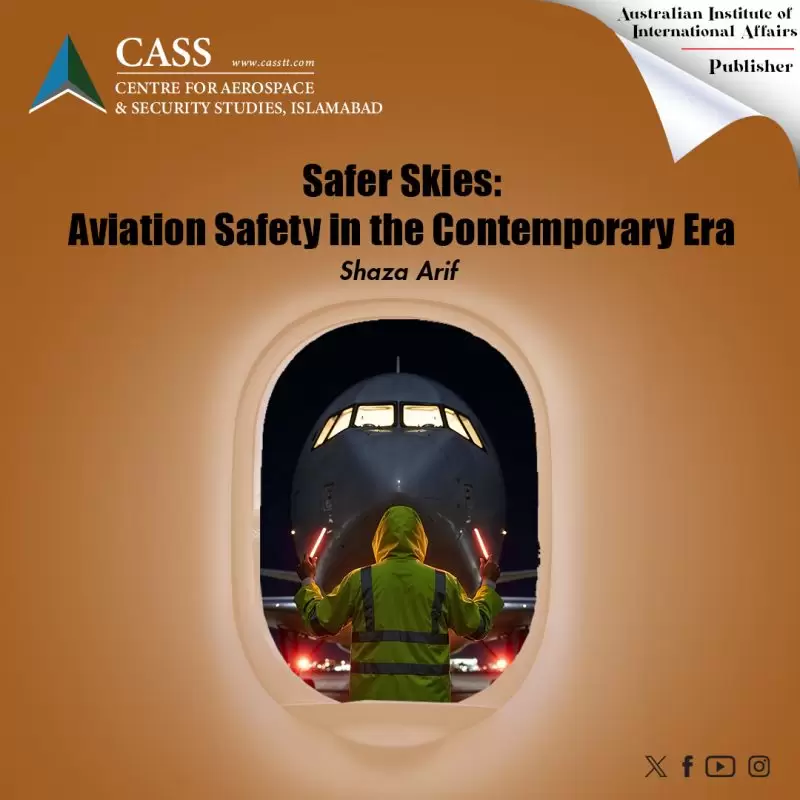
November is commemorated as Aviation History Month every year to mark the advancements in the field, while reflecting back on the lessons learnt from the past. Today, the aviation dynamics have marked a notable transformation, spread over numerous digitally linked airways. From the Wright Brother’s initial flight of 12 seconds to today’s ultra-long journey, with longest flights now exceeding 17 hours , the sector has witnessed immense transformation.
The advancements are indeed a manifestation of the industry’s century-long learning curve. The global air travel is expected to double by 2040, rising to 8 billion passengers annually as skies become more crowded with congested airspaces, there is a pressing need to address the safety and sustainability aspect.
Over time the safety standards have evolved from mechanical checklists to established procedures \ especially following the crashes witnessed during the mid-20th century such as the Tenerife Airport Disaster, British Air Tour Flight 28M and Delta Airlines Flight 191. ..For instance, global cooperation under the International Civil Aviation Organisation (ICAO) in 1944 led to the establishment of standardised procedures, protocols and certifications. With the advent of the digital era in the 1990S, new risk management frameworks such as the Safety Management Systems (SMS) came into being. Likewise, with the advent and subsequent advancements of new technologies such as AI, cyber, quantum, new domains are being explored for robust safety.
The echoes of safety reverberated at the latest Aviation Safety Transformation Summit 2025, held in the United Arab Emirates (UAE) last month. The Summit stressed on the systemic transformation of safety measures, focussing on different areas. Those included increased digital integration between regulators and operators; adoption of unified global standards for aviation safety and expansion of data-sharing frameworks for non-sensitive operational information. Likewise, there was an equal attention on investing in AI and machine learning technologies to support predictive analytics and development of specialised training programmes on digital aviation safety and risk management for industry professionals. Lastly, it called for fostering a culture of safety and governance.
The relevance of the Summit is beyond UAE. The call for digital integration is pressing. The ability to collect, process and analyse critical data will be a defining moment for aviation. In addition, it is certain that emerging technologies will play a major role in enhancing the safety of the aviation sector via enhancing situational awareness, enabling predictive maintenance and strengthening encryption. However, it is important to consider data governance before proceeding towards integration of cross-cutting technologies such as Artificial Intelligence, Quantum computing and Internet of Things (IoT). Furthermore, technology itself cannot guarantee safety; technological advancements must be accompanied with equally stringent regulations and certifications accordingly. Hence, as advanced analytics must be accompanied with frameworks that ensure accountability, transparency will remain pivotal to expand the scope of technologies in aviation.
UAE itself has showcased a pragmatic approach in its safety standards, resulting in the highest ICAO global score of 98.86 via use of AI-powered oversight mechanisms. While earlier trends have shown transitions from manual to mechanical to digital, a shift towards cognitive capabilities is on the horizon. However, it is equally important to note that there are numerous risks that are associated with such technologies. For instance the use of AI, alone, is accompanied with challenges such as data poisoning, AI bias and black box nature of the technology. Quantum computing is in its very initial stages with uncertainty associated with the technology and lack of regulatory frameworks. Likewise, cyber has its own vulnerabilities such as data breaches and unauthorised access. The key takeaway of the Summit was the reliance on technology as an enabler of human oversight in flight safety, as opposed to its replacement. In addition, given the emergence of new aviation hubs such as the Middle East, cross-regional collaboration and data sharing would become imperative.
The human resource in the aviation sector is likely to maintain its critical role in the future and therefore requires tailored training as per requirement. While new technologies are likely to augment the decision-making process, the interpretation and on-ground implementation will remain largely dependent on the workforce. Resultantly, transformation of the workforce vis-a-vis pilots, engineers, and inspectors remains crucial. In addition, fluency in data science has become increasingly more relevant in all fields.
Lastly, safety and sustainability are interlinked in contemporary times. The ultimate goal is not confined to preventing aircraft crashes but extends to performing optimally even under stressed environmental conditions. The safety aspect becomes even more pertinent in light of new threats such as climate change, which is leading to frequent and intense turbulence. The evolving priorities reflect novel challenges that need to be addressed.
While history has a lot to offer, the future of aviation remains a complex subject. The aviation ecosystem of today has transformed notably and operates under unprecedented challenges. As we commemorate Aviation History month this year, it is important to note that honouring it is to learn from its lessons and apply them in the future. While the challenges of the sector have changed notably, the same spirit that enabled the first flight is likely to guide us further in the age of algorithms.
Shaza Arif is a Senior Research Associate at the Centre for Aerospace & Security Studies (CASS), Islamabad. The article was first published in Australian Institute of International Affairs. She can be reached at [email protected]