Travelling to the avenue, the world leaders and official dignitaries passed lanes decorated with banners that read ‘Meet in Tianjin for Win-Win Cooperation.’ The Chinese port city brimmed with cultural and political visuals that resonated with the Eurasian civilisations. For two days (August 31-September 1, 2025), Tianjin became a hub of regional diplomacy that deliberated the nature of the world order. The 25th SCO Heads of State Summit was the largest in the organisation’s history, attended by over 20 world leaders and heads of around 10 international organisations.
The Tianjin Declaration began by pronouncing that ‘equitable and representative multipolarity’ is destined to be the key feature of the international system. It went on to endorse reforms in the United Nations, International Monetary Fund (IMF) and World Bank to ensure a fairer and inclusive space for Global South countries in global governance. In this regard, Tianjin Declaration closely mirrors the July 2025 Rio de Janeiro Declaration, wherein the BRICS countries unanimously advocated for a ‘strengthening Global South cooperation for a more inclusive and sustainable governance.’
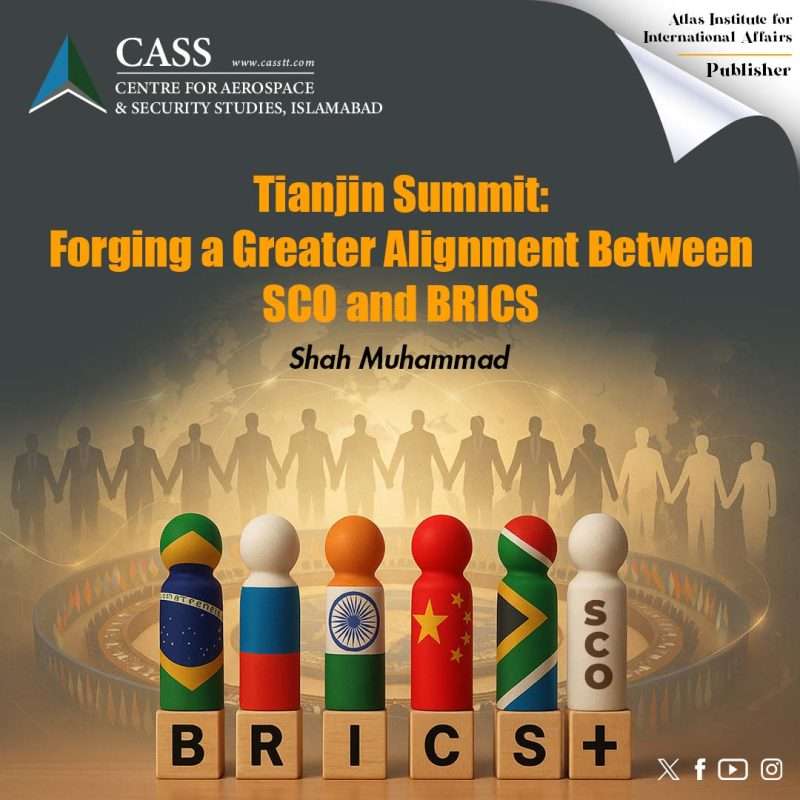
The deeper alignment between SCO and BRICS is one of the vantage points to analyse the Tianjin summit. This alignment is likely by design, with Xi Jinping and Vladimir Putin being the key architects of what may be termed as anti-West organisational convergence. In his speech during the Tianjin summit, Xi urged member countries to ‘oppose the Cold War mentality, bloc confrontation and bullying practices.’ These remarks could potentially be viewed as a pushback to the USA’s deepening geopolitical contestation against China. Similarly, Putin built a case against using finance as an ‘instrument of neocolonialism,’ while declaring that SCO has revived ‘genuine multilateralism’ in its endeavours to use local currencies for mutual trade.
It is crucial to ponder upon two pertinent questions: what would this alignment look like? And how would West react to this alignment? In response to the first question, there is overlapping membership in both groupings, with potential for further expansion. China, Russia and India are the prominent members of both, while Iran – a relatively new entrant in SCO and BRICS – is a vital bridge to the Global South. Saudi Arabia, Egypt and UAE are the new entrants in BRICS, which also maintain close ties to the SCO. When looked at separately, BRICS comprises 56% of the world population and 44% of global GDP, whereas SCO consists of 42.8% of the world population and 23.6% of global GDP. These are some of the strong indicators of both organisations’ potential to alter the global power dynamics.
The new breakthrough in alignment is Xi’s announcement at the Tianjin Summit to establish a development bank of SCO, which may be established on the model of BRICS’s New Development Bank. These banks could jointly finance major infrastructure and connectivity projects across Eurasia and the Global South at large. After greater integration and traction in the future, these could emerge as an alternative to the traditional Bretton Woods System. The Tianjin Declaration and Rio de Janeiro Declaration have recognised the salience of emerging technologies for economic gain and geopolitical clout. Therefore, digital integration of BRICS and SCO is another equally important factor of organisational convergence, with China being the key link in this regard. China is already leveraging its Digital Silk Road for the digital transformation of BRICS members. During the Tianjin summit, Xi offered SCO members access to China’s BeiDou satellite system, which is an alternative to the US-led GPS system.The existing overlapping of members could pave the way for technological partnerships, digital interoperability and standardisation of systems.
The SCO and BRICS have successfully engaged with international organisations, further internationalising their agendas and dialogue frameworks. In his remarks at the Tianjin summit, UN Secretary General António Guterres endorsed the SCO’s stance and remarked that the organisation is ‘uniquely positioned to help shape a more peaceful, inclusive and sustainable future.’ The growing participation of international organisations in the SCO and BRICS summits somehow assuages the concerns that these are anti-liberal and revisionist groupings.
On the other hand, Donald Trump has reacted strongly against both organisations. In July 2025, he threatened ‘any country’ with tariffs should they align with what he termed as ‘anti-American policies’ of BRICS. Soon after the Tianjin Summit, he accused Xi, Putin and Kim of ‘conspiring against’ the US. The Trump administration is particularly irked by BRICS’s alternative world order agenda, which is finding resonance in SCO as well. Needless to say, the US is the primary guarantor of the traditional Bretton Woods System that essentially hinges on the liberal economic principles.
However, SCO and BRIC’s ability to emerge as a collective counterweight against the West is still debatable. The misalignment of member states’ foreign policy is a hurdle in the larger organisational alignment of the two groupings. For instance, Sino-Indian tensions and India’s multi-alignment approach erode the collective strength of anti-West overtures. Although Trump’s tariffs have nudged New Delhi closer to China, India is less likely to reduce its active participation in the anti-China Quad alliance. Notably, Modi also decided to skip China’s Victory Day parade, which was attended by Putin, Kim and other world leaders. Apart from that, both SCO and BRICS have yet to match, let alone exceed, the EU and NATO in terms of institutional cohesion and seamless integration among member states. For decades, Western organisations have established their preponderance through both realpolitik as well as the semantics of liberalism.
Lastly, will the deepening SCO-BRICS alignment pose a decisive challenge to Western dominance? It appears less likely in the near future, considering that the alignment is still unfolding amidst the multiple challenges. However, Trump’s unpredictable modus operandi, along with the further fractures in transatlantic relations, could swiftly alter the global political landscape in favour of non-Western alliances. The world orders have undergone shifts before; the prevailing order cannot be deemed invincible for eternity!
Shah Muhammad is a Research Assistant at the Centre for Aerospace & Security Studies (CASS), Islamabad, Pakistan. The article was first published in Atlas Institute for International Affairs He can be reached at: [email protected]