
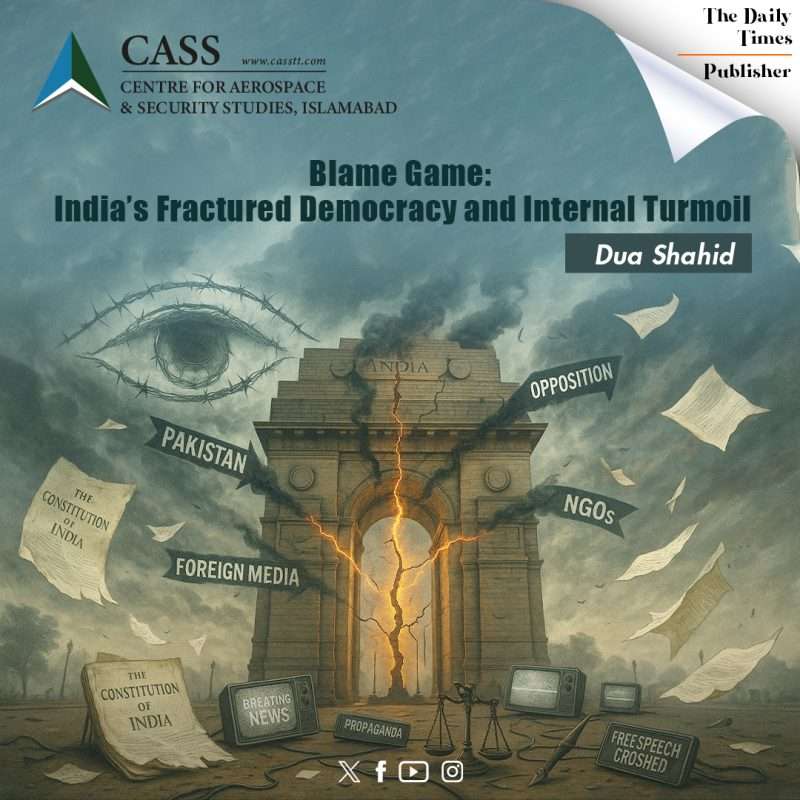
India, a self-proclaimed secular state, is the world’s largest democracy with a diverse population. The social fabric of the state is strained by internal divisions along religious lines. At its root lies the policy of the BJP-led Indian government, influenced by the ideology of the Rastriya Swayamsevak Sangh (RSS). They not only sow discord but also increase the marginalisation of minorities, resulting in incidents of insurgencies and separatist movements, particularly in Kashmir and the North-east region. Despite the existence of internal turmoil, India’s repeated projection of Pakistan as a terrorism sponsoring state is thus a tactic of deflecting attention from its fault lines.
Hindutva ideology expresses Hindu beliefs, values, and attitudes. Contradicting the idea of ‘secular India’, this ideology manifests intolerance towards followers of other faiths. Several policies of the BJP government, which are explicitly targeting Muslims, have sparked a nationwide debate and criticism, including the Citizenship Amendment Act (CAA), the proposed National Register of Citizens (NRC), the Waqf Act Amendments, and the recent cast-based census demand. Moreover, BJP leaders’ negative statements about minorities, anti-Muslim riots, denying Muslims the right to practice their religion, and treating RSS culprits with leniency for brutally killing Muslims are part of Hindutva’s plan to exclude minorities.
Since the War of Independence, the Illegally Indian Occupied Jammu & Kashmir (IIOJK), a Muslim majority region, has held resentments against the Indian government. These grievances increased with the abrogation of Articles 360 and 35A, scrapping the special status of IIOJK. Revocation of these articles led to militarisation, mass detentions of local political leaders, and lockdowns in Kashmir. Amid the crisis, the Indian government tried to portray the abrogation as a measure of counterterrorism and national integration. But the ground realities reflected heightened aggression and frustration among Kashmiris that led to resistance movements.
Another notable case in point is the Naxalite-Maoist – a guerrilla-style and left-wing extremist insurgency against the government of India, particularly in central and eastern regions. Some of the most disturbed regions, such as Assam, Arunachal Pradesh, Nagaland, and Manipur, are heavily militarised under the Armed Forces Special Powers Act (AFSPA). According to the 2024 Terrorism Assessment report of South Asia Terrorism Portal (SATP), India has recorded 36 terrorism incidents by left-wing insurgents that took the lives of 30 civilians and 15 security personnel.
As of May 2025, numerous new terror incidents have already been recorded in India, including the Bijapur IED attack on 6th January that killed 8 security personnel and a driver, Bijapur Clash on the same day that killed two security personnel, Kathua Clash on 28th March that killed 4 police officers, and then the Pahalgam attack on 22nd April that took lives of 26 civilians. Keeping this in view, the possibility cannot be ruled out that India, in the future, may again conveniently accuse Pakistan of any terror attack that occurs due to internal insurgency.
India has continuously framed Pakistan as the perennial enemy and terrorism-sponsoring state, without verifiable evidence, underscoring New Delhi’s hidden motives. Indian PM Modi labelled Pakistan as the ‘mothership of terrorism’ to ratchet international pressure against it. He further stated, ‘terrorism is the war strategy of Pakistan’. The Indian Defence Minister Rajnath Singh urged the IMF to block the loan, as ‘any economic assistance to Pakistan will be used in funding terror’ – despite the objection, the IMF approved the loan of 1 billion USD. BJP’s anti-Pakistan statements project it as a nationalistic party to win public support and deflect public attention from internal issues. These allegations against Islamabad are sensationalised by the Bollywood movies. Uri (2019) directly indicates that Pakistan is orchestrating and sponsoring terrorist attacks in India; Fighter (2024) portrays terrorism emanating from Pakistan; likewise, many other movies released aim to reinforce the government’s narratives against Islamabad.
Pakistan has consistently denied India’s allegations, both at the national and international levels. Islamabad has criticised New Delhi numerous times for continuing with the perpetual blame game, the pattern of exploitation, and baseless allegations without any credible investigation. Post-Pahalgam, PM Shahbaz had offered an ‘open, transparent, and credible’ investigation of the event, which India paid no attention to.
However, with time, the international community has realised that India is only politicising terrorism stance against Pakistan. Despite the US’s concerns about militant groups in Pakistan, it has acknowledged India’s strategic posturing, indicated by its calls for a dialogue between the two states to settle the matter. Several Indian attempts to scapegoat Pakistan for terrorist sponsoring at the UN have been blocked by the member states, particularly China, indicating India’s failure to shape an international unified response against Pakistan. Islamabad has pitched a responsible image at the international level against New Delhi’s diplomatic war.
India’s baseless allegations against Pakistan come with a substantial cost for regional stability. The recent stand-off of May 2025 reached an unprecedented level than the last flare-up. Undeniably, New Delhi’s quick blame game and military aggression against Islamabad have further hindered the potential of rational discourse and lowered the threshold for escalation.
Looking ahead, New Delhi must prudently consider the risks of any other reckless misadventure against Pakistan. Rather than continuing with its strategy of a blame game against Pakistan, it should carefully find ways to tackle internal insurgencies through inclusive policies. At the bilateral level, both states should cooperate in fighting against terrorism through cooperation based on shared intelligence and exchange of policy ideas. Taking these steps can foster a stable region and encourage trust between both states to further seek avenues for long-term cooperation.
Dua Shahid is a Research Assistant at the Centre for Aerospace & Security Studies (CASS), Islamabad, Pakistan. The article was first published in Daily Times. She can be reached at [email protected].



