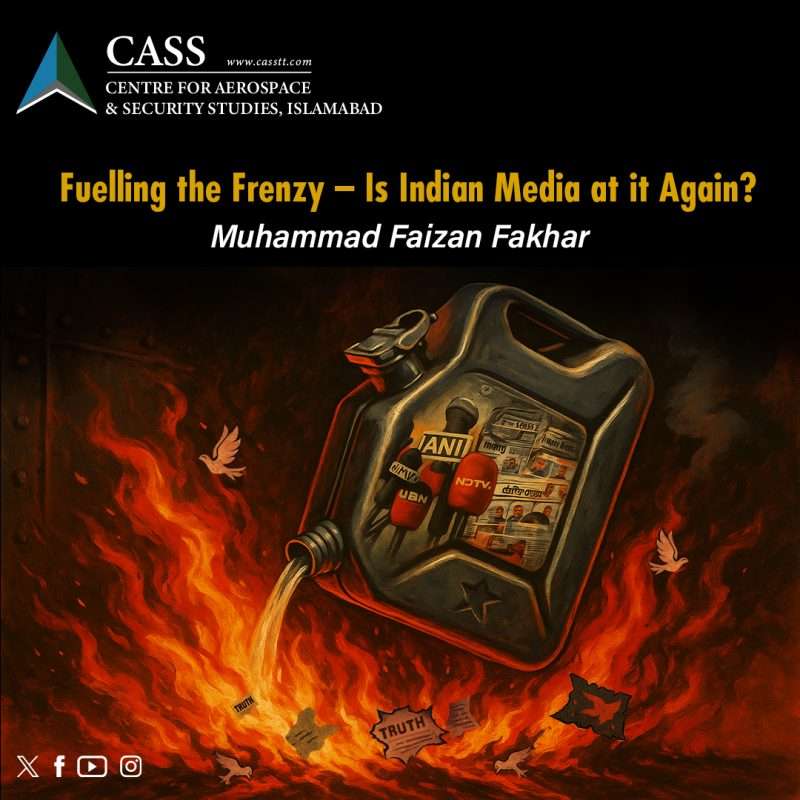
In today’s digital world, media wields enormous power in shaping public perception. Therefore, it has a critical responsibility to practice fact-based and ethical journalism. However, Indian media seems to have abandoned such practices in pursuit of sensationalism and ultra-nationalism. It has been following a pattern of capitalising on national crisis by spreading fake and unverified news. The most recent example of this pattern is the coverage around the Pahalgam attack. Many media outlets started pointing fingers at Pakistan immediately after the incident without any credible evidence rather than indulging in an introspective assessment of the situation. Caught up in a relentless race for higher ratings, news outlets are spewing baseless and fantastic claims.
India has a vast media landscape, with around 900 satellite channels and about 140,000 registered news publications. When most of these platforms start relying on sensationalism rather than rational reporting, it not only distorts public perception but also compels policymakers to make uncalculated decisions at the highest levels.
This trend is not new in Indian media, which has a long-standing history of resorting to dramatic journalism. From Uri to Pulwama and now Pahalgam, the Indian media appears to follow a familiar script fuelling public frenzy and inflaming the national atmosphere by grossly exaggerating both the perceived threat and India’s military capabilities. As a result, politicians and leadership also feel emboldened to throw caution to the wind and make risky moves, often jeopardising national security and regional stability in the process. This pattern can easily be observed by simply examining the reactions of the media in the immediate aftermath of both Uri and Pulwama incidents.
Following the Uri attack in 2016, Indian media quickly shifted the blame on Pakistan. Thus, a potential moment for national reckoning was reduced to theatrics. News outlets tried to emulate virtual war rooms in their studios. Shouting matches were carried out in the name of panel discussions. These panel discussions often included self-proclaimed experts, who discussed war scenarios with Pakistan. Primetime anchors openly started calling for a military operation. Within few days, India claimed to have crossed the Line of Control (LOC) to conduct a ‘surgical strike.’ The credibility of this claim was questioned at length by regional and international observers. As result of this, India’s projection of being a so-claimed ‘responsible’ regional state was severely damaged.
The trend of framing binary narratives and advocating for war as the only logical response was seen again in the aftermath of the Pulwama incident. Network channels rushed to outdo each other in the display of theatrics. Primetime debates on possible military actions against Pakistan were aired. Anchors such as Sudhir Chaudhary, Anjana Om Kashyap, Arnab Goswami, and Rubika Liyaquat were among the most prominent faces of this sensationalist media trend blurring the line between journalism and jingoism in their primetime broadcasts When India crossed international borders to conduct Balakot airstrikes, these anchors became ecstatic. Despite palpable tensions due to the grave possibility of escalation, media channels in India fed a narrative of victory to its innocent audience. Pakistan responded with Operation Swift Retort, successfully shooting down two Indian jets and capturing an Indian pilot. This was a clear loss to India, but the Indian media still managed to feed an absurd story of triumph and heroism.
History is again repeating itself. Indian media is once again busy charting a course of confrontation between the two countries. A simple content analysis reveals the direction in which the Indian media is steering the narrative around the Pahalgam incident. The headlines of leading print media platforms such as Times of India asks ‘Will India avenge Pahalgam terror attack with jets, drones, or something new?’, India Today speculates ‘Has Pak deployed military assets to bases near J&K after Pahalgam attack?’, and The Hindu reported “Pahalgam terror attack: Two Kashmiri men who went to Pakistan in 2018 suspected to be among the terrorists who killed tourists.’
The geopolitical environment is flaring up again as tensions have started to escalate between the two neighbours. However, instead of advocating for calm and restraint, Indian media is again fuelling mass hysteria by spinning a false narrative of external involvement. For Pakistan, such absurd journalism has become routine, as the majority of Indian media outlets follow BJP’s political narrative. However, if India aspires to be seen as a responsible state, and more importantly, to uphold peace in one of the world’s most fragile regions, its media must exercise restraint and commit to fact-based journalism. One of the guiding principles of media is to provide space for informed and rational dialogue. Unfortunately, that space is shrinking in India and it is shrinking fast.
Muhammad Faizan Fakhar is a Senior Research Associate at the Centre for Aerospace & Security Studies (CASS), Islamabad, Pakistan. He can be reached at: [email protected].