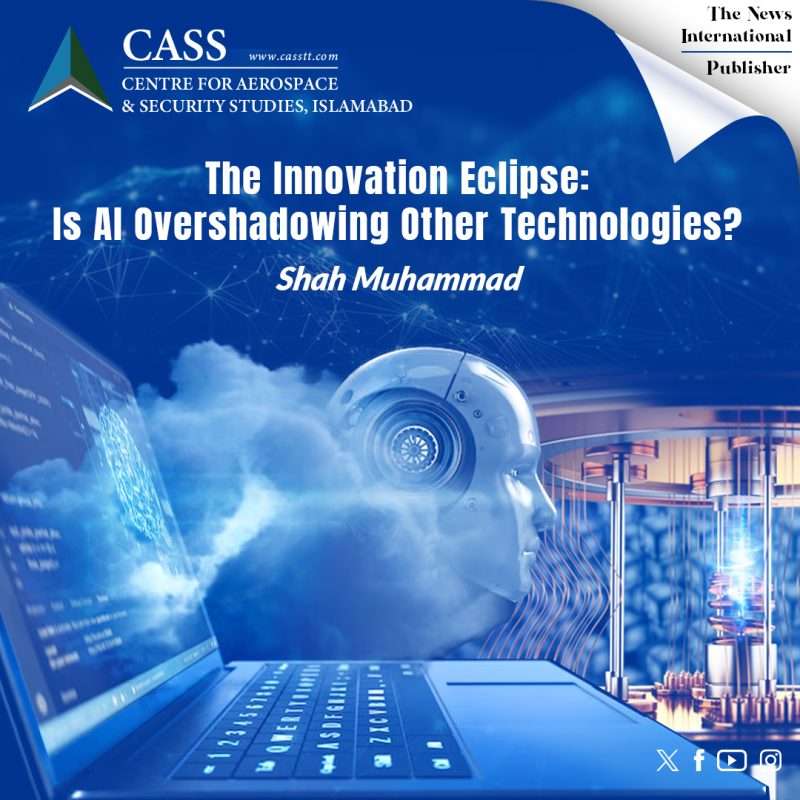
If Plato were alive today, he would have argued that his ‘Allegory of the Cave’ has been validated amid the global AI hysteria. This metaphor is a fascinating philosophical reflection on how the dominance of singular narratives tends to limit people’s ability to examine broader truths of their times. Let’s come to terms with the reality that the disproportionate attention being accorded to AI in terms of investments and policy focus is overshadowing the potential of other crucial technologies such as quantum computing, 3D printing and nanotechnology.
Gartner Inc’s ‘Hype Cycle’ for technologies is an appropriate analytical framework to evaluate the trajectory and market receptivity of innovations. It is a graphical representation of the typical progression of an emerging technology’s maturity and market adoption through five stages, i.e. ‘innovation trigger, peak of inflated expectations, trough of disillusionment, slope of enlightenment and plateau of productivity’. Gartner’s Hype Cycle for AI 2024 reveals that most AI-driven innovations are entering the peak of inflated expectations which would be followed by the trough of disillusionment in a few years. Evidently, it would take quite long till the dust settles and AI would transition into the slope of enlightenment and plateau of productivity wherein the hype would considerably subside.
Admittedly, the uneven stream of investments across this emerging tech is a testament to the lopsided technological landscape. The global market size of AI in 2025 will reportedly be approximately USD 757.58 billion. In stark contrast, the global spending on quantum computing, nanotechnology and 3D printing is USD 1.79 billion, USD 8.78 billion and USD 23.41 billion, respectively.
One might argue that the overwhelming share of capital flow into AI ventures reflects this domain’s potential to offer greater financial returns. However, experts are of the view that the AI bubble is soon to burst given that it devours enormous resources and offers little dividends in return. In essence, the imbalanced and disproportionate investments across technologies may be counterproductive for sustainable technological growth. Philanthropist and deep tech investor Tej Kohli asserts that ‘AI is overhyped, and by funnelling resources disproportionately into AI, we’re failing to recognise the enormous potential of other emerging technologies.’
The AI bandwagon is prevalent in policy circles as well. From global summits to national regulations, AI has become a buzzword worldwide. It is commonplace to come across AI policies being churned out by states (over 1000 AI-related policy initiatives in the last 2-3 years alone) but ones addressing quantum computing, additive manufacturing, and nanotechnology remain relatively scarce. Hence, AI-driven policy myopia indicates that states’ digitalisation efforts as well as security posture may have little space for other crucial technologies.
It goes without saying that AI does have significant applications across various domains that offer multifaceted benefits for the digital economy and sustainable development. For instance, some experts deem quantum computing as a bigger technology than AI. In the same vein, the full potential of 3D printing or additive manufacturing is yet to be actualised. It has the capability to enhance accuracy, production rates and cost-efficiency in the manufacturing sector. Additionally, nanotechnology drives innovation through miniaturised devices and tools. In the aviation sector, it is paving the way for smarter, reliable and energy-efficient avionics by significantly reducing the size and weight of key components.
It is imperative to invest in, prioritise, and research all vital technologies based on their merits rather than succumbing to the bandwagon effect. First, states ought to adopt a balanced investment strategy. This may be achieved through government incentives for AI as well as non-AI Research & Development. Public-Private Partnerships (PPPs) may spearhead indigenous startups in quantum computing, additive manufacturing and nanotechnology while making endeavours for international collaborations. Similar to green bonds for environmental projects, governments may consider issuing ‘innovation bonds’ to channel capital into underfunded areas of technological development.
Secondly, governments must broaden their policy horizons to recognise that very soon various technologies and sectors may soon become deeply intertwined with AI. While an AI-centric policy discourse currently resonates with widespread enthusiasm, it may not yield long-term benefits if the emerging interdependencies among diverse areas are overlooked.
Thirdly, academic institutions should promote interdisciplinary research that integrates diverse technologies and bridges social and natural sciences, recognising AI as an enabler rather than the sole focus of innovation.
To conclude, the tunnel vision of relevant stakeholders might hamper the comprehensive utility of emerging technologies. AI continues to dominate the technological and policy discourse while other technologies receive scant attention. It is crucial to adopt a balanced investment strategy and cross-disciplinary R&D to level the technological playing field. Otherwise, we would find ourselves perpetually stuck in Plato’s Allegory of the Cave!
Shah Muhammad is a Research Assistant at the Centre for Aerospace & Security Studies (CASS), Islamabad, Pakistan. The article was first published in the News International. He can be reached at [email protected].