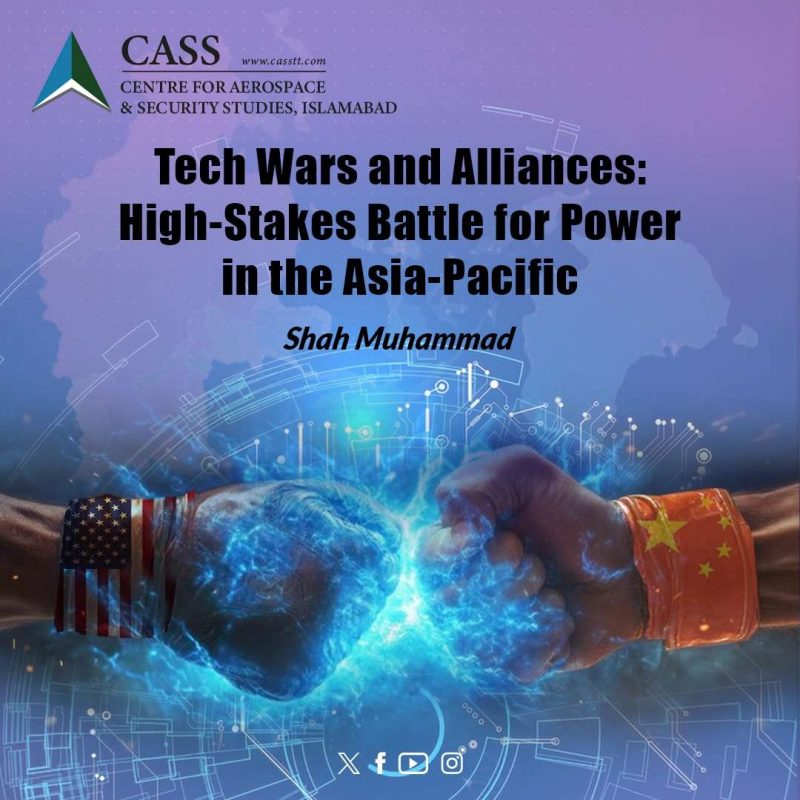
The United States (US) has built an array of alliances under hub-and-spokes model to steer its realpolitik in the Asia-Pacific region. As the dominant hub, the US has orchestrated a zero-sum game through its network of spokes, particularly regional allies and partners. The high-tech factor has become a key element of power projection and military dominance in alliance politics. By leveraging advanced technologies such as AI, robotics and 5G, the US is mobilising regional allies to counterbalance the surging politico-military stature of China. It is being steered by the US’s Integrated Deterrence strategy in the Asia-Pacific that calls for a ‘seamless combination of capabilities.’
Quad is a prominent security bloc having the US as the hub and regional allies such as India, Japan, and Australia, as spokes. The joint communique of the Quad Leaders’ 2024 Summit pledged expansion of partnerships in critical technologies such as AI, 5G and semiconductors. The inaugural funding of over USD 7.5 million was earmarked for joint research in AI, robotics and sensors. Since 2023, the members have committed undersea cable investments worth USD 140 million in the Asia-Pacific. This could be viewed as a rival strategy to undermine China’s undersea cable network under its Digital Silk Road initiative. The semiconductor competition is one of the key determinants of the Sino-US tech war. Hence, Quad is being leveraged to edge out China from semiconductor supply chains and maintain US preponderance over chips. In this regard, the bloc’s Semiconductor Supply Chain Initiative is a case in point.
AUKUS (Australia-UK-US) has emerged as another high-tech geopolitical arrangement that complements the goals of Quad in the Asia-Pacific. Firstly, it involves an underwater vehicle called Ghost Shark that the Australian Navy has acquired from the US company Anduril. It is a nuclear-powered, uncrewed and AI-enabled underwater vehicle having advanced ISR and strike capabilities. Its AI-powered features enable it to coordinate with other manned and unmanned platforms in real-time. Secondly, there are AI-enabled drones that facilitate battlefield coordination and seamless exchange of data between the AUKUS militaries. Thus, the AUKUS alliance is preparing for both land and maritime warfare in the advent of a full-fledged military confrontation against the common adversary.
On the contrary, China has restrained itself from adopting an overly geopolitical posture against these alliances, clinging to its geoeconomic approach that may offer geopolitical dividends in the long run. In 2024, the China-ASEAN joint communique called for greater cooperation in AI, 5G, cloud computing and digital government with the aim ‘to build a sustainable and inclusive digital ecosystem.’ Moreover, China has signed bilateral agreements under the Digital Silk Road with 40 countries, 24 of these being in the Asia-Pacific. Chinese companies like ZTE and Huawei are edging out Western companies by offering relatively affordable rates of 5G technology. Earlier, China exhibited a robotic dog mounted with rifles at Golden Dragon exercises in 2024 conducted jointly with regional countries Malaysia, Cambodia, Thailand and Lao. It could be a response to the robotic dog exhibited by the US military in Project Convergence exercises conducted jointly with Quad and AUKUS countries.
Recent breakthroughs, like the DeepSeek-R1 AI model, not only challenge the US’s technological swagger but also undermine its geopolitical leverage, which has been crucial in strengthening alliances. In an anarchic system where technological competition operates as a zero-sum game, this shift translates into a relative gain for China, particularly in the Asia-Pacific. As China’s geoeconomic initiatives like the Digital Silk Road gain traction, regional dependence on Chinese technology and standards will likely deepen, amplifying Beijing’s ability to extract strategic concessions and reshape the balance of power.
The techno-politics underway may entail implications for regional as well as international peace and security. Asia-Pacific is the epicentre of global supply chains, characterised by the regional integration actualised through ASEAN and Regional Comprehensive Economic Partnership (RCEP). Intensification of Sino-US rivalry could have cascading ramifications for global supply chains, endangering economic vitality of the region as a whole. The growing bifurcation of regional economies into competing blocs reflects the emergence of techno-alliances, heightening concerns over a potential Sino-US technological decoupling. If this trend solidifies, it could create a Silicon Curtain, dividing the world into rival tech ecosystems. Such fragmentation may not only restrict cross-border innovation and collaboration but also limit states’ ability to harness high-tech advancements for socioeconomic development and human security.
Most importantly, Sino-US technological arms race might flare up into a full-blown conflict between both countries, as Kenneth Waltz once put it, ‘the origins of hot wars lie in cold wars.’ Trump 2.0 may have brought some degree of optimism in Eastern European and Middle Eastern theatre. Nevertheless, Sino-US rivalry in the Asia-Pacific is likely to intensify as evidenced by the emergence of China hawks in President Trump’s Cabinet such as Marco Rubio and Michael Waltz. To conclude, the high-tech factor in Asia-Pacific alliances reflects the militarisation of Industry 4.0 technologies in the context of a highly competitive international environment. Although states have a solemn right to modernise their militaries, excessive geopolitical balkanisation might undermine the vitality and relevance of multilateral institutions. Thus, the focus on relative gains should be balanced with a commitment to mutual benefit and a multilateral approach to uphold international peace and security.
Shah Muhammad is a Research Assistant at the Centre for Aerospace & Security Studies (CASS), Islamabad, Pakistan. The article was first published in Express Tribune. He can be reached at [email protected].