
The inauguration of Donald Trump for a second term as President of the United States (US) brings substantial implications for the tech industry, particularly in areas such as Big Tech, Artificial Intelligence (AI), cybersecurity, and private sector innovations. During his previous tenure, President Trump advanced policies that significantly shaped the tech landscape, including a focus on social media platforms to address perceived biases, introduction of the U.S. Space Force, and initiatives to strengthen the US’s global technological leadership. Furthermore, collaboration between Trump and key tech leaders, such as Elon Musk, signals a direct ingress of the private sector in public policy domain. Musk’s leadership of SpaceX, Tesla, and X (formerly Twitter) alongside his alliance with the Trump administration, is poised to reshape the landscape of tech policies, with implications for US innovation, defence, and foreign policy. Trump’s proposed ‘Digital Bill of Rights’ and his critique of tech monopolies could have major ripple effects across global technology sectors, like AI, data privacy, and content moderation. At the same time, Trump Administration’s drive to bolster US technological and industrial capabilities could lead to new innovations while raising concerns about the future trends of emerging technologies, including AI, quantum computing, and renewable energy. In an effort to explore the multidimensional implications of Trump’s second presidency on the tech industry, the Centre for Aerospace & Security Studies (CASS), Islamabad, organised a roundtable on ‘Trump-Tech Nexus: Opportunities and Challenges Ahead’ on 29 January 2025. This RTC focused on forward-looking insights on the following questions: How will Trump’s tech policies influence the US position in the global technology race and tech market? How will Trump’s ‘Digital Bill of Rights’ impact Big Tech’s content moderation practices and accountability? What opportunities and risks does Trump’s focus on the tech industry present for the global community? What are the potential implications of Trump’s tech-focused policies for US diplomatic relations? Does Pakistan stand to benefit from the tech policies of US under Trump 2.0? The distinguished speakers included Ambassador Zamir Akram, Air Vice Marshal Soban Nazir Syed (Retd), and Talha Bin Afzal. The discussion was moderated by Mustafa Bilal, Research Assistant at CASS with Concluding Remarks by President CASS Air Marshal Javaid Ahmed (Retd).

The West: The History of an Idea
The world is witnessing the collapse of the Western order, if not the emergence of an alternative one. The idea of ‘West’ as against the rest is still at the root of contemporary understanding of world politics. Georgios Varouxakis, a remarkable voice on Modernity and Nationalism, has provided the historical origins and modern connotations attached with the idea of ‘West’. In his book ‘The West: The History of an Idea’, Varouxakis has argued that the West is not an eternal entity, rather it is a modern socio-political construct that emerged in the political philosophy of the early 19th century and evolved with the passage of time. The book provides an in-depth historical analysis of the idea to determine the roots of its modern interpretation.

Space-Enabled Warfare in the 21st Century: Pathways for Developing States
Space has emerged as a distinct domain of warfare alongside land, sea, air, and cyber. Developed countries like the United States, Russia, and China possess offensive and support capabilities in space. In the shadowed expanse of Low Earth Orbit (LEO), where satellites operate like silent custodians, the 2022 Russian invasion of Ukraine transformed the nature of modern conflict. As Russian troops marched forward, the commercial satellites like Maxar and Planet, which are operated by Western firms, captured high-resolution imagery of Russian troops, providing real-time intelligence to Ukrainian commanders, unlike ever before.
The US-Israel War on Iran: Objectives, Strategy, and Escalation Management
Zahra Niazi
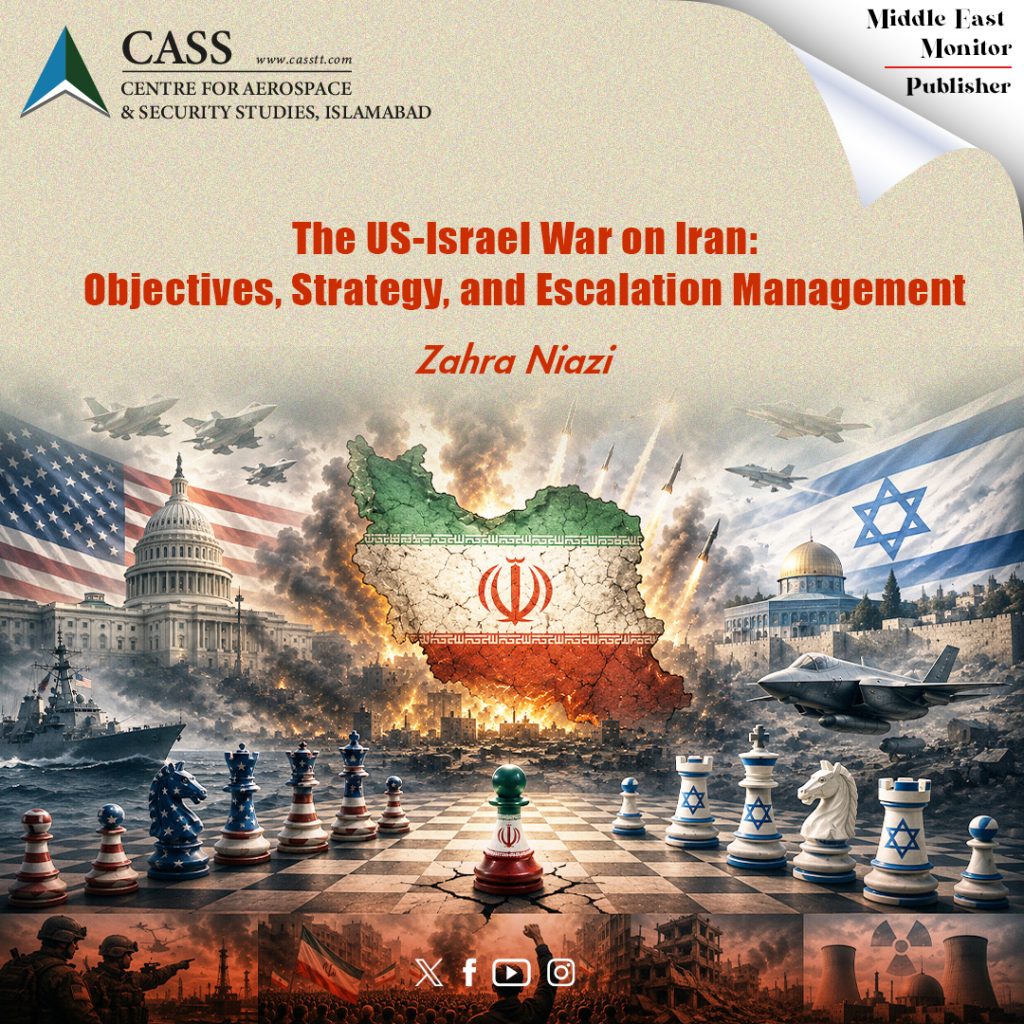
‘States tend to overestimate themselves or the benefits and swiftness of war, and to underestimate their opponents’ capabilities, intentions, or the costs and duration of war.’ If anything, the 2026 war initiated by the United States and Israel against Iran shall be remembered in the annals of warfare among the most visible manifestations of this dynamic.
The war, immediately preceded by the January mass protests in Iran, did not represent a sudden rupture but rather the continuation of a 47-year-long confrontation and a more intense phase of the June 2025 war.
The US Secretary of War, Pete Hegseth, defined the war’s objectives as being laser-focused: to destroy Iran’s missile capabilities and its security infrastructure, while ensuring that it could never develop nuclear weapons. Beyond these stated objectives, among the priorities on the continuum also lay the objective of regime change, with both President Trump and Prime Minister Netanyahu explicitly calling on the Iranian population to take over the government at the outset of the war.
