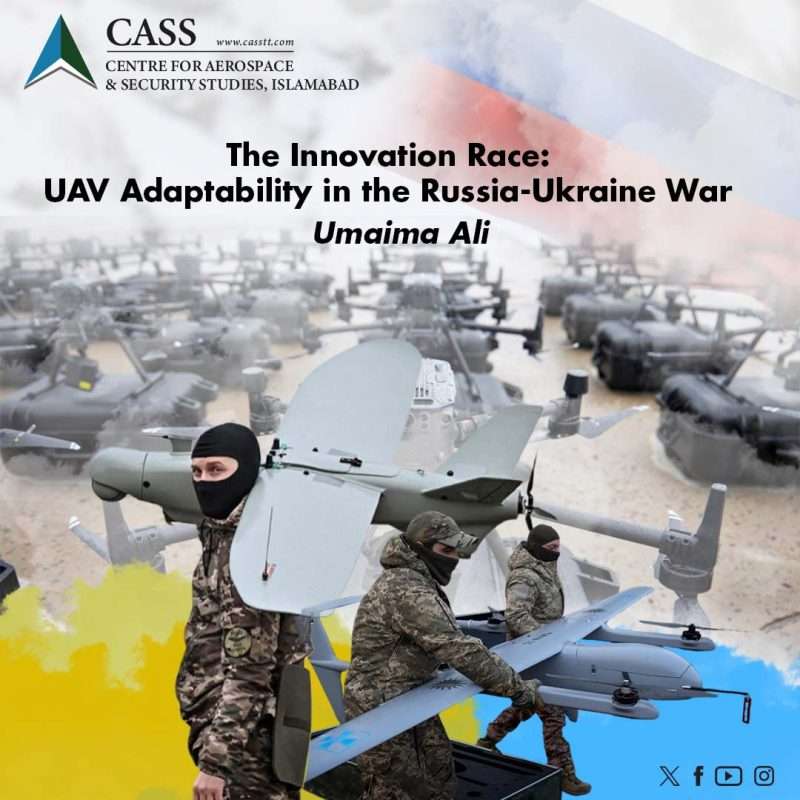
‘He who can handle the quickest rate of change survives.’ John Boyd’s OODA Loop — Observe, Orient, Decide, Act — reminds us that victory belongs to those who can adapt faster than their opponents. For its survival, underdogs like Ukraine must withstand the stronger side’s push for a quick victory. When Russia invaded Ukraine in February 2022, majority of military analysts anticipated that Moscow would take control of the airspace due to its air superiority. However, Ukrainian defences were able to put up reasonable resistance against Russia with its innovative, low-cost and effective employment of Unmanned Aerial Vehicles (UAVs).
The use of UAVs has been pivotal in Ukraine’s efforts to counter Russian air superiority. Recognising the strategic importance of drones, Ukraine integrated them as a critical military capability. Russia’s initial shortcomings in air defence and electronic warfare (EW) left gaps in its control over the electromagnetic spectrum, allowing Ukraine to exploit this vulnerability. For instance, Ukraine deployed larger UAVs like the Turkish TB2 Bayraktar, which played a significant role in notable operations, such as sinking the Russian flagship Moskva.
As Russia adapted to these tactics, detecting and neutralising larger drones became more feasible. In response, Ukraine shifted to employing smaller drones to maintain operational effectiveness. Similarly, Russia has also utilised UAVs to achieve key objectives. In November 2024, for example, it launched a large-scale attack involving 120 missiles and 90 drones targeting Ukraine’s power infrastructure ahead of winter. President Volodymyr Zelenskyy claimed that Ukrainian defences intercepted 140 air targets, however, the attack caused civilian casualties and damaged power plants, highlighting the devastating potential of UAV operations.
The Russia-Ukraine war has become an ongoing ‘innovation race,’ with both sides continuously adapting to each other’s successes and developing sophisticated strategies to counter enemy drones. This cycle of innovation, adoption, and counter-innovation creates a dynamic feedback loop. For example, in October 2023, Ukrainian forces leveraged First Person View (FPV) drones operating on standard hobby frequencies to advance several hundred meters near Avdiivka with minimal casualties. These hobby frequencies, commonly used for transmitting commands and receiving video feeds from drones, initially provided a tactical advantage. However, by January 2024, Russian anti-UAV systems began exploiting these same frequencies to disrupt and down Ukrainian drones, forcing a tactical shift. In response, Ukrainian forces adapted by switching to custom-made frequencies for their UAVs by February 2024. This innovation allowed Ukraine to deploy swarms of small drones operating on non-standard frequencies, enabling them to surveil and disrupt Russian defences near the Kursk border. The resulting action not only paralysed Russian communications for days but also diminished the effectiveness of Russian Lancet drones in the area.
Ultimately, the strategic advantage in this conflict rests with the side that can outpace the other in adapting to technological and tactical shifts.
Startups in Ukraine are developing AI-enabled drones capable of operating in swarms to disrupt Russia’s energy industry. On the other hand, Russia plans to integrate Artificial Intelligence (AI) into Iranian Shahed-136 kamikaze drones, introducing a new challenge for the advanced air defence systems of Ukraine. At the NATO-Ukraine Defence Innovators Forum held in Poland in June 2024, participants warned that Russia possesses the capability to replicate straightforward innovations. As a result, Ukrainian operators must proactively anticipate and develop countermeasures against their systems before deploying them on the battlefield. In this regard, Ukraine has been leveraging its commercial industry, fully supported by the West during the war, to maximise the potential of its private sector. From within its tech industry, a startup-style drone manufacturing industry has emerged. However, the industry is still underutilised due to limited government funding. Russia’s military-industrial complex has also been hindered by domestic capability shortfalls and technological restrictions imposed by global sanctions. In response, Moscow has initiated long-term indigenous efforts to reinforce production, improve its training programmes as well undertaken international partnerships to acquire necessary components and technology for drone development.
The Russia-Ukraine war highlights the dual role of drone technology as both a force multiplier and a disruptive equaliser. While drones have assisted the underdog in the Russia-Ukraine war, their limitations and counter-innovations demand a balanced integration of human adaptability and technological innovation to maintain strategic advantages. Future wars will depend on the integration of advanced systems that are refined and resilient to endure both obsolescence and enemy’s countermeasures. Future wars will be won by the sophistication of one’s intellect, creativity and engineering precision.
Umaima Ali is a Research Assistant at the Centre for Aerospace & Security Studies (CASS), Islamabad. She can be reached at [email protected].